



Writing an ebook can be daunting, as it involves more than merely typing out content. Ebooks must be well-designed, well-formatted, and made into professional documents that can appeal to readers.
In this blog, we provide a comprehensive ebook writing guide covering everything, from its uses to the finer aspects of crafting one.
What is an ebook?
An electronic book (ebook) is a digitized book. It can be read from devices like smartphones, computers, and tablets. Ebooks are key marketing components. They contain many digital ‘pages’ that give information to readers. This makes them an effective and engaging form of content marketing. Furthermore, they have various formats, like ePubs or PDFs, making them easy to access and share.
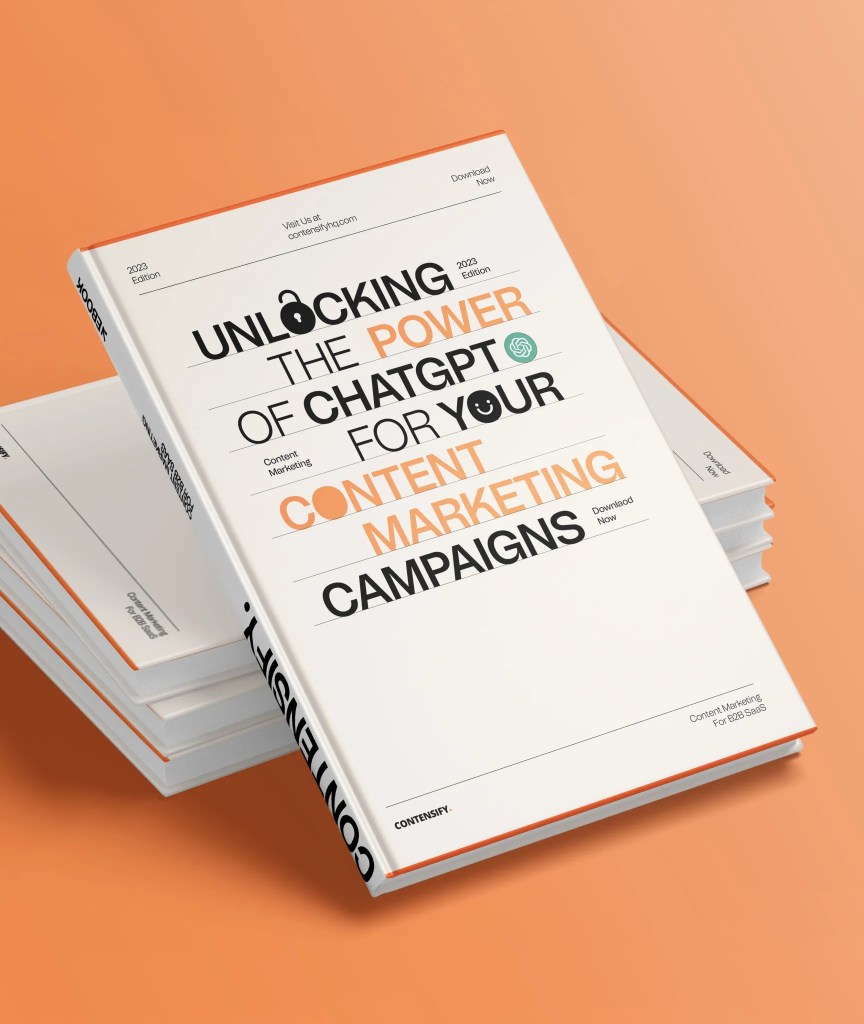
For example, Contensify’s ebook, “Learn how to use ChatGPT for Content Marketing” covers everything about using the Generative AI tool for improving content marketing efforts.

Benefits and uses of ebooks
Apart from generating traffic and leads, ebooks have many more benefits. Let’s look at some of the uses and benefits of ebooks for B2B SaaS marketers before we get into the core section of this ebook writing guide.
1. Lead generation
Ebooks are an excellent way to increase leads. Customers provide their contact details in exchange for a free ebook. You can use landing pages for your ebook as gateways to generate leads.
2. Reaching more audiences
A study by Semrush reveals that today’s audiences are interested in reads that exceed 7000 words. This further proves ebooks are valid and reliable for marketing. If well promoted, an ebook can be a great tool to reach more audiences.
3. Highly accessible
Ebooks offer remarkable portability, as they can be stored on various devices without the need for physical storage space. In contrast to lengthy printed publications, an ebook is readily accessible whenever you’re prepared to start reading.
4. Demonstrate expertise
In today’s highly competitive market, expertise and precise information are of critical value. Ebooks give B2B marketers the opportunity to demonstrate their expertise in the industry by providing well-researched information to readers.
5. Enhance and reinforce brand image
Ebooks can be used to connect your readers with your brand and to enhance your brand image. If yours is a growing business, harnessing the design of an ebook can be a strategic move to improve brand visibility.
6. Educate and inform readers
You can use ebooks to inform and educate clients on your brand, products, services, and other activities and also to provide some valuable industry knowledge coming from your own industry expertise.
7. Nurture trust
Ebooks have an inherent visual potential. These data-driven, well-researched narratives can do a great job of visualizing your brand credibility and ensuring that it reaches your target audience.
8. Tell your brand story
Ebooks can also help craft or influence your brand’s identity, reputation, and positioning. You can do this by telling your brand story in your own way. Tell the story of your brand’s inception, growth, challenges, perceptions, and more to your readers to influence the brand perception positively.
9. Save costs
Ebooks are also a cost-effective marketing tool. The digital format is not just environment-friendly, but it also allows you to publish relevant and valuable content in an inexpensive manner.
B2B SaaS ebook writing guide: step by step
Step 1. Pick an engaging topic
One of the key goals of ebooks is to generate leads. So, pick a topic that is relevant and engaging for your audiences. This will increase the likelihood of readers turning into prospective clients.
Do a thorough topic research with a clear understanding of your targeted audience. Consider demographics, interests and other factors. Your ebook will address this audience and provide solutions to their problems.
Also, make sure that your topic aligns perfectly with your own expertise. The difference between a good ebook and a bad one lies in finding relevant and engaging ebook topics.
Step 2: Research content
The next step in our ebook writing guide is research. After you have finalized your topic and envisioned who your target audience would be, conduct adequate research on the topic. Remember, thorough research is key for developing authoritative and informative content.
Dive into reputable sources, industry publications, and relevant data to gather the necessary information for your ebook. Ensure that your content is accurate, and up-to-date, and adds unique insights to distinguish your ebook from others on the same topic. Research keywords and phrases that are relevant to your topic and familiarize yourself with the trends that are related to your subject.
Step 3: Outline your ebook content
Now that you have familiarized yourself with the topic and researched your content, the next step in the ebook writing guide is to create a well-structured outline. Define the key sections and chapters of your ebook, to ensure a logical and natural flow for readers.
This outline is a roadmap. It will guide you through the writing process. It will help readers navigate the content easily. Also clearly define the tone and narrative as well as the introduction, main body, and conclusion of your ebook.
Step 4: Write the chapters
Now begin writing your ebook chapters following the outline. Begin with a good introduction to hook your readers. You should follow this with well-researched and engaging content within each of your chapters, maintaining a coherent progression.
Also make sure to keep a balance between informative and easy-to-understand language, keeping your audience in mind. Each chapter should be concluded effectively, setting the stage for the next one.
Also, keep in mind that at this stage you need to be able to provide maximum information in your chapters. The rest can be done as you edit your ebook. Let’s move to the next step in this ebook writing guide.
Step 5: Add supporting elements
So far in this ebook creation guide, we have covered all the preliminary steps. Now you get down to enhancing your work.
Your ebook might have excellent content, but it will be wasted if it does not contain engaging supporting elements to drive home your points. For example, relevant infographics, sources, images, graphics, quotations, etc. Break up large chunks of text with subheadings, bullet points, and numbered lists to improve readability.
These elements not only add a visual appeal to your ebook but also contribute to its overall narrative. Another interesting addition would be an “About the author” section that will add more personality to the ebook. The next step in the ebook writing guide? Let’s find out.
Step 6: Place CTAs
One of the most important ebook publishing tips to keep in mind is to perfectly leverage Call To Action (CTA). Strategically integrate CTA buttons throughout your ebook to guide readers toward the desired actions.
Whether it’s directing them to your website, encouraging social media engagement, or suggesting further reading, a well-placed CTA can drive user interaction and in turn, support your marketing goals.
Step 7: Edit and proofread
No ebook writing guide would skip the steps of editing and proofreading. Edit and proofread your ebook till all inconsistencies are removed, leaving streamlined, perfectly coherent content. Revising your ebook can be carried out one chapter at a time, preventing you from feeling intimidated by the task of reviewing and editing the entire book. You can also seek assistance from a local or remote editor to streamline and accelerate the editing process.
Step 8: Design the ebook
The visual presentation of your ebook is equally important as its written content. You need to pay attention to the overall design, layout, and formatting. Also, incorporate consistent styling, and ensure proper alignment of text and images.
The cover can play a great part in attracting readers. To make a lasting first impression on your readers, leverage some of the professional creative assets that you might find and create an appealing cover page for your ebook. Consider the use of color schemes that align with your brand identity. Break up text with visuals and use formatting elements to create a visually engaging reading experience.
Step 9: Choose an appropriate format
Now choose a format for your ebook. A popular and highly accessible format choice would be PDF. PDFs are quick and easy to make and can be read on any device with ease. Other popular formats include EPUB, AZW/AZW3, IBA, ODF etc.
Step 10: Create a designated landing page
The next important step in ebook writing guides is creating landing pages. Create a dedicated landing page on your website from where people can access and download your ebook. This is where you start gaining your leads with your ebook content strategy.
A landing page functions as a dedicated web space crafted to showcase and promote your offering. It will have a form where visitors are encouraged to provide their contact details to unlock access to your ebook. This approach facilitates the conversion of website visitors into potential business leads, which paves the way for follow-up interactions by your sales team.
Step 11: Promote your ebook
The final step in this ebook writing guide is to promote your ebook on all the right channels so that it reaches your audiences.
Advertise on your website. Use CTAs to lead to the landing page. Promote through your blogs. There are a lot of ways to make sure that your ebook finds its readers, so utilize them for maximum reach.
You can also send out segmented emails to your contacts who have displayed interest in your business. Now that we have created an ebook and promoted it like a pro, you can start engaging the generated leads.
Get started with your ebook strategy
By now we have conveyed how awesome ebooks are and provided you with a comprehensive ebook writing guide that covers all the necessary steps of writing compelling ebooks.
Nevertheless, this is not an easy task, to put it plainly. But we can make it easier for you.
Among other content marketing services and expert assistance that we offer at Contensify, we also help our B2B SaaS customers write compelling and impactful ebooks for improved conversion.
Take a look at ebooks created by Contensify.
Want help creating your ebooks? Reach out to us at Contensify.