Search rankings have evolved. It’s no longer about inserting the right keywords or covering a topic from every possible angle. That approach may have worked earlier, but today it falls short.
Search engines and increasingly AI systems prioritize one thing above everything else: intent satisfaction. In other words, content is rewarded not for what it says, but for how well it solves what the user is actually trying to do.
This shift changes how content should be created. It’s not about what people search, but the outcome they expect from that search. Missing this often leads to content that looks complete on the surface but fails to perform.
In this blog, we’ll focus on what truly matters. No textbook SEO theory, just a clear breakdown of how to identify search intent and build content that aligns with it to drive real rankings.
What Search Intent Really Means (Before You Optimize It)
Search intent is the purpose behind a query, the outcome a user expects after searching. It is not defined by the keyword itself, but by what the user is trying to accomplish.
Each query reflects a stage in decision-making. Some users want to understand a topic, others are comparing options, and some are ready to act. Your content needs to match that expectation in structure, depth, and format. If it doesn’t, it may appear relevant but will struggle to perform.
Types of Search Intent (Based on Keywords)
Search intent becomes easier to apply when you map queries to clear intent types. These categories are useful indicators of what the user expects next:
- Informational: The user is looking to understand a concept or find an answer (e.g., “what is search intent”)
- Commercial investigation: The user is evaluating options before making a decision (e.g., “best SEO tools”)
- Transactional: The user is ready to take a specific action (e.g., “buy SEO tool subscription”)
- Navigational: The user wants to reach a specific website or page (e.g., “Ahrefs login”)
A common point of confusion is when SEO tools show multiple intent types for the same keyword. This happens because queries often carry overlapping intent, and search results reflect that mix.
Tool-based labels simplify intent, but they do not capture what is actually ranking. Without reviewing the SERP, it is easy to misjudge what the user expects. Intent is not a fixed category; it is context-driven. Understanding that distinction is what separates basic optimization from content that actually ranks.
10 Things to Know About Search Intent Optimization That Actually Improves Rankings
Here are 10 things you need to know if you want your content to actually match intent and rank:
1. The most reliable way to understand intent is to study what already ranks
Before writing, analyze the SERP. What ranks reflect real user behavior, what people click, engage with, and find useful.
Focus on what patterns repeat:
- Titles: comparison, problem-led, or feature-focused
- Format: listicles, landing pages, or guides
- Structure: summaries, evaluations, or action-driven
For example, search “best noise-canceling headphones” and you’ll mostly see comparison-style listicles with pros, cons, and recommendations. A generic informational article explaining how noise cancellation works is unlikely to perform well for that query.
2. Search intent is about what users want to do, not just what they type
A keyword only reflects the surface of a search; intent captures the action behind it. Similar queries can signal very different stages in the decision process. For example, “CRM tools” suggests early exploration, “best CRM for SaaS startups” indicates evaluation, while “HubSpot pricing” points to readiness to act.
Focusing only on keywords strips away this context and often leads to mismatched content. In contrast, understanding intent helps you align with what the user is trying to achieve next. Content that maps to these underlying actions consistently performs better than content built around keywords alone.
3. Matching content format to intent is often more important than adding more content depth
Adding more content does not compensate for a mismatch in format. If the structure does not align with what the user expects, even detailed and well-written content will struggle to perform.
Each type of query carries an implied format, whether it is a comparison, a step-by-step guide, or a decision-focused page. When that expectation is not met, users have to work harder to find what they need, which leads to drop-offs.
4. Different keywords require different page types
Not every keyword should be targeted with a blog post. Each query carries an expectation not just of content, but of page type. Queries aimed at understanding require structured guides. Those focused on evaluation expect comparisons. Decision-stage queries need product or landing pages, while utility-driven searches often require interactive tools.
Trying to serve multiple intents with a single page usually weakens performance, because the content ends up partially satisfying each need without fully meeting any.
It is more effective to treat each keyword as an entry point into a specific experience, where the page type, structure, and depth are aligned with what the user expects to do next.
5. High rankings come from fully satisfying intent, not just covering keywords
Ranking depends on how completely you resolve the query, not how many keywords you include. Most searches have layers, a primary question, and the supporting details users need to make a decision.
Take “best time tracking software”. A simple list is not enough. Users also expect pricing, key features, comparisons, and clarity on who each tool is suited for. When these elements are missing, users return to search results to fill the gaps. That behavior signals incomplete intent satisfaction.
The goal is not coverage, but completion, ensuring users find everything they need without leaving the page.
6. How you frame content often matters more than the content itself
Strong content alone is not enough. What determines performance is how quickly users feel they’ve landed in the right place. Your title sets the promise, the introduction reinforces it, and the headings help users navigate toward answers. If any of these are misaligned with intent, users disengage before the content has a chance to deliver value.
For example, a query like “how to improve website conversion rate” expects clear, actionable steps. If the page opens with a broad explanation instead, users are likely to leave early. Engagement is not a byproduct; it is a signal. And it starts with how well you meet expectations up front.
7. Search intent optimization requires continuous adjustment
Intent does not stay fixed, and neither should your content. What works today can lose relevance as search results evolve and new formats begin to perform better. To maintain rankings, you need to regularly reassess how your content aligns with current expectations:
- Check what is ranking now in terms of format, angle, and structure
- Identify shifts such as guides being replaced by comparisons or shorter formats
- Update accordingly by refining sections, adjusting structure, and improving clarity
Content that is not revisited gradually loses alignment. Treat it as something that requires ongoing refinement, not a one-time effort.
8. Content that aligns with intent improves engagement and conversion potential
When content aligns with intent, the impact is evident in user behavior. Users find what they expect, stay longer, and are more likely to take the next step.
For example, a query like “what is CRM” is satisfied with a clear explanation. But “best CRM for small business” requires comparisons, pricing context, and recommendations to support a decision. If that depth is missing, users leave to find it elsewhere.
This is where performance diverges. Early-stage content builds traffic, but decision-stage content drives conversions. The value of a page is not just in how many users it attracts, but in how well it moves them forward.
9. Building topic clusters helps you cover intent across the buyer journey
Trying to satisfy multiple intents on one page often weakens performance. It is more effective to map different intents to separate, connected pages aligned with stages of the user journey.
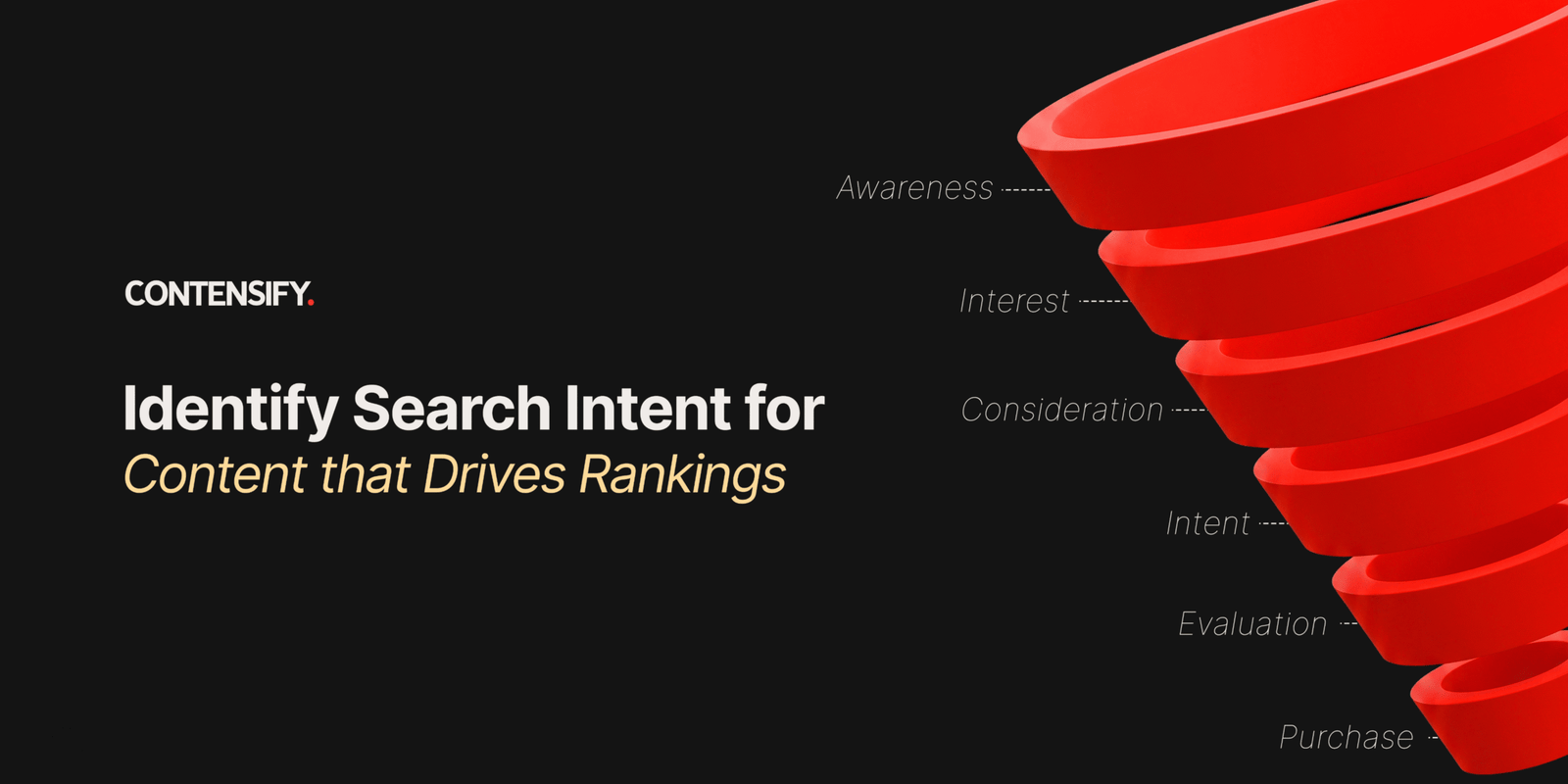
Awareness queries need explanations, consideration queries need comparisons, and decision-stage queries require evaluation or action-oriented content. When structured this way, each page stays focused and complete. Linking these pages builds topical authority and improves overall rankings.
10. Teams that prioritize intent over search volume attract more qualified traffic
Search volume can be misleading. High-volume queries often bring broad, low-intent traffic that rarely converts. In contrast, lower-volume queries usually reflect clearer intent and stronger decision signals. While they attract fewer visitors, they drive better outcomes. The key is not how many people search a query, but what they are trying to do when they search it.
Conclusion
Search intent is what determines whether your content ranks or gets ignored. When you align with what users are actually trying to do, everything else follows.
The shift is simple, stop optimizing for keywords alone and start building content around decisions. At Contensify, we’ve spent over a decade helping SaaS, Shopify, and ecommerce brands turn search intent into measurable growth through SEO content.