Lately, we’ve seen a lot of marketing teams and brands producing more content than ever. Some are scaling with large in-house teams, while others are relying heavily on AI tools to keep up with demand.
But publishing more content doesn’t automatically mean getting more results. In many cases, it simply means spending more time, money, and effort without seeing meaningful traffic, leads, or conversions in return.
That’s where the real question comes in: how do you know if your content strategy is actually working, or if you are just producing content for the sake of staying active?
In this blog, we’ll help you identify whether you are publishing more content than you actually need and break down the key signs that your content output may be hurting your strategy instead of helping it.
Signs You’re Publishing Too Much Content and Getting No Results
Here are some of the biggest signs that your content output is increasing, but your results are not:
1. Your Traffic Is Growing Faster Than Your Pipeline
Traffic growth and pipeline growth should usually move together. If your organic session volume is up 40% YoY, but demo requests, qualified opportunities, or pipeline-influenced revenue remain flat, that is a strong signal your content is attracting the wrong ICP.
This is not always a content quality problem. More often, it is a targeting problem. Your content may be generating visibility, but not business impact.
A common reason behind this is an over-reliance on high-volume informational keywords. These topics bring in users who are researching a subject, not actively evaluating a solution. As a result, traffic numbers grow, but buying intent stays low.
Over time, this starts showing up in other metrics too. Your MQL-to-SQL conversion rate drops, lead quality weakens, and sales teams struggle to move organic leads through the pipeline. That is why traffic alone is an incomplete KPI.
2. You’re Ranking for Topics Buyers Never Mention on Sales Calls
Keyword research tools optimize for search volume and ranking difficulty, not for the language buyers use when evaluating a solution. Those are different datasets. As a result, many companies build strong topical authority while missing the BOFU questions that actually influence deals.
You may be ranking for broad educational terms like “what is revenue operations,” while buyers are asking about Salesforce integrations, reporting capabilities, or implementation timelines on sales calls.
A simple way to diagnose this is to compare your last 20 sales call transcripts with your top-ranking keywords. If there is little overlap, your content strategy is optimized for SEO performance, not keyword-to-revenue attribution.
3. Your Content Calendar Is Built Around Keywords, Not Commercial Narratives
A keyword-led content calendar can look productive on paper. There are topic clusters, SEO opportunities, and new keywords being targeted every week. But over time, the content starts feeling disconnected from the actual business. It ranks for industry topics without reinforcing what the company wants to be known for.
Strong content does more than answer search queries. It shapes buyer perception, strengthens positioning, and helps your ICP understand why your solution is different. Without that commercial narrative, content becomes informative but forgettable.
Some common signs of this include:
- Your blogs rank, but rarely influence demos or deals
- Buyers know the topic, but not your positioning
- Content focuses more on traffic than pipeline influence
- Publishing decisions are driven only by keyword volume
- SEO visibility grows faster than revenue impact
4. You’re Publishing More, but Branded Search Demand Isn’t Increasing
Branded search volume is a strong indicator of whether your content is generating real market interest. When people start searching for your company name, product name, or terms like “[company] vs [competitor],” it usually means your content is creating awareness beyond a single visit. If content output continues to grow but branded search remains flat, your strategy may be driving visibility without creating net-new demand.
This matters because branded search carries much higher search intent than non-branded traffic. These users already know your brand and are actively looking for more information. Direct traffic is often a correlated signal too. If your content is not increasing those signals, it is likely functioning more as a demand capture strategy than a demand generation one.
5. Your Best-Performing Content Attracts Readers Who Will Never Buy
In most analytics setups, “best-performing” content usually refers to the highest traffic or the longest time on page. But those metrics do not measure buyer fit. A blog getting thousands of visits from students, freelancers, or competitors can easily outperform a post attracting a smaller number of high-intent buyers, even though the second piece creates more business value.
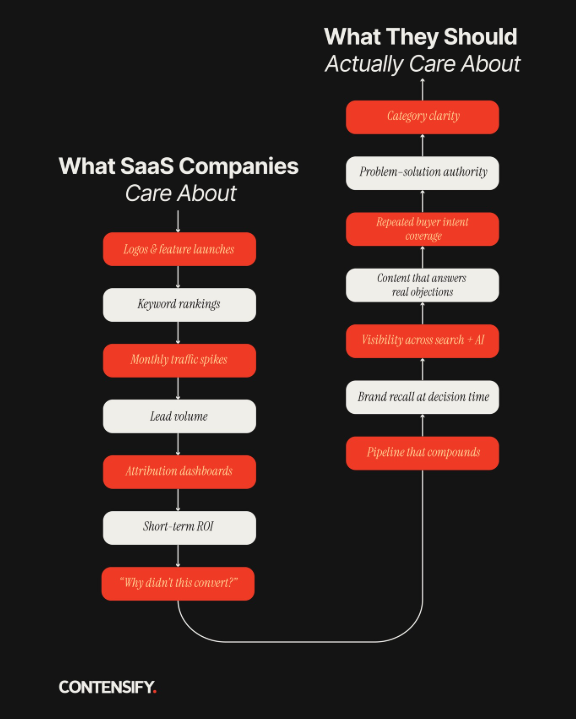
That is why content performance should not be measured by traffic alone. It should also be evaluated through:
- Session-to-pipeline conversion rate
- Demo requests or qualified leads influenced
- Buyer journey stage alignment
- Audience segmentation and ICP fit
- Revenue influenced by specific content pieces
A lot of high-traffic content attracts users looking for free alternatives, DIY solutions, or basic educational information. While that may increase visibility, it often contributes very little to actual pipeline growth.
6. Your Content Sounds Educational but Says Nothing Opinionated or Memorable
A lot of B2B content is accurate but interchangeable. It explains processes, defines terms, and shares best practices in the same way every competitor does. The problem is not quality. It is differentiation. Without a clear point of view, the content becomes useful but forgettable.
Opinionated content takes a stance. It challenges common industry thinking, reframes problems, or explains why a certain approach works better. That is what builds content-driven positioning and makes content more effective for sales enablement, too.
A simple test is to remove your logo from your last few blogs. If buyers cannot recognize the brand from the perspective alone, the content likely reflects production volume rather than a distinct voice.
7. You Keep Publishing New Content Instead of Improving Existing Winners
Publishing more content is not always the fastest way to grow traffic or pipeline. In many cases, the better opportunity already exists in pages that are ranking, getting impressions, but underperforming on clicks or conversions. A page sitting at position 6-9 with high impressions can often generate results faster than a new article with no authority.
Older content also loses effectiveness over time. Search intent changes, statistics become outdated, and weak internal linking limits conversion potential. Regularly updating existing pages is often a higher-ROI activity than constantly expanding the content calendar.
Signs a page is under-optimized include:
- High impressions but low CTR
- Weak title tags and meta descriptions
- No links to product, pricing, or demo pages
- Outdated statistics or references
- CTAs that do not match search intent
8. Your Content Generates Activity Across Channels but No Clear Market Association
High engagement doesn’t mean strong positioning. LinkedIn impressions, email opens, shares, and saves measure activity, not category association. A company can generate consistent engagement and still fail to own a clear narrative in its market.
Strong content creates recognition around a specific problem, category, or point of view. Buyers should associate your company with something clear through search, peer recommendations, analyst conversations, Reddit threads, Quora discussions, or dark social channels like Slack and DMs. If your content covers too many disconnected topics, the share of voice may increase without building real positioning.
A simple test is whether people in your market can clearly explain what your company is known for. If they cannot, your content strategy is likely too broad.
Conclusion
Content volume without revenue alignment is the core issue behind all of these signs. The problem is usually not content quality. It is a strategy gap. More publishing does not fix weak ICP alignment, poor positioning, or low pipeline influence.
At Contensify, we have over a decade of experience helping brands build content strategies that drive both organic visibility and real business growth. If these signs feel familiar, the right starting point is a content audit focused on ICP fit, buyer stages, positioning, and revenue alignment.