Search hasn’t gone away, but how people get answers has fundamentally changed. Instead of comparing links, users now rely on AI to read, filter, and recommend solutions based on their specific context.
This shift changes what visibility means. You’re no longer competing just to rank; you’re competing to be part of the answer.
However, most brands still track visibility the old way, through rankings, traffic, or a single “AI visibility score.” While convenient, these metrics often hide the real picture, where a brand may appear strong overall but remain absent in key conversations.
That’s because AI operates at the level of topics, problems, and use cases. In this blog, we’ll break down 10 things you need to know about topic-based GEO to show up consistently in AI answers.
10 Things to Know About Topic-Based GEO That Actually Improves AI Visibility
Here are the 10 things that actually determine whether your brand shows up or gets overlooked when AI systems generate answers across the topics:
1. AI visibility is earned at the topic level, not the brand level
In traditional SEO, strong brand authority could lift visibility across multiple keywords. AI doesn’t follow that pattern. Large language models focus on matching specific problems to the most relevant solutions, not on how well-known a brand is.
As a result, visibility depends on how well you cover a given topic. You can show up consistently in one area, yet remain completely absent in another closely related one, because each is treated as a separate context with its own signals.
2. Why “AI visibility scores” are misleading without topic breakdowns
A single AI visibility score may seem simple, but it flattens everything into a single number. In doing so, it mixes high visibility in a few topics with zero presence in others, which cancels out the real insight you need.
For instance, you might be performing strongly in a niche use case but completely missing in core buying conversations. The average still looks “decent,” so the gap goes unnoticed.
This is where the difference between a score and a topic-level view becomes clear. A score tells you where you stand overall. A topic map shows where you’re actually winning, losing, and invisible, which is what drives meaningful decisions.
3. Each topic behaves like its own market inside AI search
AI search fragments intent far more than traditional search ever did. What looks like a small variation in wording often reflects a different need, context, or stage in the decision process, and AI responds accordingly.
As a result, even closely related queries can produce very different answers. For example, “best project management tools,” “project management software for remote teams,” and “alternatives to Jira” may seem similar, but each leads to distinct recommendations.
There’s no carryover of authority here. Performing well in one phrasing or use case doesn’t ensure visibility in another, even when they appear closely related.
4. Topic-level tracking turns GEO from guesswork into execution
Without topic-level visibility, GEO remains abstract. Teams know they need to improve AI presence, but lack clarity on where to act or what to prioritize. Once you break visibility down by topic, the direction becomes much clearer. You can:
- Identify where you’re already gaining traction
- Spot topics where you’re completely missing
- Prioritize high-impact areas tied to real demand
- Avoid spending effort on low-value or irrelevant topics
This shifts GEO from a broad strategy into a set of concrete actions. It also brings structure to your roadmap, helping teams focus on closing gaps and expanding coverage in a deliberate, measurable way.
5. Expanding topics can lower your metrics (and why that’s a good sign)
As you expand into new topics, your overall visibility percentage may drop, and that often creates unnecessary concern. The reason is simple: you’ve increased the number of topics being measured, but haven’t built presence in them yet.
So, as your coverage grows, your average visibility is diluted in the short term. Nothing has actually worsened; you’ve just widened the scope. This is similar to entering new markets. Your overall market share may decrease initially, not because you’re losing ground, but because you’re now competing across a larger space.
Understanding this shift helps avoid misinterpretation and keeps the focus on long-term coverage rather than short-term metrics.
6. Topic mapping is the foundation of any scalable GEO strategy
Without a clear map of topics, GEO efforts tend to stay scattered. A topic map brings structure as it defines the full set of conversations where your product or service should appear, across categories, use cases, and different customer contexts.
Instead of thinking in isolated content pieces, you start thinking in coverage. What problems are you solving, for whom, and in which scenarios? A simple way to build this is to break your space into:
- Core categories your product belongs to
- Key customer problems you solve
- Specific use cases or workflows
- Different personas or buyer types
- Real-world scenarios where your solution fits
This creates a more complete view of where you need visibility and makes it easier to scale content in a focused, systematic way.
7. The best GEO topics come from customer conversations, not keyword tools
Most teams still rely on keyword tools to decide what to write. That worked for SEO. It falls short for AI. GEO needs a different source of truth, real customer conversations. AI responds to specificity. And that level of detail rarely shows up in keyword data. It comes from how customers describe their problems, constraints, and expectations in real situations.
To extract the right topics, look at:
- Sales calls → what prospects are trying to solve
- Objections → what’s holding them back
- Onboarding conversations → where they struggle early
These inputs reveal the exact language, scenarios, and nuances that AI systems pick up and match back to user queries.
8. Content depth matters more than content volume in GEO
Publishing more content doesn’t guarantee visibility in AI. What matters is how deeply you cover a topic. Shallow blogs explain concepts at a surface level. AI, however, favors content that reflects real decision-making, clear use cases, practical evaluation criteria, and honest trade-offs.
Depth means going beyond basic explanations and addressing when something works, how it should be evaluated, and where it may fall short. For example, a generic overview adds little value, while a detailed, scenario-driven piece is far more likely to be surfaced in AI-generated answers.
9. Topic authority compounds your chances of being recommended
In AI search, one piece of content rarely does the job. What matters is how consistently you show up across a topic. When multiple pieces cover related angles, they reinforce each other and increase your chances of being picked up.
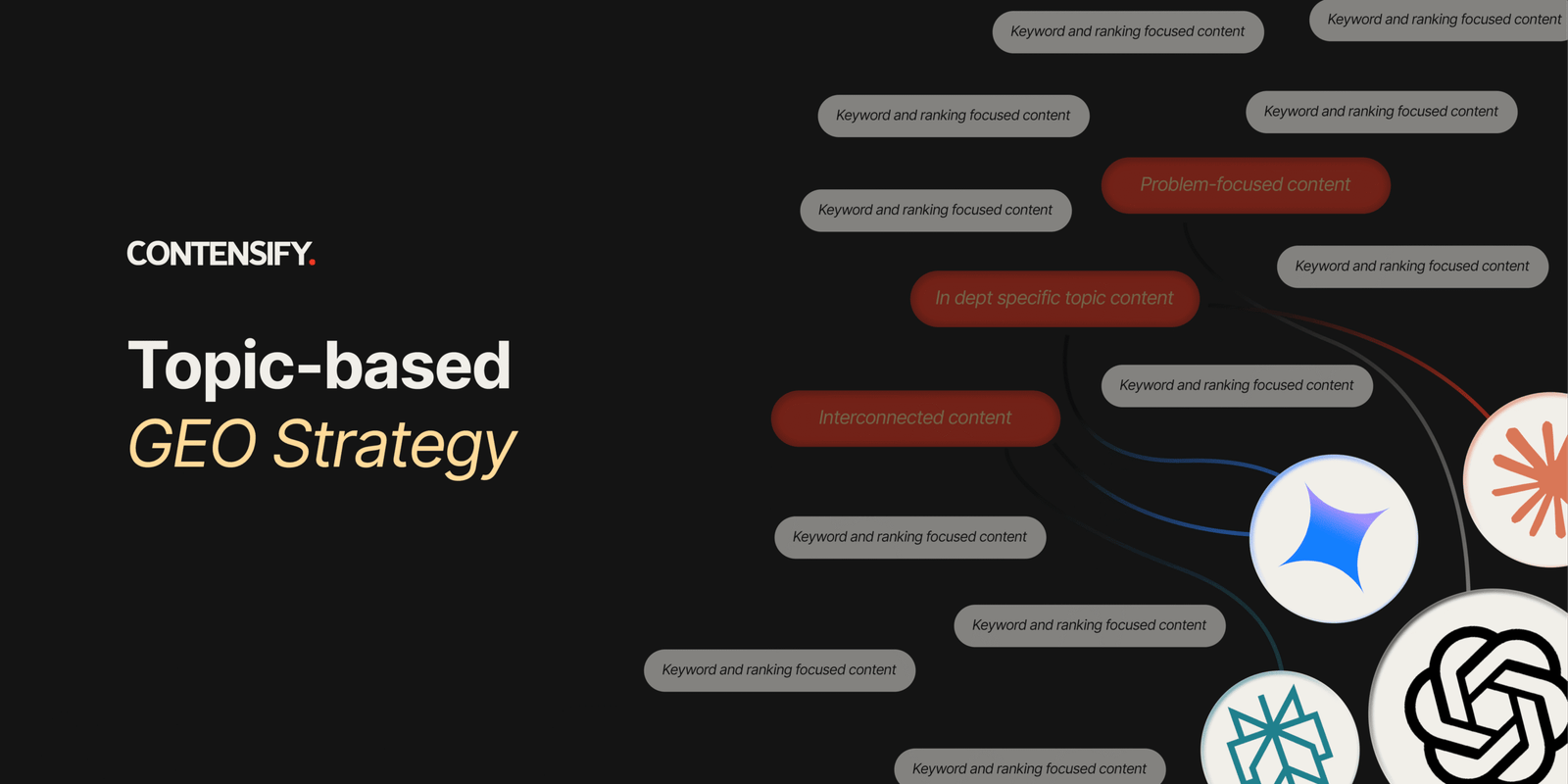
This is where coverage density comes in. Instead of a single article, you build a cluster that addresses different use cases, comparisons, and scenarios within the same topic.
For example, one article may get occasional visibility, but a set of 8-10 connected pieces creates a stronger signal, making your brand a more reliable choice in AI-generated recommendations.
10. A scalable GEO strategy focuses on expanding topic coverage systematically over time
GEO scales through structured expansion, not isolated efforts. Visibility improves as you consistently add coverage across related topics instead of relying on a few high-performing pieces.
The approach is layered. You begin with core topics, expand into adjacent areas, and then move into more specific or advanced scenarios. Each addition increases your surface area in AI-driven conversations. Over time, this creates steady, compounding visibility driven by coverage, not one-off content wins.
How to Start Building Your Topic-Based GEO Strategy
Here’s a simple way to start building a topic-based GEO strategy:
- Identify core problem clusters: Define 3–5 key areas where your product solves meaningful customer problems, focusing on real use cases rather than features.
- Break into specific scenarios: Expand each cluster into detailed use cases and situations, as greater specificity improves AI’s ability to match your content to queries.
- Create decision-driven content: Develop content that mirrors actual buying conversations by addressing comparisons, edge cases, and expected outcomes.
- Track by topic, not prompts: Measure visibility across defined topics to clearly see where you’re gaining traction and where gaps still exist.
- Expand systematically: Follow a repeatable process of filling gaps, moving into adjacent topics, and gradually deepening your overall coverage.
Conclusion
AI visibility doesn’t come from more pages; it comes from covering the right topics with enough depth. Most teams still track surface-level metrics and miss where they actually show up in real conversations. That’s why results feel inconsistent.
The shift is simple: move from pages to structured topic coverage.
At Contensify, we’ve spent over a decade helping brands grow through SEO and content marketing, and now, we’re applying that same depth to building effective GEO strategies that drive real visibility in AI answers.