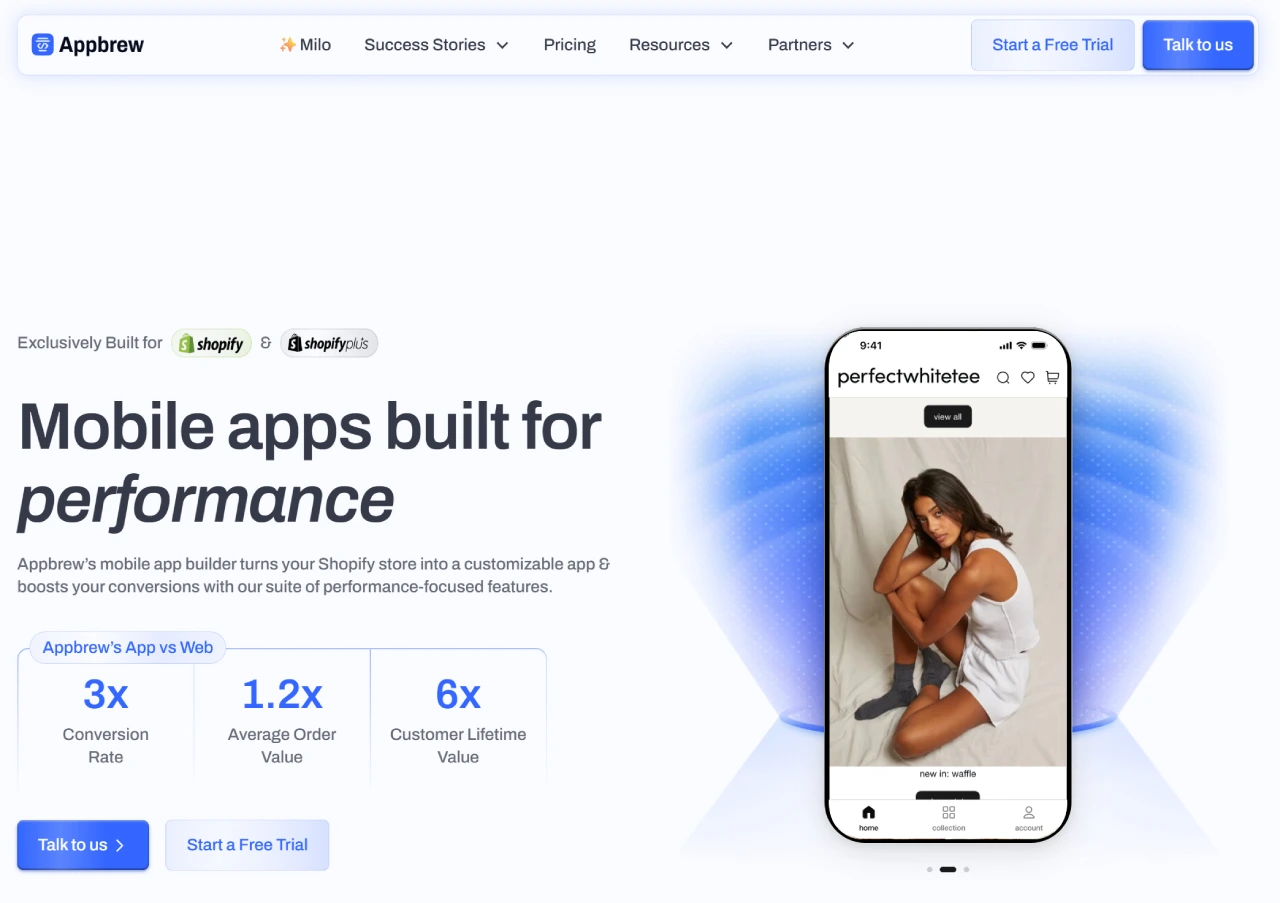

About Appbrew
An AI-powered mobile app platform built for Shopify brands that want to own performance
Appbrew helps DTC brands convert their Shopify stores into native iOS and Android shopping apps without needing a large in-house engineering team. It enables brands to launch fully branded mobile apps, run push notification campaigns, personalise the in-app shopping experience, and integrate with their existing stack, including Klaviyo, Recharge, and Yotpo.
Appbrew’s positioning centres on outcomes that matter to retention-driven ecommerce teams: higher conversion rates, stronger AOV, better LTV, and more repeat purchases through owned mobile channels.
Its ideal customer is an established DTC Shopify brand in fashion, beauty, skincare, or lifestyle with existing traffic and a team that wants to scale retention without scaling engineering.
The Challenge
Content that chased traffic instead of buyers and fell short of both
When Appbrew came to Contensify, the problem was not a lack of content investment. It was that every prior engagement had produced volume without strategy.
Traffic without relevance, articles without authority. The result was a content library that looked active on the surface but was actively working against Appbrew’s growth goals. Four compounding problems defined the starting point.
- Wrong audience, wrong traffic
Existing content was attracting visitors with no intent to buy. Appbrew was chasing traffic metrics instead of ICP relevance, resulting in sessions that didn’t convert and leads that didn’t materialise. - Zero qualified pipeline from organic
Despite a live content programme, not a single qualified lead was coming through search. Organic was a cost centre, not a growth channel. - Losing ground to every major competitorZ
Tapcart, Shopney, Vajro, and MageNative were all outranking Appbrew on the keywords that drive demos and trials. The gap wasn’t narrowing. It was widening. - Quality that undermined credibility
Most existing content was visibly AI-generated, thin, and lacking the depth that builds trust with a sophisticated ecommerce buyer. Previous partners had treated output as the deliverable, not outcomes.
The Engagement
A full-stack content and SEO build, grounded in commercial priorities
Competitive intelligence first. Content second.
Contensify began with a thorough audit of the competitive landscape before a single piece of content was briefed. Appbrew provided directional input on which verticals they wanted to index on within six months. Contensify used that as the foundation and built the entire strategic architecture on top of it. The goal was to make organic a reliable, predictable pipeline channel, not just a traffic source.
- Competitor & Content Gap Analysis
Mapped every major competitor’s footprint across Tapcart, Shopney, Vajro, and MageNative to identify where Appbrew could win fastest. - Technical SEO & Crawl Analysis
Full crawl audit covering site architecture, indexability, Core Web Vitals, canonical issues, internal linking, structured data, and crawl budget. - On-Page SEO
Intent-aligned optimisation of title tags, meta descriptions, header structures, semantic keyword coverage, and content depth across new and existing pages. - Backlink Building
Relevance-first backlink strategy targeting ecommerce, Shopify ecosystem, and mobile commerce publications. Quality and contextual fit over raw domain volume. - Blog Production
8 content pieces per month across formats, including consistent refresh cycles for underperforming existing content. - Comparison Pages & Listicles
High-converting formats targeting in-market buyers actively evaluating Appbrew against alternatives. - Answer Engine Optimisation (AEO)
Content structured to be surfaced by Google AI Overviews, ChatGPT, Perplexity, and other generative search surfaces. - Monthly Reporting + Bi-weekly Calls
Regular syncs incorporating market trends, product updates, and signals from Appbrew’s sales conversations.
Use Cases
Capturing In-Market Buyers Dissatisfied with Competitors
- The Challenge
Shopify brands already using Tapcart, Shopney, or Vajro and looking for a better option had no clear path to Appbrew through search. The brand was invisible at the exact moment buyer intent was highest. - Contensify’s Approach
Contensify identified the highest-conversion entry point: buyers already in-market and already dissatisfied. Comparison pages and listicles were built to intercept this audience precisely when they were evaluating options, with enough depth and product knowledge to drive demo requests, not just page views. - The Results
#1 Listicles and comparison pages became the highest-performing demo-capture formats. “Best Tapcart Alternatives” and “Best Shopify Mobile App Builders” both moved to #1, and organic demos began compounding as AI tools started surfacing Appbrew for the same searches.
Owning the Keywords That Define the Category
- The Challenge
The Shopify mobile app category is dominated by established players with years of SEO investment. For Appbrew to build a reliable organic pipeline, they needed to own the searches buyers use when they are closest to a decision, not just rank for peripheral topics with marginal commercial intent. - Contensify’s Approach
Keyword strategy was built around commercial intent, not volume. Contensify identified the cluster of high-intent money keywords that would move the business. Technical SEO, on-page optimisation, and a deliberate backlink programme worked in combination to build the authority needed to compete at the top. - The Results
30+ Commercial terms in the top 3, with #1 positions on 5 core money keywords. “Turn Shopify Store into Mobile App” and “Best Shopify Mobile App Builders” are both now ranking #1 and generating consistent inbound demo requests.
Getting Cited Where Buyers Research Before They Search
- The Challenge
A founder or retention lead evaluating a Shopify mobile app platform in 2025 is as likely to ask ChatGPT or Perplexity as they are to scroll a traditional search results page. For Appbrew to capture early-stage demand, presence in AI-generated responses was as strategically important as traditional rankings. - Contensify’s Approach
Every content piece was built with generative AI surfaces in mind. Content was structured with clear, citable answers to the specific questions buyers ask AI tools. Depth, formatting, authority signals, and third-party validation were all optimised to increase the likelihood of being surfaced as a trusted source. - The Results
200+ AI prompts where Appbrew is now cited or mentioned across ChatGPT, Perplexity, and Google AI Overviews, giving the brand presence at the top of the research funnel before a buyer ever clicks a single link.
Pivoting from Ecosystem Play to Brand Awareness in New Markets
- The Challenge
Appbrew’s initial content strategy was tightly scoped to the Shopify ecosystem. The right starting point, but insufficient for the brand’s ambition to build awareness in markets like the US where broader ecommerce search intent also represented a meaningful opportunity. - Contensify’s Approach
Without abandoning the Shopify-specific content that was already compounding, Contensify layered in a parallel track targeting broader ecommerce searches: mobile commerce, app-first shopping, ecommerce retention, and mobile engagement. New content was added on top of a compounding base, not in place of it. - The Takeaway
A strategy built entirely around one ecosystem will cap the addressable audience. The right move is to compound what works, then expand deliberately, not abandon it.
The Relationship
From chasing traffic to owning the channel with a content partner that understands what growth actually looks like
01 / The Starting Point
Content invested in. Nothing to show for it.
Appbrew came to Contensify having already invested in content and having little to show for it. Prior partners had produced output without strategy, traffic without relevance, and articles without the quality needed to compete. The product was strong. The organic presence wasn’t reflecting it.
02 / The Build
Rebuilt from the ground up. Every piece connected.
Contensify rebuilt Appbrew’s content and SEO presence from scratch. Competitive intelligence, technical audit, keyword architecture, comparison content, blog production, AEO, backlinks, distribution, and monthly reporting, all connected to Appbrew’s commercial priorities and ICP.
03 / The Expansion
Scope deepened. Channel confirmed.
In Q1 2026, Appbrew expanded scope to include more blog production, Reddit distribution, deeper generative engine optimisation touchpoints, and an accelerated backlink programme. When a client deepens investment, it means the channel is working and the ROI is clear enough to double down on.
Why Contensify
What makes the difference
- ICP-first strategy
Every keyword, every piece, and every format is built around the buyer, not the algorithm. Traffic that doesn’t convert is just noise. - Technical SEO that goes deep
Crawl analysis, site architecture, Core Web Vitals, structured data, and internal linking — the foundation that makes everything else work. - Built for generative AI
Optimized for ChatGPT, Perplexity, and AI Overviews, so your brand shows up wherever buyers are researching, not just where they’re clicking. - Formats that drive demos
Comparison pages, listicles, and intent-aligned blogs built to convert, not to pad a content calendar. - A strategy that adapts
When Appbrew’s goals shifted, the strategy shifted with them. Content partners should follow business direction, not the other way around. - Compounding returns
Every blog, backlink, and optimization builds on the last. Organic done right becomes the most efficient pipeline you have.