
About The Brand Strategy Lab
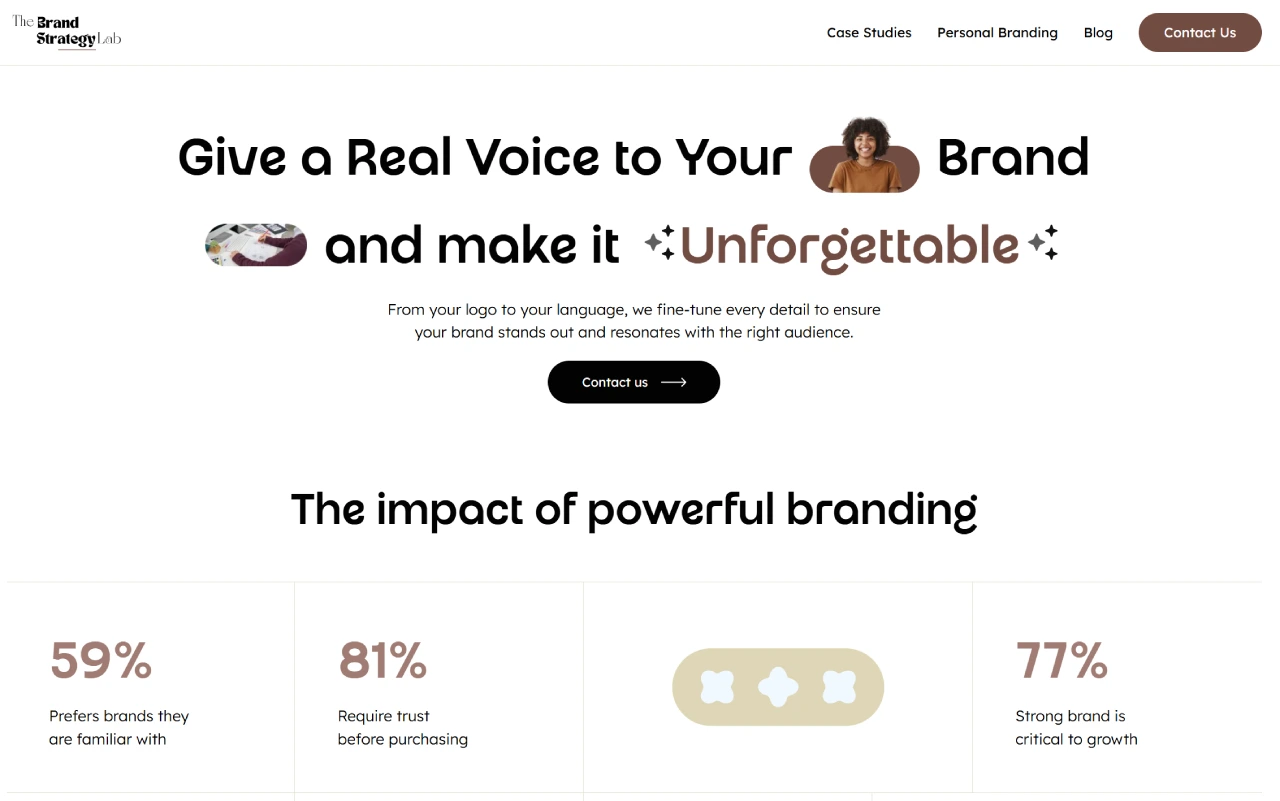
A branding agency helping startups build stronger market positioning
The Brand Strategy Lab is a branding agency working with both B2B and B2C startups to help them define how they position themselves in the market through:
- brand positioning
- messaging systems
- visual identity
- logo design
- and foundational brand strategy
The agency primarily targeted startup founders, early-stage businesses, growth-stage companies and founder-led brands looking to establish stronger market differentiation.
Its primary geographies included the United States, the United Kingdom and Singapore.
At the time of engagement, The Brand Strategy Lab was still in its earliest stage of growth.
The company had no organic traffic, no existing content library, no historical SEO authority, no indexed topical depth and only a homepage live on the website.
Unlike established branding agencies already benefiting from years of search visibility and founder recognition, The Brand Strategy Lab was entering the market with no discoverability advantage.
Everything needed to be built from scratch.
The Challenge
Competing in one of the most saturated service categories online
Launching a new agency is difficult under almost any circumstance. Launching one inside the branding category is significantly harder.
The space is crowded with established agencies, founder-led studios, design-first brands, heavily funded competitors and companies with years of accumulated authority.
At the same time, startup founders researching branding services are often exposed to messaging that sounds remarkably similar across agencies.
Most agencies talk about storytelling, differentiation, creativity and “building iconic brands”, without clearly contextualising business outcomes, positioning decisions or industry-specific realities.
This creates an environment where trust becomes difficult to earn organically, especially for a newly launched agency with no existing authority.
For The Brand Strategy Lab, the challenge wasn’t simply about generating traffic.
The company needed to:
- establish credibility quickly
- compete for meaningful buyer-intent searches
- attract founders organically
- and create a scalable inbound engine without relying on paid acquisition
There was another strategic complication as well. The audience itself was broad.
The agency wanted visibility across:
- B2B startups
- B2C startups
- multiple industries
- and multiple geographies
Without careful planning, this could easily create fragmented messaging and diluted authority. The strategy needed to scale relevance without weakening positioning.
The Engagement
Building an inbound search visibility engine from zero
Contensify approached the engagement as a long-term visibility and authority-building initiative rather than a short-term traffic exercise.
The objective was not simply publishing blogs, increasing impressions or chasing low-intent traffic.
The objective was to build discoverability, topical authority, founder trust and qualified inbound demand through educational and commercially relevant content.
This required balancing several priorities simultaneously:
- competing for high-intent keywords
- establishing expertise quickly
- building topical depth
- and creating content strong enough to perform across both traditional search engines and AI-powered discovery systems
The strategy was intentionally designed around the belief that search visibility compounds when content depth, positioning clarity and topical consistency work together systematically.
Competing directly for commercial branding demand
One of the most important strategic decisions was choosing not to avoid competitive search categories.
Many newer agencies default to obscure long-tail keywords, ultra-low competition topics or surface-level awareness content because competing directly feels unrealistic.
Instead, The Brand Strategy Lab intentionally targeted high-intent searches connected to real buyer demand, including:
- branding agency
- branding agencies for startups
- branding for SaaS companies
- industry-specific branding searches
- and location-based agency queries
The reasoning behind this approach was straightforward: High competition usually exists where high commercial intent exists.
Avoiding competitive searches would also mean avoiding the very buyers the company wanted to attract.
Creating a differentiated content tilt
Another major challenge in branding content is sameness.
Much of the branding content online tends to repeat broad advice, speak abstractly and avoid contextual specificity.
To differentiate The Brand Strategy Lab from generic branding agencies, the strategy focused heavily on industry-specific and context-driven branding discussions.
Instead of speaking about branding in universal terms, the content explored:
- branding considerations across industries
- startup-specific positioning challenges
- founder decision-making patterns
- and how branding changes depending on business model and market maturity
This immediately made the content feel more relevant, practical and more founder-aware, while helping the company establish authority within narrower contexts faster.
Designing for multiple ICPs without diluting positioning
The company needed visibility across B2B startups, B2C startups, multiple industries and multiple geographies.
Rather than forcing a single audience profile artificially, the strategy intentionally created multiple structured audience pathways through:
- industry-focused content
- geography-aware pages
- startup-specific educational guides
- and commercial comparison content
This allowed the brand to expand discoverability while still maintaining a consistent positioning narrative. The key was ensuring every content cluster still reinforced:
- strategic branding
- founder education
- and market positioning expertise.
Using blogs as the primary growth infrastructure
Blogs were selected as the core growth mechanism because they enabled:
- rapid publishing
- scalable authority building
- search visibility expansion
- and long-term discoverability
All without requiring heavy design or development resources. But the content strategy was never built around publishing volume alone.
The focus remained on depth, comprehensiveness, clarity and search intent alignment.
This was especially important because the content needed to perform across Google Search, AI-powered search systems and founder research journeys simultaneously.
Use Cases
Building Authority Quickly on a New Domain
The Challenge
New domains typically struggle with discoverability because they lack authority, backlinks, content depth and search trust signals. For a newly launched agency competing in a saturated category, this challenge becomes even harder.
Without strong topical depth, Brand Strategy Lab risked remaining invisible during the exact searches potential buyers were already conducting.
Contensify’s Approach
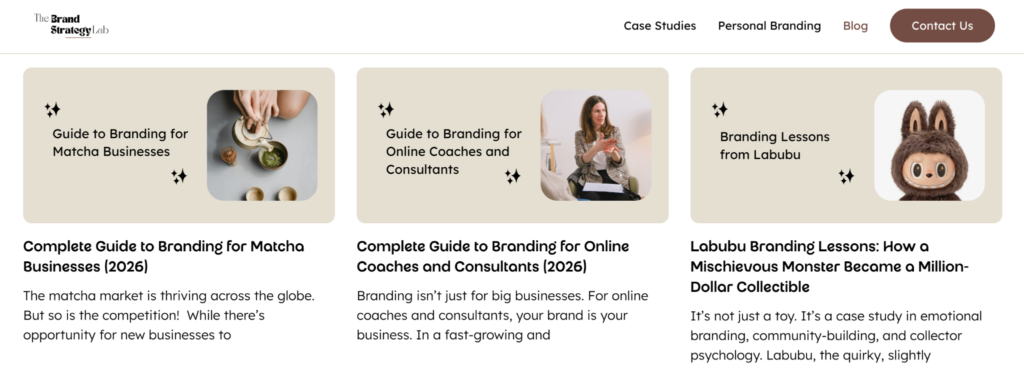
To accelerate authority-building, the strategy focused heavily on pillar-and-cluster SEO architecture, topical consistency and deep educational content.
Core branding themes were broken into structured content clusters designed to reinforce topical relationships, contextual depth and semantic relevance. This helped search engines and AI systems better understand what the brand specialised in, which topics it had expertise in and how different content assets connected strategically.
The Results
Within five months the website reached over 1,500 qualified monthly visitors, built topical visibility across branding-related searches and established a measurable inbound acquisition engine despite starting from a completely new domain.
Capturing High-Intent Founder Demand
The Challenge
Traffic alone would not create a business impact. The company needed content capable of attracting founders actively evaluating branding support, companies looking for strategic guidance and buyers closer to conversion stages, without relying on outbound sales systems.
Contensify’s Approach
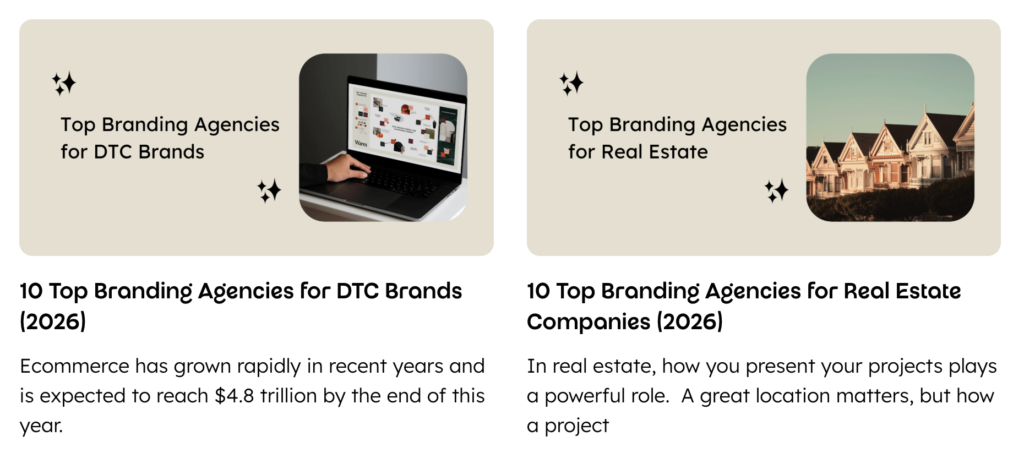
To capture higher-intent demand, the strategy included commercial comparison pages, “best branding agencies” listicles, industry-focused agency searches and startup-specific branding guides.
These pages were intentionally designed to align with evaluation-stage searches, strengthen trust and position The Brand Strategy Lab within credible market conversations.
The Results
The website generated 52+ sales-qualified leads in 5 months only, inbound founder conversations and paying clients directly through organic visibility.
Optimising for AI Search Visibility Early
The Challenge
Search behaviour is increasingly shifting toward AI-powered discovery experiences. This means content now needs to perform not only in traditional SERPs, but also inside AI summaries, generative search systems and LLM-driven discovery experiences.
Contensify’s Approach
From the beginning, the content strategy incorporated AI SEO principles, answer-first formatting, entity-rich explanations, logical information hierarchy and context-driven educational structures.
Content was intentionally designed to improve machine readability, contextual understanding and citation potential within AI systems, without sacrificing human readability or depth.
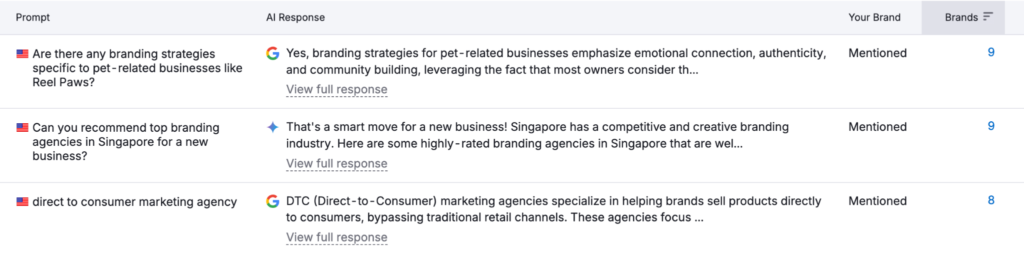
The ResultsThe Brand Strategy Lab achieved 116 pages cited within AI-powered search experiences, stronger discoverability outside traditional SERPs and expanded visibility across emerging AI-driven search environments within the first five months of growth.
The Relationship
From zero visibility to a functioning inbound engine
01 / The Starting Point
The Brand Strategy Lab launched with no authority, no content ecosystem, no inbound acquisition engine and no discoverability advantage. The business needed a growth system capable of generating trust organically.
02 / The Build
Contensify developed a strategy designed to compound authority over time, including:
- a pillar-and-cluster SEO framework
- high-intent content systems
- educational branding guides
- AI-search-aware content structures
- and commercially aligned BOFU content
03 / The Outcome
Within five months, The Brand Strategy Lab evolved from a newly launched agency with zero visibility to a discoverable branding authority generating qualified inbound demand organically across multiple geographies.
The content became the acquisition engine, the trust layer and the primary driver of inbound growth.
Why Contensify
What makes the strategy work
- Competing for real commercial intent
Rather than avoiding competitive terms, the strategy focused on high-intent searches where genuine buyer demand existed and conversion opportunities were strongest. - Structured topical authority building
A pillar-and-cluster content framework strengthened topical relevance, improved search understanding, and created a foundation for long-term organic discoverability. - Industry-aware positioning
Content moved beyond generic branding advice to address the specific challenges, priorities, and growth concerns faced by founders and industry decision-makers. - Search visibility beyond traditional SEO
The strategy incorporated SEO, GEO, AI discoverability, and machine-readable content structures from the outset to improve visibility across modern search and research environments. - Building sustainable inbound growth
The goal was never vanity traffic. Every initiative was designed to increase qualified demand, strengthen authority, improve discoverability, and support long-term inbound acquisition.
Conclusion
More Than Traffic Growth
This engagement demonstrated that new agencies can compete effectively in saturated categories without relying on:
- paid acquisition
- aggressive outbound sales
- or inflated growth tactics
For Brand Strategy Lab, content became the authority engine, the inbound acquisition system and the foundation for scalable growth.
Search visibility and organic growth today requires more than publishing content consistently. It requires strategic visibility systems designed around discoverability, authority, buyer intent and long-term trust.
If your company wants to build sustainable inbound growth through SEO, GEO, and content strategy, we can help.