Taking a startup to market requires more than a good product. Founders need to define their ideal customer profile (ICP), sharpen positioning, build demand, generate leads, and align marketing with sales.
Managing these functions in-house can be expensive, especially for early-stage startups that lack the resources to build a full GTM team.
GTM agencies offer specialised expertise without the cost of hiring across every function. However, their services vary, from outbound sales and paid acquisition to SEO, organic growth, and fractional GTM leadership.
In this blog, we’ll explore the best go-to-market (GTM) agencies for startups looking to build and scale their growth.
What Is a GTM Agency?
A go-to-market (GTM) agency helps businesses bring products to market, reach their target customers, and drive revenue growth. It connects marketing, sales, and revenue operations to build a coordinated approach to customer acquisition.
A GTM agency may support several areas, including:
- ICP and audience research: Identifying ideal customers and understanding their needs.
- Positioning and messaging: Defining the product’s value proposition and differentiators.
- Product marketing: Communicating product value to target buyers.
- Demand generation: Creating awareness and generating qualified leads.
- Content marketing: Developing content to attract and engage potential customers.
- SEO and AI search: Improving visibility across search engines and AI-powered platforms.
- Paid acquisition: Running paid campaigns to reach target audiences.
- Outbound: Generating leads through targeted prospecting and outreach.
- Sales enablement: Equipping sales teams with the content and resources they need to convert prospects.
- RevOps: Aligning marketing, sales, and customer success processes, data, and technology.
How Does a GTM Agency Differ From a Traditional Marketing Agency?
Traditional marketing agencies typically focus on specific channels, campaigns, or creative execution. GTM agencies take a broader approach by connecting marketing activities with sales processes and revenue goals.
However, the scope varies significantly between agencies. Some specialise in outbound, paid acquisition, or organic growth, while others provide end-to-end GTM support or fractional leadership. The right fit depends on a startup’s growth stage, priorities, and internal capabilities.
What Should Startups Look for in a GTM Agency?
Choosing the right GTM agency depends on your startup’s stage, growth strategy, and the expertise you need. Here’s what to look for when selecting a GTM agency:
Startup Stage
Pre-seed startups may need help defining their ICP and positioning, while Series A/B companies may focus on scaling acquisition. Consider your product-market fit and GTM readiness. An agency built for established SaaS companies may not suit a startup still validating its market.
GTM Motion
Choose an agency experienced in your GTM model, whether it’s product-led, sales-led, founder-led, outbound, inbound, paid acquisition, or a hybrid approach. It should understand how your target customers discover and buy your product.
Specialization
Look for B2B SaaS experience with similar buyers, average contract values (ACVs), and sales cycles. The agency should also have proven expertise in the specific channel you need, such as SEO, outbound, or demand generation.
Execution vs. Strategy
Determine whether you need strategic guidance, campaign execution, end-to-end GTM management, or fractional specialists. Choose an agency whose delivery model matches your team’s capabilities and requirements.
Measurement
Evaluate agencies on qualified leads, pipeline contribution, customer acquisition cost (CAC), conversion rates, and revenue attribution. Traffic, impressions, and activity metrics alone don’t show whether GTM efforts are generating business results.
Best GTM Agencies for Startups
Here are some of the best GTM agencies for startups, compared by their services, pricing, strengths, and the type of business they’re best suited for.
1. Contensify
Best For: B2B SaaS startups focused on organic-led GTM and inbound pipeline growth.
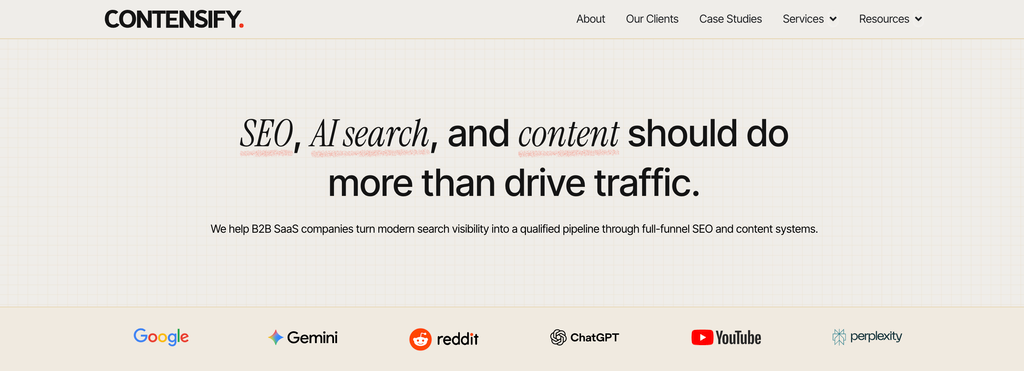
Contensify has over a decade of experience helping businesses strengthen their search presence and content marketing. The team works closely with SaaS brands to build sustainable growth strategies aligned with buyer intent and business goals.
GTM Services:
- Organic growth strategy
- Content marketing and full-funnel content
- SEO and technical SEO
- AI search optimization (GEO, LLM SEO, and AEO)
- Content distribution and link building
- Reddit, Quora, and YouTube SEO
Industries / Company Types:
B2B SaaS, eCommerce SaaS, MarTech, FinTech, Enterprise Tech, HR Tech, EdTech, nonprofits, and Shopify agencies.
Pricing:
Starts at $1,499 for an SEO and LLM visibility sprint.
What Makes Them Different
- Connects organic search and AI visibility with buyer intent and pipeline goals.
- Combines content creation, SEO, and distribution into one integrated growth approach.
Potential Limitations
- Best suited to startups prioritizing organic acquisition over paid or outbound-led GTM.
- Companies seeking a full-service GTM partner across sales, paid acquisition, and RevOps may need additional support.
2. GTM 80/20
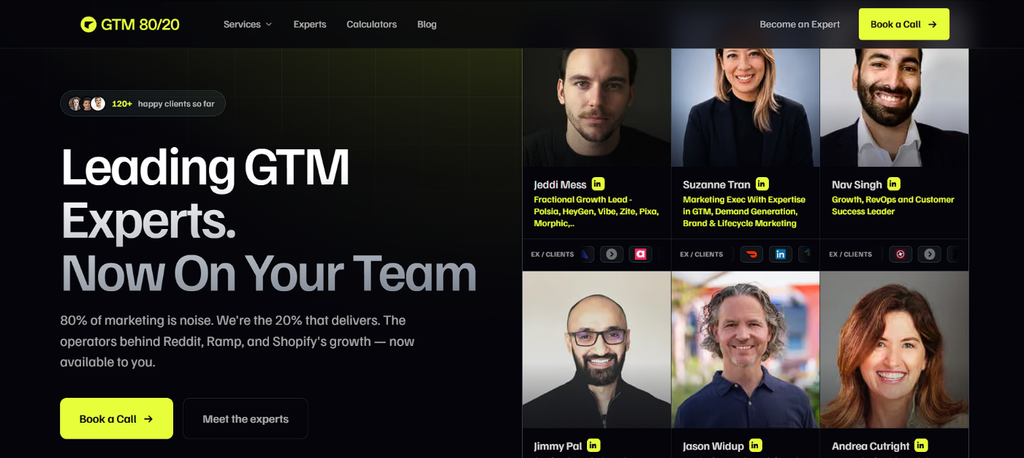
Best For: Startups needing flexible, senior GTM expertise without hiring full-time specialists.
GTM 80/20 connects companies with experienced operators across different GTM functions. Its flexible retainer model lets businesses bring in specialists based on their immediate needs rather than commit to a fixed agency package.
GTM Services:
- GTM strategy and digital strategy
- Fractional CMO support
- Demand and growth marketing
- Product marketing
- Paid advertising and performance marketing
- Marketing analytics and operations
- RevOps and enterprise sales
Industries / Company Types:
B2B SaaS, eCommerce, FinTech, retail technology, and other technology businesses.
Pricing:
Custom pricing based on specialist seniority and hours, with flexible monthly retainers and no long-term commitment.
What Makes Them Different
- Matches companies with specialists based on specific GTM gaps rather than predefined service bundles.
- Operators execute the work directly, without an account manager acting as an intermediary.
Potential Limitations
- Execution capacity depends on the availability and working hours of the assigned specialist.
- SaaS-specific expertise varies by operator, as the platform serves multiple industries.
3. Refine Labs
Best For: Mid-market and enterprise B2B tech companies looking to improve demand generation and qualified pipeline.
Refine Labs has worked with 300+ B2B technology companies since 2019. Its approach connects brand, demand generation, and customer expansion, combining strategy, paid media, and creative execution to drive revenue growth.
GTM Services:
- GTM strategy and demand generation
- Brand positioning and messaging
- Paid media management across major channels
- Ad creative and video production
- Pipeline measurement and marketing attribution
- Customer expansion campaigns
Industries / Company Types
B2B technology, SaaS, mid-market businesses, and enterprise companies, particularly Series B and later-stage organizations.
Pricing:
- Paid Media Management: Starts at $14,000/month
- Full Demand & Media Service: Starts at $26,000/month
- Creative Only: Starts at $5,000/month
- Revenue Performance Assessment: Starts at $35,000 for six weeks
What Makes Them Different
- Connects brand, demand generation, and customer expansion instead of treating them as separate functions.
- Combines strategic direction with hands-on paid media and in-house creative execution.
Potential Limitations
- The monthly retainers and minimum contract periods may be difficult for early-stage startups with limited budgets.
- Its focus on paid media and demand generation may not suit startups primarily seeking organic-led growth.
4. Hey Digital
Best For: B2B SaaS startups with product-market fit looking to scale paid acquisition and improve pipeline generation.
Hey Digital is a performance marketing agency focused exclusively on B2B SaaS. It combines paid media strategy, campaign execution, in-house creative production, and CRM-connected reporting to help software companies turn ad spend into qualified pipeline and revenue.
GTM Services:
- Paid search and paid social advertising
- GTM strategy, ICP targeting, and ABM planning
- In-house ad creative and video production
- Landing page design and optimization
- Budget allocation and campaign experimentation
- CRM-connected attribution and revenue reporting
Industries / Company Types
B2B SaaS companies across different growth stages, including businesses with self-serve signup and sales-led demo models.
Pricing:
Custom monthly retainer. Pricing is not publicly specified.
What Makes Them Different
- Works exclusively with B2B SaaS companies, bringing experience with software buying journeys and sales cycles.
- Combines strategy, media buying, creative production, and performance reporting under one team.
Potential Limitations
- Focuses on paid acquisition rather than organic channels such as SEO and content marketing.
- Best suited to companies with product-market fit, a defined ICP, and sufficient budget to invest in paid campaigns.
5. Revenue Wizards
Best For: B2B SaaS companies that need stronger RevOps systems, CRM infrastructure, and reliable revenue reporting.
Revenue Wizards helps B2B companies build and optimize their RevOps systems, including CRM infrastructure, data management, lead routing, and revenue reporting. Its focus is on aligning teams, improving processes, and building a reliable revenue engine.
GTM Services:
- Revenue operations strategy and implementation
- CRM architecture and optimization across Salesforce and HubSpot
- Lead routing, lifecycle management, and sales process design
- Revenue reporting, pipeline analytics, and executive dashboards
- Data quality, integration, and migration
- Sales planning, compensation, and territory alignment
Industries / Company Types
B2B SaaS, FinTech, industrial technology, and other businesses with complex sales and revenue operations.
Pricing:
Custom pricing based on project scope and requirements. Public pricing is not specified.
What Makes Them Different
- Focuses on the operational systems behind GTM, helping teams improve data quality, process alignment, and revenue visibility.
- Emphasizes knowledge transfer and building internal RevOps capabilities rather than creating long-term dependence on an external partner.
Potential Limitations
- Primarily focused on RevOps and GTM infrastructure, rather than demand generation or campaign execution.
- Startups with straightforward sales processes may not need the same level of systems and operational support.
GTM Agency vs. Specialized Marketing Agency
A GTM agency can cover several functions, including positioning, demand generation, sales enablement, and revenue operations. However, startups don’t always need support across every function. The right choice depends on where the biggest growth gaps lie.
A broad GTM partner can help when multiple functions need alignment. A specialized agency may be a better fit when a specific channel, such as SEO, content marketing, paid acquisition, or outbound, needs focused expertise.
| Broad GTM Agency | Specialized Agency |
| Covers multiple GTM functions | Focuses on a specific channel or function |
| Connects strategy and execution across teams | Provides deeper expertise in a particular area |
| Useful when several GTM gaps need attention | Useful when one channel is limiting growth |
| Coordinates activities across functions | Concentrates on channel-specific performance |
| May involve greater scope and complexity | Easier to evaluate against specific KPIs |
Neither model is automatically better. Startups should choose based on their current priorities, internal capabilities, and the expertise they need to reach their next growth milestone.
Which Type of GTM Agency Does Your Startup Need?
Here’s a quick overview of the type of GTM agency your startup needs at each stage of growth:
- If You Are Still Finding Product-Market Fit: Prioritize customer research, ICP definition, positioning, and founder-led experimentation before scaling acquisition.
- If You Have Product-Market Fit but Need Pipeline: Consider demand generation, paid acquisition, outbound, or content-led growth based on your sales motion.
- If Outbound Is Your Main Growth Motion: Look for expertise in prospecting, data enrichment, email outreach, LinkedIn, and sales development.
- If Organic Acquisition Is the Goal: Choose an agency specializing in SEO, content marketing, and AI search visibility.
- If Paid Acquisition Is Already Working: Find a partner that can scale campaigns while improving creative, landing pages, attribution, and conversions.
- If Your Internal Team Is Growing: Consider fractional GTM support to fill expertise gaps without hiring full-time specialists.
How Much Does a GTM Agency Cost?
GTM agency pricing varies based on your startup’s requirements and the type of engagement you choose. Here’s what to consider when estimating costs and comparing different pricing models.
Key factors that influence pricing include:
- Scope and channels: Number of channels and campaigns managed.
- Expertise: Seniority and specialization of the team.
- Strategy: Research, positioning, and GTM planning requirements.
- Content and creative: Volume of content, design, and campaign assets.
- Paid media: Advertising budget and campaign management fees.
- Technology and RevOps: CRM setup, integrations, data, and reporting requirements.
Typical GTM Agency Pricing Models
| Model | How It Works | Best For |
| Project-based | Fixed scope and timeline | Strategy, positioning, and audits |
| Monthly retainer | Ongoing support and execution | Growth-stage startups |
| Fractional | Senior specialist working for defined hours | Lean teams needing specific expertise |
| Performance-based | Fees tied partly to agreed outcomes | Select acquisition motions |
| Hybrid | Retainer combined with performance or project fees | More mature GTM teams |
How to Choose the Right GTM Agency for Your Startup
Before exploring how to choose the right GTM agency for your startup, it’s important to understand when hiring one makes sense and when it might be too early.
An agency can help when you need specialised expertise, lack the internal resources to execute your GTM strategy, or want to scale a proven growth channel.
However, if you’re still validating your product, identifying your target audience, or refining your messaging, hiring an agency may be premature. With that in mind, let’s look at how to choose the right partner for your startup’s needs:
1. Identify Your Biggest Growth Bottleneck
Start by identifying what’s holding back growth. Choose an agency that addresses that specific problem rather than paying for services you don’t need.
2. Check Startup and SaaS Experience
Look for experience with companies at a similar stage, with comparable business models, ACVs, sales cycles, and target buyers.
3. Clarify What the Agency Will Own
Determine whether the agency handles strategy, execution, reporting, full-channel management, or cross-functional GTM coordination. Define responsibilities before signing.
4. Ask About the First 90 Days
Understand how the agency approaches discovery, research, strategy, setup, execution, testing, and optimization. Ask for clear milestones and expected deliverables.
5. Focus on Commercial Metrics
Prioritize metrics tied to business outcomes, such as qualified opportunities, pipeline, revenue, customer acquisition cost (CAC), and conversion rates. Don’t rely on activity metrics alone.
6. Understand What Your Team Must Provide
Confirm the agency’s requirements for product access, subject-matter expertise, analytics, sales feedback, approvals, and CRM access. Make sure your team can support the engagement.
7. Ask What the Agency Doesn’t Do
Clarify which GTM functions fall outside its scope. A “full-service” label doesn’t guarantee coverage across every function, so identify where you may need additional specialists.
Conclusion
There’s no single best GTM agency for every startup. The right choice depends on your growth stage, budget, internal capabilities, and biggest bottleneck. Identify what needs to change, then look for an agency with proven experience in that area.
At Contensify, we help B2B SaaS companies turn organic search into a sustainable growth channel. From SEO and content marketing to AI search optimization, we bring these efforts together to improve visibility, reach the right buyers, and support pipeline growth.