For the last 12 years, we’ve helped startups and SaaS companies build long-term search visibility. And one thing we’ve learned is that choosing the right growth tactics is rarely straightforward; especially now that LLMs have expanded the search surface far beyond traditional search engines.
So if you’re wondering whether your brand needs SEO, LLM SEO, or both, this guide is for you. We’ll break down how they differ, where they overlap, and how to use both to bring your brand in front of the right buyers.
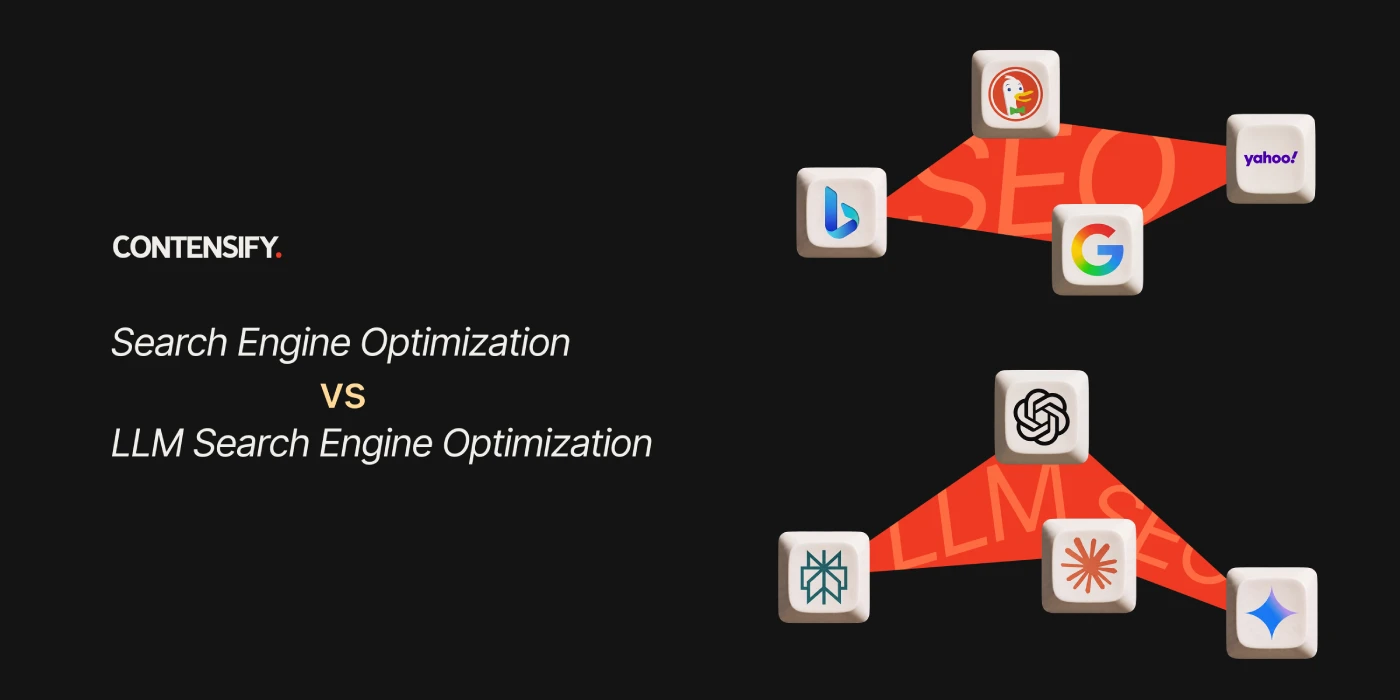
SEO vs LLM SEO: Quick Comparison
If you want the short version, here’s how traditional SEO and LLM SEO differ across the areas that matter most:
| Factor | SEO | LLM SEO |
| Primary Goal | Increase visibility and rankings in traditional search results | Increase visibility and representation in LLM-generated responses |
| Primary Platforms | Google, Bing, and other search engines | ChatGPT, Gemini, Claude, Perplexity, and other LLM-powered experiences |
| User Behavior | Users search, scan results, and click through to websites | Users ask conversational questions and expect synthesized answers |
| Primary Focus | Rankings, organic traffic, and search intent | Mentions, recommendations, citations, and brand representation |
| Content Focus | Content optimized around topics, keywords, and search intent | Clear, authoritative information that LLMs can understand, contextualize, and reference |
| Research | Keywords, search volume, SERPs, and search intent | Prompts, questions, entities, conversations, and LLM responses |
| Authority Signals | Backlinks, topical authority, content quality, and brand signals | Brand mentions, third-party sources, citations, topical authority, and entity associations |
| Technical Foundation | Crawlability, indexability, site architecture, speed, structured data | Strong technical SEO plus accessible, well-structured, and clearly contextualized information |
| Visibility | Search rankings and SERP features | Brand mentions, recommendations, and citations in LLM responses |
| Key Metrics | Rankings, impressions, CTR, organic traffic, conversions | LLM mentions, citations, prompt coverage, share of responses, AI referral traffic, conversions |
| Conversion Path | Search → website → conversion | LLM response → brand discovery/citation → website or product → conversion |
| Relationship | Core foundation for organic search visibility | Extends search visibility into LLM-driven discovery |
SEO helps your brand get found when people search. LLM SEO helps your brand get surfaced when people ask AI. For B2B SaaS, the two increasingly need to work together.
Want to explore how SEO or LLM SEO can help your business grow?
We help you understand the nuances and the opportunities that search visibility brings. No hacks. No shortcuts.
Understanding SEO (Search Engine Optimization)
Let’s get a deeper understanding of what SEO really is and why it remains an important growth channel for B2B SaaS companies.
What Is SEO?
SEO (Search Engine Optimization) is the process of improving a website’s visibility, relevance, and authority in organic search results. It brings together technical optimization, keyword research, search intent, content, internal linking, authority building, and other signals to help search engines understand and surface the right pages for relevant searches.
For B2B SaaS, SEO goes beyond ranking blog posts. It can help your brand become discoverable across the entire buying journey – from searches around a problem or category to product comparisons, solution research, and high-intent commercial queries.
Why Is SEO Important?
- Captures existing demand: B2B buyers actively search for solutions, vendors, comparisons, and answers before making purchasing decisions. SEO puts your brand in front of that existing demand.
- Builds category authority: Consistent coverage of the problems, use cases, and topics around your category helps establish your SaaS as a credible source—not just another vendor trying to rank.
- Creates compounding acquisition: A strong SEO asset can continue attracting relevant visitors and leads long after it is published, allowing organic acquisition to compound over time.
- Supports the entire buying journey: SEO can reach prospects at multiple stages, from early problem research to vendor comparisons and product-specific searches.
- Reduces dependence on paid acquisition: While SEO requires ongoing investment, strong organic visibility can create a sustainable acquisition channel that doesn’t depend on paying for every visit.
Key Elements of SEO
A modern B2B SaaS SEO strategy doesn’t need dozens of disconnected tactics. The core elements are:
- Technical SEO: Make the website crawlable, indexable, fast, and easy for search engines to understand.
- Keyword Research & Search Intent: Identify what your buyers search for and understand the intent behind those searches.
- Content Strategy & Optimization: Build useful, authoritative content around the topics, problems, use cases, and commercial searches that matter to your business.
- Site Architecture & Internal Linking: Organize content logically and connect related pages so search engines can understand your topical coverage and users can navigate the site.
- Authority Building: Earn relevant backlinks, mentions, and other external signals that strengthen your site’s credibility.
- Measurement & Optimization: Track search visibility, traffic, conversions, and revenue impact to continuously improve the strategy.
SEO Roles and Responsibilities
Whether SEO is handled in-house, by a freelancer, consultant, or agency, these are the core responsibilities that need to be covered. One person or team may own multiple roles depending on the company’s size and SEO maturity.
| Role | Primary Responsibility |
| SEO Manager / Strategist | Owns the overall SEO strategy, roadmap, priorities, and performance. |
| Technical SEO Specialist | Handles crawling, indexing, site architecture, migrations, and technical optimization. |
| SEO Content Strategist | Turns search demand into topic clusters, content plans, briefs, and editorial priorities. |
| SEO Content Writer | Creates useful, search-focused content aligned with audience needs and search intent. |
| On-Page SEO Specialist | Optimizes titles, headings, content, URLs, internal links, and other page-level elements. |
| Link Building / Digital PR Specialist | Builds relevant backlinks, mentions, and authority through legitimate outreach and PR. |
| SEO Analyst | Measures performance, identifies opportunities, and turns search data into actionable insights. |
| SEO Developer / Engineer | Implements technical SEO recommendations that require development resources. |
But as we always say, the important thing isn’t how many people you have. It’s whether these responsibilities are actually covered without overlaps.
SEO KPIs to Measure
SEO performance should be measured against business outcomes, not rankings alone. For B2B SaaS, the most useful KPIs show whether SEO is increasing visibility, attracting the right audience, and contributing to pipeline and revenue.
| KPI | What It Measures |
| Organic Traffic | The volume of visitors coming from organic search. |
| Rankings | How well target pages perform for relevant search queries. |
| Impressions | How often your pages appear in search results. |
| CTR | How effectively search visibility turns into website visits. |
| Indexed Pages | Whether important pages are being discovered and indexed by search engines. |
| Backlinks | The number and quality of external links supporting your site’s authority. |
| Referring Domains | The number of unique websites linking to your domain. |
| AI Visibility | How often your brand or content appears in AI-generated search experiences. |
| Organic Conversions | Leads, sign-ups, demos, or other business actions generated through organic search. |
For B2B SaaS, the strongest SEO measurement framework connects visibility → qualified traffic → conversions → pipeline, rather than treating rankings as the end goal. Don’t expect leads from day zero and if you’re being promised those, you’re being lied to.
Want to explore how SEO or LLM SEO can help your business grow?
We help you understand the nuances and the opportunities that search visibility brings. No hacks. No shortcuts.
Understanding LLM SEO (Large Language Model SEO)
We know how confusing all those social posts about LLM SEO can be. Between ChatGPT optimization, AI search, GEO, LLM visibility, and a dozen new acronyms, it can be hard to understand what actually matters. So let’s make LLM SEO a little clearer.
What Is LLM SEO?
LLM SEO is the practice of improving how your brand, products, expertise, and content are understood, retrieved, and represented by large language models (LLMs) such as ChatGPT, Gemini, Claude, and Perplexity.
Unlike traditional SEO, where the goal is largely to help pages rank and earn clicks from search results, LLM SEO focuses on increasing the likelihood that your brand is mentioned, recommended, referenced, or cited when buyers ask AI questions relevant to your business.
For B2B SaaS companies, this means optimizing beyond individual keywords. It involves building strong topical authority, clear brand and product associations, authoritative content, consistent information across the web, and credible third-party references that help LLMs understand what your company does and when it is relevant.
Why Is LLM SEO Important?
- AI Is Becoming Part of the B2B Buying Journey: Buyers increasingly use AI tools to research problems, evaluate solutions, compare vendors, and narrow down their options before visiting a company’s website.
- It Creates a New Layer of Brand Discovery: A prospect may never search your brand name but can still discover your company when an LLM recommends solutions for a specific problem, category, or use case.
- Being Mentioned Can Influence Consideration: When an LLM includes your product in a shortlist or recommendation, it can introduce your brand at a critical point in the buyer’s research process.
- It Strengthens Your Overall Search Visibility: The work involved in LLM SEO – building topical authority, creating authoritative content, strengthening entities, and earning credible mentions, can also support traditional SEO.
- B2B SaaS Has a Strong Opportunity to Benefit: SaaS buying journeys involve complex questions, comparisons, use cases, and vendor evaluation. These are exactly the types of research journeys where AI-generated answers can influence which brands buyers consider.
Key Elements of LLM SEO
LLM SEO is broader than optimizing individual pages. The most important elements are:
- Prompt & Query Research: Identify the questions, comparisons, use cases, and recommendations buyers ask LLMs.
- Content Quality & Context: Create clear, authoritative content that gives LLMs enough context to understand your expertise and relevance.
- Entity Optimization: Build clear associations between your brand, products, category, expertise, and the problems you solve.
- Topical Authority: Build comprehensive coverage around the topics and questions your target buyers care about.
- Third-Party Mentions & Citations: Strengthen your brand’s credibility through relevant mentions, references, reviews, directories, publications, and other authoritative sources.
- Brand Consistency: Ensure your company, products, positioning, and key facts are represented consistently across your website and the wider web.
- AI Visibility Monitoring: Track where and how your brand appears across relevant LLM prompts and identify gaps in visibility and representation.
LLM SEO Roles and Responsibilities
LLM SEO is not necessarily a completely separate function from SEO. Depending on the size of the company, several of these responsibilities may sit with the same person or team.
| Role | Key Responsibilities |
| LLM SEO / GEO Strategist | Develops the LLM visibility strategy, identifies opportunities, prioritizes prompts, and defines the roadmap. |
| SEO Strategist | Connects LLM SEO with traditional search strategy, topical authority, site architecture, and organic visibility. |
| Content Strategist | Maps buyer questions, topics, entities, and content gaps to create authoritative content coverage. |
| Content Writer | Creates clear, useful, evidence-backed content designed to answer buyer questions and establish expertise. |
| Digital PR / Link Building Specialist | Builds relevant third-party mentions, citations, backlinks, and external authority signals. |
| Product Marketing | Strengthens product positioning, category associations, use cases, differentiators, and messaging. |
| Brand / Communications | Ensures consistent brand information and positioning across owned and external channels. |
| LLM SEO Analyst | Tracks AI visibility, mentions, citations, prompt coverage, competitors, and changes in performance. |
| Technical SEO / Developer | Ensures content is accessible, crawlable, well-structured, and supported by a strong technical foundation. |
LLM SEO KPIs
LLM SEO needs to be measured by how effectively your brand appears and is represented across AI-generated answers, not just by the number of mentions.
| KPI | What It Measures |
| AI Visibility | How frequently your brand appears across relevant LLM-generated responses. |
| AI Mentions | How often your brand, product, or company is mentioned in relevant answers. |
| AI Citations | How frequently your website or other brand-owned sources are referenced or cited by AI systems. |
| Prompt Coverage | The percentage of relevant prompts where your brand appears or is represented. |
| Share of AI Answers | Your brand’s visibility compared with competitors across relevant AI responses. |
| Competitive Visibility | How your brand’s LLM presence compares with competing companies and products. |
| Citation Share | The proportion of relevant AI citations attributed to your brand or its content. |
| AI Referral Traffic | Website traffic generated from AI platforms and AI-powered search experiences. |
| AI-Assisted Conversions | Leads, sign-ups, demos, or other conversions influenced by AI-driven discovery. |
For B2B SaaS, the goal isn’t simply to get mentioned by AI. The stronger objective is to be consistently surfaced in the right conversations, associated with the right category and use cases, and represented accurately when buyers are evaluating solutions.
So please don’t be fooled by an overall AI visibility score in a report. Look into the details.
How SEO and LLM SEO Work Together
SEO and LLM SEO are not two completely separate strategies. They focus on different discovery environments, but many of the same foundations – high-quality content, topical authority, strong technical infrastructure, and credible external signals, support both.
| SEO | LLM SEO |
| Helps search engines discover, understand, and rank your content | Helps LLMs understand, retrieve, and represent your brand and expertise |
| Focuses on keywords and search intent | Focuses on prompts, questions, entities, and conversational intent |
| Optimizes for rankings and organic traffic | Optimizes for mentions, recommendations, citations, and AI visibility |
| Builds topical authority through comprehensive content and internal linking | Builds authority through content, entities, third-party mentions, and corroboration |
| Optimizes pages for search engines and users | Makes information clear and contextual enough for LLMs to interpret and synthesize |
| Measures rankings, traffic, CTR, and organic conversions | Measures AI visibility, mentions, citations, prompt coverage, and AI-assisted conversions |
A technically sound website, authoritative content, strong topical coverage, clear brand positioning, and credible external mentions can contribute to both SEO and LLM SEO.
The difference is how that information gets ultimately surfaced.
SEO can help your SaaS company appear when someone searches Google for “best customer feedback software.” LLM SEO helps increase the likelihood that your company is considered when a buyer asks an AI platform “What are the best customer feedback tools for a B2B SaaS company?”
That is why we say that treating LLM SEO as a replacement for SEO misses the bigger opportunity. SEO builds the foundation; LLM SEO extends your visibility into a different discovery environment.
Want to explore how SEO or LLM SEO can help your business grow?
We help you understand the nuances and the opportunities that search visibility brings. No hacks. No shortcuts.
SEO vs LLM SEO: Search Behavior and User Intent
SEO focuses on how people use traditional search engines to find information, products, and solutions. It targets keywords and search intent across queries such as informational searches, problem-based searches, comparisons, and high-intent searches, with the goal of matching a user’s query to the most relevant page.
LLM SEO focuses on how people use AI platforms to ask questions and explore solutions through conversational prompts. Instead of isolated keywords, it considers longer, contextual questions, follow-up queries, comparisons, recommendations, and problem-solving conversations that help determine when a brand or product is surfaced.
SEO vs LLM SEO: Content Strategy
SEO content strategy is built around search demand, keywords, search intent, and topic coverage. For B2B SaaS, this can include blog posts, comparison pages, product-led content, landing pages, and pillar content designed to comprehensively cover topics and build topical authority.
LLM SEO content strategy focuses on creating clear, authoritative, and context-rich information that LLMs can understand and use when generating answers. Content needs to clearly establish expertise, explain concepts and entities, address relevant questions, and provide enough depth and context for the information to be accurately represented or referenced.
Want to explore how SEO or LLM SEO can help your business grow?
We help you understand the nuances and the opportunities that search visibility brings. No hacks. No shortcuts.
SEO vs LLM SEO: How Visibility Is Earned
SEO visibility is earned through relevance, technical accessibility, content quality, search intent, and authority. Search engines evaluate factors such as how well a page satisfies the query, the quality and depth of its content, the site’s technical health, internal structure, and external authority to determine where it should appear in search results.
LLM visibility is earned through a combination of relevance, content quality, contextual understanding, entity associations, topical authority, and credible information available across the web. Rather than achieving a fixed ranking, a brand needs to become a relevant and trustworthy source that an LLM can draw on when generating answers, recommendations, or comparisons.
SEO vs LLM SEO: Authority, Trust, and Citations
SEO authority is built through strong content, topical depth, relevant backlinks, reputable referring domains, and other signals that demonstrate a website’s credibility and expertise. The goal is to establish enough authority for search engines to trust the site as a relevant source for its target topics.
LLM authority is strengthened when a brand is consistently supported by credible information across its website and the wider web. Third-party mentions, authoritative publications, citations, reviews, expert contributions, and consistent brand information can help reinforce what a company is known for and its association with specific topics, categories, and use cases.
SEO vs LLM SEO: Technical Requirements
SEO has well-established technical requirements that help search engines crawl, understand, index, and rank a website. These include crawlability, indexation, site architecture, page speed, Core Web Vitals, canonicalization, redirects, XML sitemaps, internal linking, and structured data.
LLM SEO still depends on a strong technical SEO foundation because LLMs need accessible, understandable information to work with. Beyond that foundation, the focus shifts toward clear content structure, well-defined entities, accessible information, consistent brand data, and making important information easy to interpret and connect across the web.
SEO vs LLM SEO: Measurement and Reporting
SEO reporting typically measures rankings, impressions, click-through rates, organic traffic, indexed pages, backlinks, referring domains, and organic conversions. For B2B SaaS, these metrics should ultimately connect search visibility with qualified leads, pipeline, and revenue.
LLM SEO reporting focuses on AI visibility and how a brand is represented across relevant prompts and AI-generated responses. Key metrics include AI mentions, citations, prompt coverage, share of AI answers, competitive visibility, AI referral traffic, and AI-assisted conversions. The quality and context of the representation also matter; not just whether the brand appears.
Want to explore how SEO or LLM SEO can help your business grow?
We help you understand the nuances and the opportunities that search visibility brings. No hacks. No shortcuts.
SEO vs LLM SEO: Which One Should You Invest In?
The right investment depends on where your buyers are discovering solutions and what type of visibility you want to build.
- If You Want Traditional Search Visibility: Prioritize SEO. Focus on technical SEO, keyword targeting, content, topical authority, and backlinks to improve rankings and organic traffic.
- If You Want LLM Visibility: Prioritize LLM SEO. Focus on authoritative content, entities, topical coverage, third-party mentions, and relevant AI prompts to increase your chances of being surfaced in LLM-generated answers.
- If You Want Both: Build an integrated search visibility strategy. Combine SEO and LLM SEO so your brand can capture demand across traditional search engines and AI-driven discovery.
How to Build an Integrated SEO + LLM SEO Strategy
SEO and LLM SEO work best when they are built into the same search visibility strategy rather than treated as two separate channels. Here’s a practical step-by-step approach for B2B SaaS:
1. Start With Your Positioning
Before optimizing for search or LLMs, clarify what your company stands for, who it serves, what category it belongs to, what problems it solves, and what differentiates it. Strong positioning gives both search engines and LLMs clearer context about your brand.
2. Research Your Competitors
Analyze competitors across both traditional search and LLMs. Identify which companies dominate relevant search results and AI responses, what topics and queries they are visible for, how they are positioned, and where there are gaps you can own.
3. Map Search Demand and AI Prompts
Research the keywords your buyers search for alongside the questions, comparisons, use cases, and recommendations they ask AI platforms. This creates a broader view of how your audience discovers and evaluates solutions.
4. Build Your Topic and Entity Strategy
Turn your research into topic clusters and content priorities while defining the entities your brand should be associated with. This helps build topical authority while creating stronger connections between your company, products, category, expertise, and use cases.
5. Create Content for Search and AI
Develop content that satisfies search intent while being clear and useful for AI-driven discovery. Focus on authoritative, original content that directly answers important questions, provides context, demonstrates expertise, and covers topics comprehensively.
6. Build External Authority
Strengthen your visibility beyond your own website through relevant backlinks, digital PR, expert contributions, third-party mentions, reviews, and other credible sources. External validation can strengthen both traditional search authority and how your brand is understood across the wider web.
7. Strengthen the Technical Foundation
Make sure your website is technically accessible and easy to understand. Address crawlability, indexation, site architecture, internal linking, structured data, page performance, and content accessibility so important information can be discovered and interpreted effectively.
8. Measure, Learn, and Iterate
Track traditional SEO metrics alongside LLM visibility metrics. Monitor rankings, organic traffic, conversions, AI mentions, citations, prompt coverage, competitive visibility, and AI-assisted conversions to identify what’s working and where your search visibility still has gaps.
Want to explore how SEO or LLM SEO can help your business grow?
We help you understand the nuances and the opportunities that search visibility brings. No hacks. No shortcuts.
Common SEO and LLM SEO Mistakes
We frequently run search visibility audits for companies. Here are some of the most common mistakes we see:
- Treating LLM SEO as a Replacement for SEO: LLM visibility still benefits from strong technical foundations, authoritative content, and a credible information footprint, so abandoning traditional SEO is counterproductive.
- Optimizing for Keywords but Ignoring Context: Focusing only on individual keywords can miss the broader topics, entities, questions, and relationships that help both search engines and LLMs understand your expertise.
- Creating Content Just to Increase Visibility: Publishing more content doesn’t automatically improve search or LLM visibility. B2B SaaS companies need useful, original, authoritative content that adds something beyond what already exists.
- Ignoring Brand Positioning: If your category, product, audience, and differentiation are unclear, neither search engines nor LLMs have a strong contextual understanding of where your brand fits.
- Optimizing for Prompts Instead of Building Authority: Chasing hundreds of individual AI prompts can become an endless exercise. Strong topical authority and a consistent information footprint create broader visibility across related questions.
- Ignoring Third-Party Visibility: Focusing exclusively on your own website misses an important part of how authority is established. Relevant publications, reviews, expert mentions, backlinks, and other credible sources can reinforce your brand’s presence.
- Measuring Mentions Instead of Meaningful Visibility: Getting mentioned in an AI response isn’t necessarily a win. Track whether you’re appearing for the right prompts, being represented accurately, appearing alongside the right categories or use cases, and ultimately influencing qualified discovery and conversions.
Conclusion
SEO and LLM SEO aren’t competing strategies. They address different ways buyers discover information, but both contribute to the same broader goal: building search visibility for your brand.
SEO helps your B2B SaaS company get discovered through traditional search by building rankings, organic traffic, and authority around the topics your buyers care about. LLM SEO extends that visibility into AI-driven discovery, where buyers increasingly ask questions, compare solutions, and look for recommendations through conversational platforms.
The strongest approach isn’t choosing one over the other. It’s building a connected strategy that combines technical SEO, topical authority, high-quality content, brand positioning, and external credibility with an understanding of how your audience searches and interacts with LLMs.
Want to know more about SEO or LLM SEO and how it can help your business grow? Validate if search visibility is good with this sprint.
Want to explore how SEO or LLM SEO can help your business grow?
We help you understand the nuances and the opportunities that search visibility brings. No hacks. No shortcuts.
Frequently Asked Questions
No. LLM SEO extends search visibility into AI platforms, while traditional SEO remains essential for rankings, organic traffic, technical foundations, and building topical authority.
They overlap significantly, but aren’t identical. GEO is broader and focuses on generative search experiences, while LLM SEO focuses specifically on visibility across large language models.
SEO focuses on visibility in traditional search results, while LLM SEO focuses on being mentioned, recommended, represented, or cited within AI-generated responses.
Yes. Strong technical SEO, authoritative content, topical depth, internal linking, and credible backlinks provide important foundations that can support visibility across LLM-driven discovery.
Yes. Ranking well on Google doesn’t guarantee LLM visibility. AI platforms consider broader signals, including context, entities, authority, citations, and information available across the web.
Not necessarily. Strong SEO content can support LLM visibility, but LLM SEO places greater emphasis on clear answers, context, entities, authority, and factual information.
Measure AI visibility through metrics such as mentions, citations, prompt coverage, share of AI answers, competitive visibility, AI referral traffic, and AI-assisted conversions.
Most B2B SaaS companies should invest in both. SEO captures traditional search demand, while LLM SEO helps brands remain visible as buyers increasingly use AI for research and evaluation.
No. LLM SEO applies across AI platforms including ChatGPT, Gemini, Claude, Perplexity, and other LLM-powered discovery experiences where buyers research products and solutions.
There is no fixed timeline. Results depend on authority, content quality, brand presence, competition, and existing visibility, so meaningful improvements typically require consistent optimization and measurement.
Want to explore how SEO or LLM SEO can help your business grow?
We help you understand the nuances and the opportunities that search visibility brings. No hacks. No shortcuts.