After more than a decade of working with SaaS companies and startups, we’ve answered our fair share of questions about how to build sustainable organic growth. The latest one we’re hearing more often is: “Do we need SEO or GEO?”
If you’ve spoken to us before, you probably already know our answer: it’s not really an either-or decision. SEO and GEO serve different parts of the search journey, but they increasingly need to work together. This guide breaks down what each one does, where they differ, and how to decide where your business should invest.
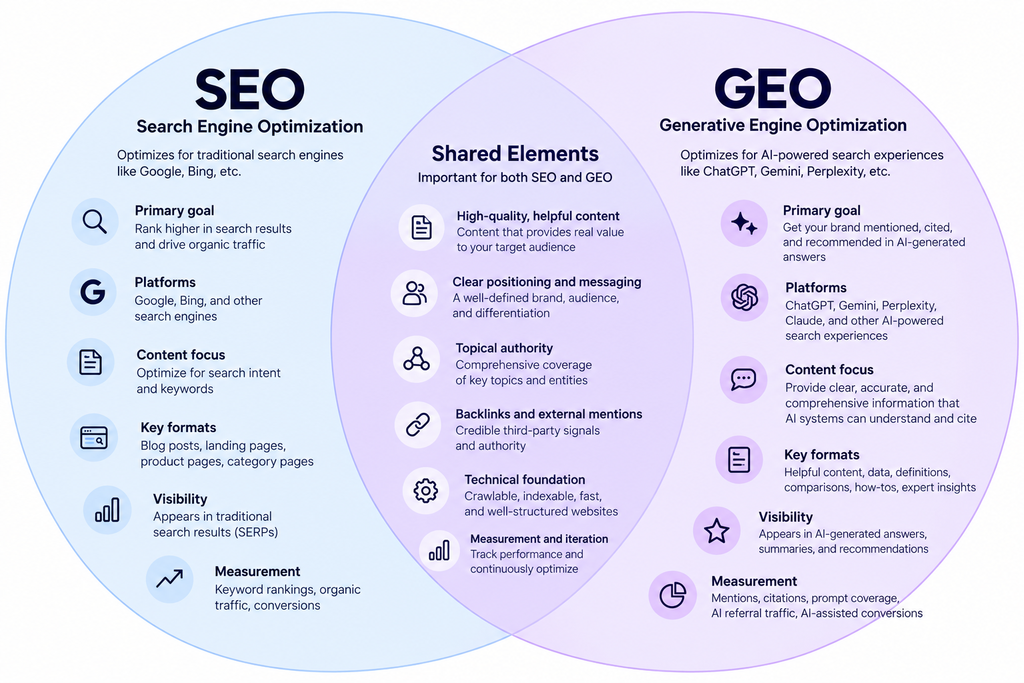
SEO vs GEO: Quick Comparison
If you’re looking for the short version, here’s how SEO and GEO differ across the areas that matter most:
| Factor | SEO | GEO |
| Primary Goal | Increase visibility in traditional search results | Increase visibility in AI-generated answers |
| Search Platforms | Google, Bing, YouTube, and other search engines | ChatGPT, Google AI Overviews, Gemini, Perplexity, Claude, and other AI search experiences |
| Primary Focus | Rankings, organic traffic, and search visibility | Mentions, citations, and inclusion in AI-generated responses |
| How Visibility Is Earned | Relevance, technical accessibility, content quality, authority, links, and search intent | Strong information, authority, entity recognition, citations, content structure, and relevance to AI-generated answers |
| User Experience | User searches → compares results → clicks a page | User asks a question → AI synthesizes information → user may explore cited sources |
| Content Strategy | Create content that satisfies search intent and earns rankings | Create clear, authoritative, easily understood information that AI systems can retrieve, understand, and cite |
| Keyword Research | Core part of strategy | Still useful, but prompts, questions, entities, and conversational queries become more important |
| Authority Signals | Backlinks, topical authority, brand signals, content quality | Brand authority, third-party mentions, citations, topical relevance, and corroborated information |
| Technical SEO | Critical | Still important because AI systems often rely on crawlable, accessible web content |
| Key Metrics | Rankings, organic traffic, impressions, CTR, conversions | AI mentions, citations, share of AI answers, prompts covered, referral traffic, and assisted conversions |
| Conversion Path | Search → click → website → conversion | AI answer → citation/brand discovery → website/product → conversion |
| Time Horizon | Long-term compounding acquisition channel | Long-term visibility and brand discovery channel |
| Relationship Between the Two | Foundation for broader search visibility | Builds on many of the same foundations while optimizing for AI-mediated discovery |
The simplest way to think about it: SEO helps you get found in search results; GEO helps your brand get surfaced in AI-generated answers. For B2B SaaS, we just say one thing – the strongest strategy increasingly addresses both.
Is your brand visible where your buyers are searching?
See how SEO and GEO can strengthen your search visibility.
Understanding SEO (Search Engine Optimization)
Before you make a decision on how effective a tactic is, let’s understand search engine optimization in detail.
What Is SEO?
SEO (Search Engine Optimization) is the process of improving a website and its content so search engines can understand, rank, and surface it for relevant searches. It combines technical optimization, content, search intent, internal linking, authority building, and user experience to improve organic visibility.
For B2B SaaS companies, SEO is ultimately about being discoverable when potential customers are actively searching for problems, solutions, products, and information related to what you sell.
Why Is SEO Important?
- Captures existing demand: SEO puts your business in front of people already searching for solutions, information, or products relevant to your category.
- Compounds over time: Unlike paid campaigns that stop generating traffic when spending stops, strong organic visibility can continue delivering traffic and leads as your content and authority grow.
- Builds sustainable acquisition: A well-developed SEO program can become a consistent acquisition channel rather than relying entirely on paid or outbound campaigns.
- Reaches high-intent audiences: Searches such as product comparisons, solution queries, and problem-specific searches often indicate stronger purchase intent than passive audience channels.
- Builds authority: Consistently producing useful, authoritative content around your category helps establish your brand as a credible source.
- Supports the entire buyer journey: SEO can capture users researching a problem, evaluating solutions, comparing vendors, and looking for specific products or features.
- Extends into AI search: The content, authority, entities, and technical foundations built through SEO can also contribute to visibility across newer AI-powered search experiences.
Key Elements of SEO
As we always say, a good SEO strategy typically brings together several disciplines that work together to improve search visibility:
- Technical SEO: Ensures search engines can crawl, understand, index, and efficiently access your website.
- Keyword Research: Identifies the searches, topics, and language your potential customers use when looking for information or solutions.
- Search Intent: Determines what users actually want from a search so the page addresses the right need rather than simply targeting a keyword.
- On-Page SEO: Optimizes elements such as titles, headings, content, URLs, images, and other page-level signals.
- Internal Linking: Connects related pages to help users and search engines discover important content and understand relationships between topics.
- Content Optimization: Improves existing and new content to make it more useful, comprehensive, relevant, and aligned with search intent.
- Link Building: Earns relevant, authoritative links and mentions that strengthen a site’s credibility and authority.
- Structured Data: Uses schema markup to help search engines understand entities, content types, products, organizations, and other information on a page.
- Local SEO: Improves visibility for location-based searches where geographic relevance matters.
- AI SEO: Optimizes content and website signals for visibility across AI-powered search and discovery experiences.
- GEO: Focuses specifically on increasing the likelihood that a brand, product, or content is surfaced and cited in generative AI answers.
- AEO: Optimizes content to provide clear, direct answers that can be surfaced in answer-focused search experiences.
SEO Roles and Responsibilities
Whether SEO is handled by an in-house team, freelancer, consultant, or an agency like Contensify, these are the core roles and responsibilities typically required to run a comprehensive search visibility program.
| Role | Primary Responsibility |
| SEO Manager / Strategist | Owns the overall SEO strategy, priorities, roadmap, and performance |
| Technical SEO Specialist | Handles crawling, indexing, site architecture, technical issues, migrations, and technical optimization |
| SEO Content Strategist | Translates search demand into content strategies, topic clusters, content briefs, and editorial priorities |
| SEO Content Writer | Creates search-focused content that satisfies intent while remaining useful and readable for the target audience |
| On-Page SEO Specialist | Optimizes page-level elements including titles, headings, internal links, content, URLs, and structured data |
| Link Building / Digital PR Specialist | Builds relevant backlinks, mentions, and authority through outreach, PR, partnerships, and other legitimate methods |
| SEO Analyst | Tracks performance, identifies trends and opportunities, and turns search data into actionable insights |
| SEO Developer / Engineer | Implements technical SEO recommendations that require development resources |
| UX / CRO Specialist | Improves the experience and conversion paths for organic visitors |
| AI SEO / GEO Specialist | Develops strategies to improve visibility across AI search, generative engines, and answer-focused experiences |
The exact team structure tends to vary by company, but the responsibilities don’t disappear just because you have one SEO generalist or outsource SEO to an agency. The question is who owns each function and whether they have the expertise and resources to execute it well.
SEO KPIs to Measure
SEO performance should be measured against visibility, traffic, engagement, and business outcomes, rather than rankings alone.
| KPI | Why It Matters |
| Organic Traffic | Shows how much traffic the website is generating from search engines. |
| Rankings | Indicates how prominently key pages appear for relevant searches. |
| Impressions | Shows how often your pages are appearing in search results, even when users don’t click. |
| CTR | Measures how effectively search visibility turns into website visits. |
| Indexed Pages | Helps determine whether important pages are being discovered and included in search indexes. |
| Backlinks | Indicates how many external websites are linking to your content and contributing to authority. |
| Referring Domains | Shows the breadth of websites linking to your domain, rather than simply counting individual links. |
| AI Visibility | Tracks how often your brand or content appears across AI-powered search experiences. |
| Organic Conversions | Connects SEO performance to signups, leads, opportunities, purchases, or other business outcomes. |
For B2B SaaS, the most important SEO KPI is ultimately not traffic. It’s whether organic visibility is contributing to qualified pipeline and revenue. See how ZenAdmin worked on their organic pipeline with us.
Is your brand visible where your buyers are searching?
See how SEO and GEO can strengthen your search visibility.
Understanding GEO (Generative Engine Optimization)
Now let’s get an understanding of generative engine optimization in detail.
What Is GEO?
GEO (Generative Engine Optimization) is the process of improving a brand’s visibility and representation in AI-generated answers across platforms such as ChatGPT, Google AI Overviews, Gemini, and Perplexity. Instead of optimizing primarily for a position in a traditional search results page, GEO focuses on increasing the likelihood that your brand, products, expertise, or content are mentioned and cited when an AI system answers a relevant question.
For B2B SaaS companies, this means optimizing for the questions potential customers are asking AI systems throughout the buying journey – from understanding a problem and exploring solutions to comparing vendors and choosing a product.
Why Is GEO Important?
- AI is becoming part of the discovery journey: Buyers are increasingly using AI tools to research problems, evaluate solutions, and compare vendors before visiting a company’s website.
- Visibility is shifting from rankings to recommendations: A company can rank well in traditional search but still be absent when an AI system generates a recommendation or comparison.
- AI can influence consideration before the click: An AI-generated answer may summarize your category, explain your product, or recommend competitors before a buyer ever reaches a website.
- It creates a new layer of brand visibility: Being mentioned or cited in relevant AI answers can put your brand in front of prospects even when they don’t encounter you through a traditional search result.
- B2B SaaS buying journeys are particularly research-heavy: Prospects often ask AI systems broad, specific, and comparative questions before speaking to sales, making AI visibility increasingly relevant for SaaS brands.
- It complements SEO rather than replacing it: GEO builds on many of the same foundations as SEO – useful content, technical accessibility, authority, relevance, and strong brand signals, while optimizing for a different search experience.
Key Elements of GEO
GEO focuses on making your brand and content easier for generative AI systems to understand, retrieve, trust, and cite. Key elements include:
- Prompt and Query Research: Identify the questions and prompts your target audience is asking AI systems, including informational, commercial, comparison, and product-specific queries.
- Entity Optimization: Build clear associations between your brand, products, people, categories, and the problems you solve.
- Content Quality: Create accurate, comprehensive content that directly addresses the questions users are asking.
- Information Structure: Organize content with clear headings, definitions, concise answers, supporting evidence, and easily extractable information.
- Topical Authority: Build depth across the topics and entities relevant to your category rather than publishing isolated pieces of content.
- Third-Party Mentions: Build credible mentions across relevant websites, publications, communities, and other sources that AI systems may use to understand your brand.
- Citations and References: Strengthen claims with authoritative sources and make important information easy to verify.
- Brand Consistency: Maintain consistent information about your company, products, positioning, and expertise across your website and external sources.
- Content Distribution: Make useful information available across the platforms and sources where your audience and AI systems may discover it.
- AI Visibility Monitoring: Track which prompts produce mentions of your brand, competitors, products, and category and identify where visibility gaps exist.
GEO Roles and Responsibilities
GEO is still an emerging discipline, so companies may not have a dedicated GEO team. We’ve found that the responsibilities can sit across SEO, content, brand, PR, product marketing, and analytics teams.
| Role | Primary Responsibility |
| GEO Strategist | Develops the GEO strategy, identifies visibility opportunities, and prioritizes prompts, topics, and entities. |
| SEO Strategist | Connects GEO with technical SEO, search intent, content architecture, internal linking, and broader organic visibility. |
| Content Strategist | Develops content designed to answer relevant questions clearly and build topical authority. |
| Content Writer | Creates accurate, structured, authoritative content that AI systems can understand and reference. |
| Digital PR / Link Building Specialist | Builds relevant third-party mentions, citations, and authority signals across external sources. |
| Product Marketing | Ensures product positioning, use cases, differentiation, and category associations are clear and consistent. |
| Brand / Communications | Builds consistent brand signals and manages how the company is represented across external channels. |
| GEO Analyst | Tracks prompts, AI mentions, citations, competitors, visibility trends, and the impact on organic discovery and conversions. |
| Technical SEO / Developer | Ensures important content is crawlable, accessible, structured, and technically discoverable. |
Just like SEO, GEO doesn’t necessarily require nine different people. A single specialist, internal team, freelancer, or agency can own multiple responsibilities. What matters is that the core functions are covered.
GEO KPIs to Measure
GEO performance is less about traditional rankings and more about whether your brand is being discovered, mentioned, cited, and recommended across AI search experiences.
| KPI | Why It Matters |
| AI Visibility | Measures how often your brand appears across relevant AI-generated answers and prompts. |
| AI Mentions | Tracks how frequently your brand, product, or company is mentioned in AI responses. |
| AI Citations | Measures how often your website or content is cited as a source in AI-generated answers. |
| Prompt Coverage | Shows how many relevant prompts your brand appears for across your target topics and use cases. |
| Share of AI Answers | Compares your visibility against competitors across the prompts that matter to your business. |
| Competitive Visibility | Tracks how often competitors are mentioned or cited when your brand is absent. |
| Citation Share | Measures your share of citations across a defined set of relevant prompts or topics. |
| AI Referral Traffic | Shows how much website traffic is coming from AI platforms where referral data is available. |
| AI-Assisted Conversions | Connects AI-driven discovery to signups, leads, opportunities, or other conversions. |
For B2B SaaS, the goal isn’t simply to appear in more AI answers. It’s to show up for the right prompts, in the right context, alongside information that supports consideration and conversion.
How SEO and GEO Work Together
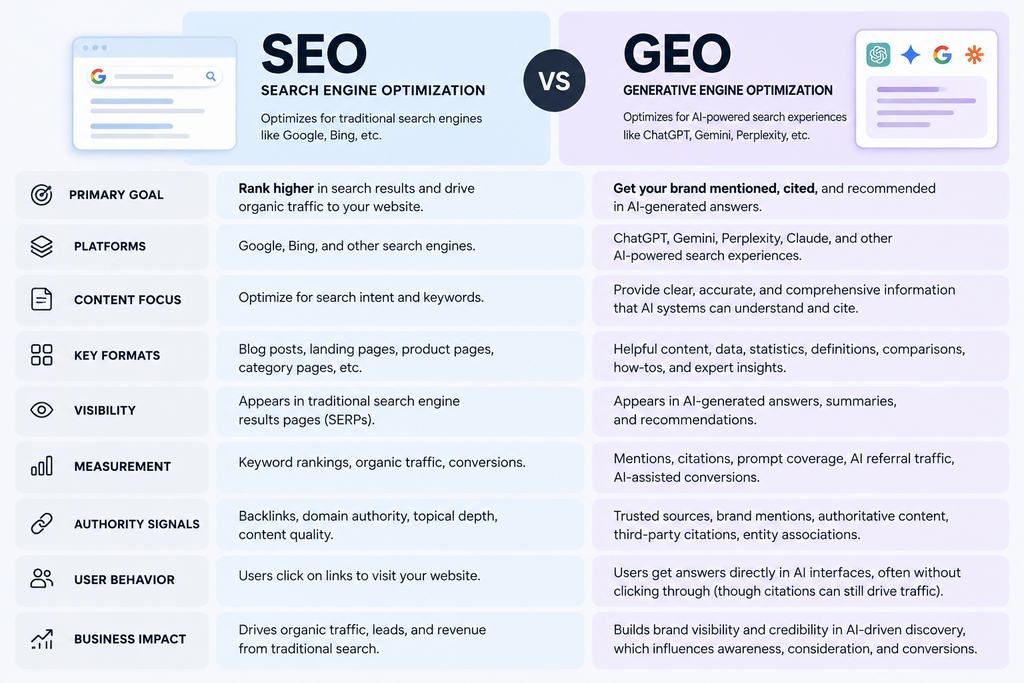
We’ve always told companies that SEO and GEO are not separate growth channels that require completely different strategies. They overlap across content, authority, technical foundations, search intent, and brand visibility. The main difference is where that visibility ultimately appears.
Let us put things into perspective:
| SEO | GEO |
| Helps search engines discover and rank your content | Helps AI systems understand and surface your brand and content |
| Targets keywords and search intent | Targets prompts, questions, entities, and conversational intent |
| Drives visibility in traditional search results | Drives visibility in AI-generated answers |
| Builds topical authority through content and internal linking | Builds authority through content, entities, citations, and third-party signals |
| Optimizes pages for search engine discovery | Optimizes information for AI retrieval and synthesis |
| Measures rankings, traffic, CTR, and conversions | Measures mentions, citations, prompt coverage, AI visibility, and conversions |
The important part is that the foundations overlap heavily. Useful content, strong technical SEO, clear site architecture, topical authority, credible external mentions, and consistent brand information can support both traditional and AI search visibility.
For B2B SaaS companies, the strongest approach is therefore not SEO vs. GEO. It is building an integrated search visibility strategy where SEO creates the foundation and GEO expands that visibility into AI-powered discovery.
Is your brand visible where your buyers are searching?
See how SEO and GEO can strengthen your search visibility.
SEO vs GEO: Search Behavior and User Intent
SEO focuses on the searches people actively make on traditional search engines. The goal is to understand the query, identify its intent, and create a page that best satisfies what the searcher is looking for. That could mean finding an answer, researching a problem, comparing solutions, or evaluating a product. SEO therefore works heavily around keywords, search intent, topics, and the journey from search result to website.
GEO focuses on the questions people ask AI systems and how those systems interpret and answer them. Users tend to ask longer, more conversational, multi-part questions and expect the AI to synthesize information rather than simply return a list of links. GEO therefore considers prompts, entities, context, comparisons, recommendations, and conversational intent, with the goal of making your brand relevant enough to be included in the generated answer.
SEO vs GEO: Content Strategy
SEO content strategy focuses on creating and optimizing content around search demand and intent. This means identifying the topics and keywords your audience searches for, building topical coverage, and creating pages that provide the best answer to those searches. Content is typically structured around formats such as blogs, landing pages, comparison pages, product pages, and pillar content, with the goal of earning rankings and driving qualified organic traffic.
GEO content strategy focuses on making information easy for AI systems to understand, retrieve, synthesize, and cite. Content needs to answer questions clearly, establish context, demonstrate expertise, and provide information that can be confidently used in an AI-generated response. This makes factors such as direct answers, entity clarity, factual depth, structured information, and third-party corroboration increasingly important.
Is your brand visible where your buyers are searching?
See how SEO and GEO can strengthen your search visibility.
SEO vs GEO: How Visibility Is Earned
SEO visibility is earned primarily through relevance, technical accessibility, content quality, authority, and alignment with search intent. Search engines evaluate these and many other signals to determine which pages should appear for a query. Strong SEO therefore requires more than publishing content; it requires making the site technically sound, building topical authority, earning relevant links, and consistently satisfying the intent behind important searches.
GEO visibility is earned by becoming a credible and relevant source that AI systems can understand and draw upon when generating answers. This can involve content quality, entity recognition, topical authority, brand mentions, citations, and corroboration across trusted sources. Unlike a traditional ranking, there isn’t simply a fixed position to win; the objective is to increase the likelihood that your brand or content is mentioned, recommended, or cited in the answers that matter to your audience.
SEO vs GEO: Authority, Trust, and Citations
SEO builds authority through signals that help search engines determine whether a website is a credible source for a topic. These include relevant backlinks, topical depth, high-quality content, brand signals, and consistent expertise across the site. The goal is to establish enough relevance and authority for search engines to confidently rank your pages for important queries.
GEO also depends on authority, but citations and third-party corroboration become especially important. AI systems can draw information from multiple sources when generating an answer, so being consistently mentioned, referenced, or cited across credible and relevant sources can strengthen how your brand is understood. The goal isn’t simply to accumulate backlinks, but to build a credible information footprint around your brand, products, expertise, and category.
See how Interakt built topical authority with us.
Is your brand visible where your buyers are searching?
See how SEO and GEO can strengthen your search visibility.
SEO vs GEO: Technical Requirements
SEO has a broader and more established technical requirement set because search engines need to crawl, render, index, and rank your website. This includes site architecture, crawlability, indexability, page speed, Core Web Vitals, canonicalization, structured data, XML sitemaps, redirects, internal linking, and other technical elements that affect search visibility.
GEO still relies heavily on these SEO foundations, but the emphasis shifts toward making information accessible and understandable to AI systems. Clear content structures, well-defined entities, accessible pages, structured information, consistent brand data, and crawlable content can all support AI discovery. GEO therefore isn’t a technical replacement for SEO; a technically inaccessible website is unlikely to become more visible simply because it has a GEO strategy.
SEO vs GEO: Measurement and Reporting
SEO measurement focuses on how effectively your website is gaining visibility, traffic, and conversions from traditional search. Core metrics include rankings, impressions, CTR, organic traffic, indexed pages, backlinks, referring domains, and organic conversions. For B2B SaaS, reporting should ultimately connect these metrics to qualified leads, pipeline, and revenue, rather than treating rankings or traffic as the end goal.
GEO measurement focuses on whether your brand is appearing in the AI answers that matter to your business. This includes tracking AI visibility, brand mentions, citations, prompt coverage, share of AI answers, competitive visibility, AI referral traffic, and AI-assisted conversions where measurable. Because AI search is less standardized than traditional search, GEO reporting should focus on visibility across a defined set of relevant prompts and how that visibility changes over time, rather than relying on a single ranking position.
SEO vs GEO: Which One Should You Invest in?
Here’s how we guide companies to make a decision on what they should invest in – SEO or GEO:
- If You Want Traditional Organic Traffic: Invest in SEO first. If your primary goal is rankings, organic traffic, and search-driven leads, SEO should be the foundation of your strategy.
- If You Want AI Search Visibility: Invest in GEO alongside your existing SEO. If buyers are increasingly researching your category, products, or competitors through AI platforms, GEO can help expand your visibility into those experiences.
- If You Want Both: Build an integrated SEO + GEO strategy. For most B2B SaaS companies, this is the strongest approach: use SEO to build search visibility and authority while optimizing that foundation for AI-driven discovery.
If you ask us, we would recommend building a search visibility strategy that takes care of it all. This ensures that when platforms expand or algorithms change, you don’t disappear from your target market’s searches.
Is your brand visible where your buyers are searching?
See how SEO and GEO can strengthen your search visibility.
How to Build an Integrated SEO + GEO Strategy
Here’s how we build a comprehensive search visibility strategy, addressing both SEO and GEO:
- Start with positioning: Before optimizing for search, clarify what the company stands for, who it serves, the category it owns, its differentiators, and the problems it solves. Strong positioning gives both SEO and GEO a clear context to reinforce.
- Research competitors: Analyze competitors across traditional search and AI search to understand who currently owns visibility, which topics and queries they dominate, how they are positioned, and where visibility gaps exist.
- Map search demand and AI prompts: Identify the keywords, questions, comparisons, use cases, and conversational prompts your target audience uses across Google and AI platforms.
- Build the topic and entity strategy: Turn that research into topic clusters, content priorities, entities, product associations, and areas where the brand needs to establish stronger authority.
- Create and optimize content: Develop content that satisfies search intent while making important information clear, structured, authoritative, and easy for AI systems to understand and reference.
- Build authority and external visibility: Strengthen the brand’s footprint through relevant backlinks, digital PR, third-party mentions, expert contributions, citations, and other credible external signals.
- Optimize the technical foundation: Ensure the site is crawlable, indexable, well-structured, fast, and accessible so search engines and AI systems can discover and understand the information.
- Measure, learn, and iterate: Track traditional SEO metrics alongside AI visibility, prompt coverage, mentions, citations, competitive visibility, and ultimately qualified leads and pipeline. Use those insights to continuously refine the strategy.
This is also why we don’t treat GEO as a separate add-on to SEO at Contensify. Positioning, competitive intelligence, search demand, content, authority, and measurement all need to work together if the goal is broader search visibility.
Common SEO and GEO Mistakes
We often audit SEO and GEO strategies of companies. Here are some of the most common mistakes we see them make:
- Optimizing before fixing positioning: If your category, audience, differentiation, and messaging aren’t clear, you can end up creating content that ranks or gets cited, without clearly communicating why someone should choose you.
- Treating AI visibility as a content volume problem: Publishing more articles won’t automatically increase GEO visibility. If the brand lacks authority, clear entity associations, or credible third-party signals, adding another 50 articles rarely fixes the problem.
- Optimizing for prompts instead of building topical authority: Tracking hundreds of prompts can become another vanity exercise if each one is treated independently. AI visibility improves when your brand has genuine depth and credibility across the broader topic.
- Ignoring what competitors are being cited for: Looking only at your own AI mentions misses half the picture. Competitor citations can reveal the sources, topics, claims, and positioning patterns that AI systems already trust and the gaps you need to close.
- Measuring visibility without measuring representation: Being mentioned isn’t necessarily a win. A brand can appear in an AI answer but be positioned incorrectly, mentioned alongside stronger competitors, or excluded from the actual recommendation. GEO measurement needs to consider how you’re represented, not just whether you’re mentioned.
Conclusion
SEO and GEO aren’t competing strategies. For B2B SaaS companies, the strongest approach is to build a search visibility engine that captures demand across both traditional and AI search.
If you’re not sure where your brand currently stands, reach out to Contensify or try our Validate Your Search Visibility offer to see where you’re visible, where you’re missing, and what to fix next.
Is your brand visible where your buyers are searching?
See how SEO and GEO can strengthen your search visibility.
Frequently Asked Questions
No. GEO is expanding search visibility into AI experiences, while SEO remains essential for traditional search and provides many foundations GEO relies on.
GEO overlaps heavily with SEO but has a distinct focus: increasing visibility within AI-generated answers, recommendations, and citations rather than traditional search results.
SEO optimizes for search engine visibility and organic traffic; GEO optimizes for visibility, mentions, and citations within AI-generated answers and search experiences.
Yes. Strong technical SEO, authoritative content, topical depth, internal linking, and relevant backlinks can all provide foundations for stronger AI search visibility.
Yes. Traditional rankings and AI visibility are measured differently, so strong Google rankings don’t guarantee that AI systems will mention or cite your brand.
Not necessarily. The strongest content can serve both, but GEO places greater emphasis on clear answers, entities, context, evidence, and information AI systems can easily understand.
Track AI visibility, mentions, citations, prompt coverage, competitive visibility, AI referral traffic, and AI-assisted conversions where reliable measurement is available.
Most should invest in both. SEO captures traditional search demand, while GEO expands visibility across AI-driven discovery and increasingly research-heavy SaaS buying journeys.