Writing without a clear plan often leads to scattered ideas, repeated points, and drafts that take longer to edit than they did to write. A content outline helps you organize your thoughts before you begin, keeping your writing focused, logical, and easy to follow.
Whether you’re writing for SEO, educating readers, or publishing thought leadership content, a strong outline improves both the writing process and the final result.
In this guide, you’ll learn what a content outline is, why it matters, and a simple, repeatable process to create outlines that rank well and provide a better reading experience.
What Is a Content Outline?
A content outline is a structured document that defines what an article should include before writing begins. It serves as a framework for the final piece, organizing ideas into a logical flow and ensuring every section supports the topic.
Not all outlines look the same. Their structure should vary based on the content type, audience, and purpose.
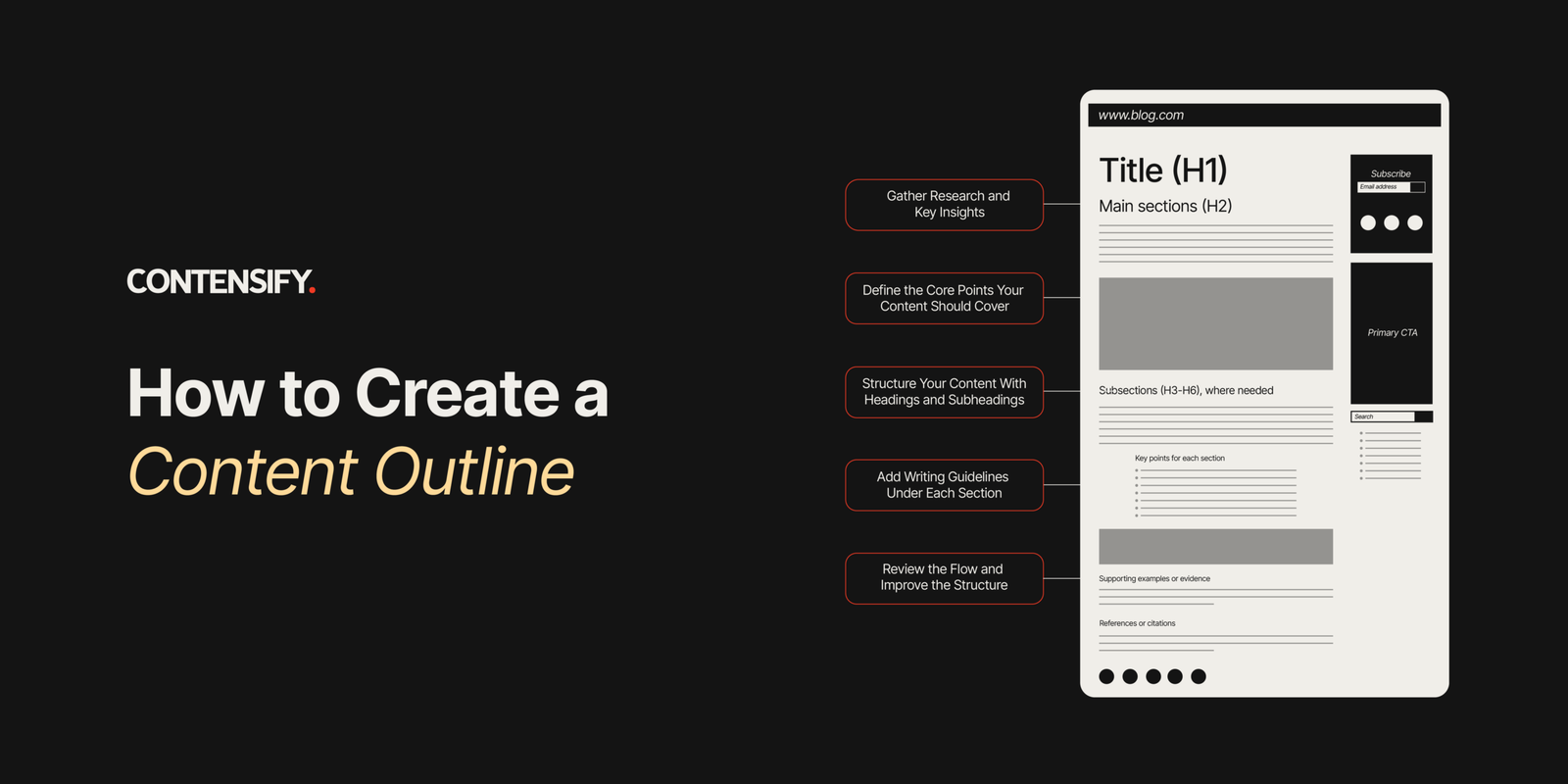
A content outline typically includes:
- Title (H1)
- Main sections (H2)
- Subsections (H3-H6), where needed
- Key points for each section
- Supporting examples or evidence
- References or citations
The right content outline structure depends on what you’re creating and what you want the content to achieve. A thought leadership piece needs a different flow than a detailed how-to guide. Choose a structure that matches the reader’s intent, content format, and funnel stage to create content that is clear, engaging, and effective.
Content Outline vs. Content Brief
Although they’re often used together, a content brief and a content outline serve different purposes. The brief provides the strategic direction for the content, while the outline translates that strategy into a clear structure for writing.
| Content Brief | Content Outline |
| Defines the content’s goals, target audience, target keywords, competitor insights, search intent, and tone. | Defines the headings, subheadings, key points, and the logical flow of the content. |
In short, the content brief explains why you’re creating the content, while the content outline defines what to cover and in what order.
Why Content Outlines Are Worth the Time
Here’s why content outlines are worth the time:
- Better organisation: Structures ideas in a logical sequence, making the content easier to write and follow.
- More clarity: Forces you to define key points before drafting, reducing gaps and unnecessary sections.
- Stronger focus: Keeps the content aligned with the topic and prevents it from going off track.
- Overcomes writer’s block: Gives you a clear path forward instead of starting from a blank page.
- Strategic alignment: Helps connect content with audience needs, product goals, and key pain points.
- Faster writing process: Reduces time spent figuring out structure while drafting.
- Easier collaboration: Gives editors and teams a shared framework to review direction, tone, and SEO goals before writing begins.
- Scalable content creation: Helps multiple writers maintain consistency as content production grows.
Define Who You’re Writing For and What You Want to Achieve
Before creating an outline, you need clarity on two things: who the content is for and what outcome it should drive. These decisions influence the structure, depth, and direction of your content.
Understand Your Reader’s Intent and Context
A good outline starts with understanding what your audience needs from the content. Consider:
- Search intent: Is the reader looking for information, a specific page, product options, or a solution? Your outline should match their reason for searching.
- Knowledge level: Decide whether your audience needs basic explanations or advanced insights. This determines what you should explain and what you can assume.
- Funnel stage: Structure content based on where readers are in their journey: learning about a problem, evaluating solutions, or ready to take action.
- Role and challenges: Understand the reader’s responsibilities, pain points, and goals. For unfamiliar audiences, job descriptions and LinkedIn profiles can provide useful context.
- Location and context: Adapt examples, language, and references based on whether you’re writing for a global or regional audience.
- Awareness level: Identify what readers already know and what they need to understand next.
Define the Purpose of Your Content
Every piece of content should have a clear objective beyond simply publishing information. A defined goal helps you choose the right structure, sections, and call-to-action.
Your objective could be to:
- Rank for specific keywords and increase organic traffic
- Generate leads through downloads, sign-ups, or forms
- Explain a product, feature, or solution
- Build authority through thought leadership
- Drive readers toward a specific action or conversion
Research Keywords and Search Intent
Keyword research helps you decide what to target, while search intent helps you understand how to structure the content. Choosing the right keyword but ignoring intent can lead to creating the wrong type of content for the audience you’re trying to reach.
Choose a Target Keyword
Start with a keyword that balances search demand with realistic ranking difficulty. Avoid chasing only high-volume terms dominated by established competitors.
Long-tail keywords are often a better starting point because they have lower competition and clearer intent. Filtering keyword research results by questions can help you find these opportunities quickly.
Confirm Search Intent on the SERP
Before finalising your content angle, analyse what is already ranking for the keyword. The SERP reveals the format Google expects, whether it’s a how-to guide, listicle, review, product page, video, or thought leadership piece.
If one format dominates the results, align your outline with that structure. Creating a completely different type of content usually makes ranking harder.
Find Related Keywords and Subtopics
Related keywords improve topical coverage and help identify sections to include in your outline. You can find them through:
- Keyword research tools and related term reports
- Google’s People Also Ask results
- Forums like Reddit and Hacker News
- Insights from experts and practitioners
Find Your Content’s Unique Angle
After researching existing content, identify what competitors are missing. Look for gaps such as outdated information, missing perspectives, or overlooked questions. Instead of simply rewriting what already ranks, add original value through expert insights, interviews, first-hand data, or unique examples.
How to Create a Content Outline in 5 Steps
Once you have clarity on your audience, goals, and research, turn those insights into a structured content outline. Follow these five steps to organise your ideas and create a clear writing roadmap.
Step 1: Gather Research and Key Insights
Collect information from reliable sources to understand the topic, identify key themes, and uncover opportunities to add value. These sources should include:
- Industry-leading blogs and websites
- Research and studies
- Quotes and statistics
- Competitor content
Step 2: Define the Core Points Your Content Should Cover
Turn your research into a focused set of key ideas that support your content objective. These points act as the foundation of your outline. Each one should answer an important reader question, support the main topic, and move the content forward.
Step 3: Structure Your Content With Headings and Subheadings
Once you have defined your key points, organise them into a logical structure using headings and subheadings to make the content easy to scan and follow.
- Create multiple H1 options and choose the one that best matches the topic and intent.
- Group related ideas into H2 sections.
- Break complex sections into H3-H6 subsections where needed.
- Review ranking content to ensure your outline covers important subtopics.
Step 4: Review the Flow and Improve the Structure
Before writing, review the outline from a reader’s perspective. Check whether the sections follow a logical order and whether each heading has a clear purpose. Reorganise sections where needed and ensure subtopics sit under the right level of heading.
Step 5: Add Writing Guidelines Under Each Section
Add notes below each heading to make the writing process easier and more consistent. Include:
- Key points the section should cover
- Sources, examples, or data to reference
- Internal links to include
- Product mentions or CTAs, where relevant
- Any context a writer needs before drafting
Final Check: Is Your Outline MECE?
Before starting the first draft, review your outline using the MECE framework: Mutually Exclusive and Collectively Exhaustive. This helps ensure your sections are clear, non-repetitive, and cover everything the reader needs.
Mutually Exclusive
Each H2 and H3 should cover a distinct idea without overlapping with another section. A common mistake is creating separate sections like “What is X,” “Benefits of X,” and “Why Use X” when they all cover the same concept from slightly different angles.
If a section does not add new information or value, it likely does not need to exist.
Collectively Exhaustive
Your outline should also cover all important questions a reader might have. Avoid broad headings that leave expectations unclear.
For example, “Email Providers” is vague, while “7 Affordable Email Providers” clearly defines what the section covers. Specific headings usually indicate stronger research and a more complete content structure.
Build Content That Actually Ranks
A strong content outline combines audience insights, keyword research, clear structure, and search intent before writing begins. It helps you create content that is focused, valuable, and built to rank.
At Contensify, we help B2B SaaS companies build SEO-driven content strategies that attract the right audience and support growth. With years of experience in content marketing and SEO, we handle everything from research and planning to content execution.
Ready to build a content strategy that drives results? Talk to our team today.