The global SaaS market is believed to grow by 400% in the next decade. More competition means rethinking your SaaS marketing strategy to sustain this crowded marketplace.
However, B2B SaaS marketing is not for the faint-hearted. It’s tricky and often time consuming.
As a product-specific industry, most SaaS companies focus solely on marketing strategies that get them direct sales.
But is this the best way to scale your startup?
This post compares the four most common B2B SaaS marketing strategies based on various parameters we use to measure growth at Contensify.
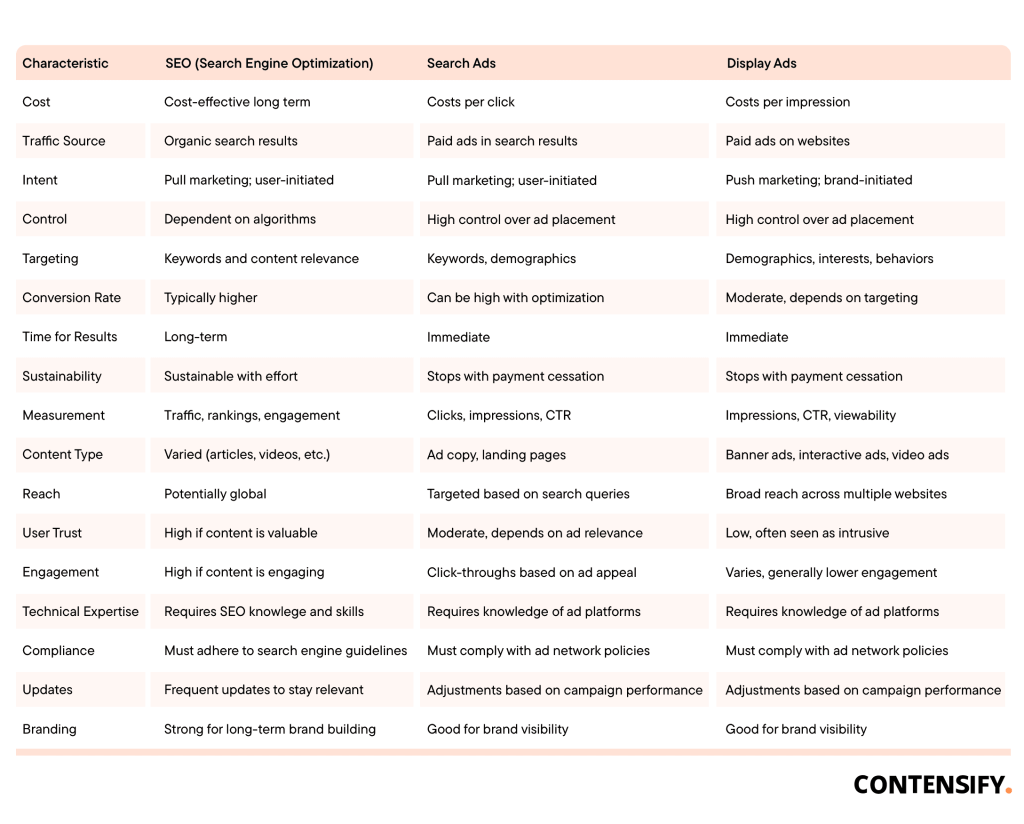
Comparison of the best marketing channels for B2B SaaS growth (2026)
Here’s the list of the top 4 B2B SaaS marketing channels that we’ll be dissecting:
- SEO (Search Engine Optimization)
- Search Ads
- Display Ads
- Email Marketing
Here’s a quick summary of the same before we dive into each channel:
1. SEO (Search Engine Optimization)
SEO helps optimize your content, improve website visibility, and rank higher on the search engine results page (SERPs).
SaaS startups should invest in SEO early on in their marketing journeys. This will ensure their website content ranks organically and attracts the right traffic.
Cost
SEO can be carried out in-house without the burden of ads, making it one of the most cost-effective marketing strategies for ensuring long-term growth. Around 81% of survey respondents say SEO provides better lead quality than PPC.
Traffic source
SEO drives organic traffic to your website and landing pages and effectively uses relevant content to engage the target audience.
Intent
SEO is a user intent-driven pull marketing strategy since it helps your target audience discover your brand, products, or services by appearing in organic search results.
Here’s an example of SEO in play. The specific intent-driven keywords in search returns the top-rated organic results that engages its target ICP – sales professionals:

Control
SEO is controlled mainly by how search engines work, aka using algorithms. For example, Google uses algorithms to find the ideal website display order based on specific search criteria.
Targeting
SEO targeting is influenced by your target audience’s choice of keywords, and content is ranked based on its relevance to these specific keywords.
Conversion rate
Good SEO typically has a higher-than-average conversion rate. A typical rate is around 2%, and 5%+ is considered an excellent conversion rate.
Time for results
SEO result timelines can be between 4 to 6 months or even a year for more complex strategies, thus making it a long-term plan.
Sustainability
SEO is a sustainable marketing channel, considering consistent efforts are being made. That’s because it is a long-term approach that needs a continuous focus on creating higher-quality, relevant content that’s prone to changing with the target audience’s evolving needs.
Measurement
SEO performance can be measured via keyword rankings, increased organic traffic, and engagement rate.
Content type
An effective SEO strategy can involve varied content types, such as blog articles, videos, short-form posts, infographics, etc., to boost engagement.
Semrush is an excellent example of a SaaS tool employing long-form, authoritative content to drive organic traffic:

Reach
SEO has the potential to reach globally and target wider groups of audiences.
User trust
User trust with SEO largely relies on how valuable and authoritative your content is to the end user’s search intent.
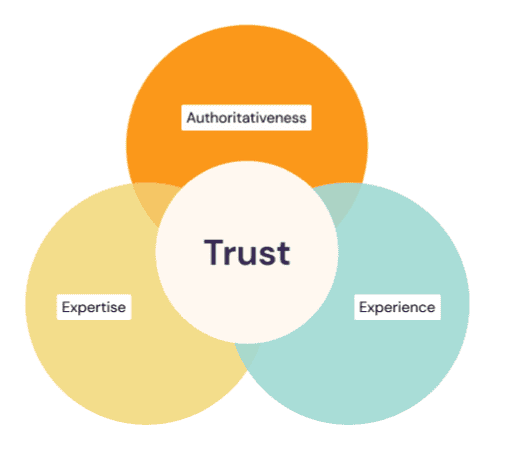
Image source – Google
Engagement
Despite the competition for the top spot on SERPs, you can increase user engagement with SEO if your results satisfy searchers’ intent and persuade them to stay on the landing page long enough.
This is possible by fixing technical SEO errors that may hamper user experience, using various visually appealing content formats, and improving site navigation.
Technical expertise
SEO requires technical knowledge and skills as it involves various tech-heavy functions, such as data analytics, keyword research, on-page optimization, technical SEO, and more.
Compliance
Search engines require adherence to their specific guidelines and best practices. SEO compliance lets search engines index your web pages better, increasing organic traffic.
For example, Google requires keyword optimizations, a specific URL structure, and a good site speed.
Updates
Frequent updates and content freshness can significantly affect SEO rankings since search engines aim to provide their users with the most up-to-date content.
Branding
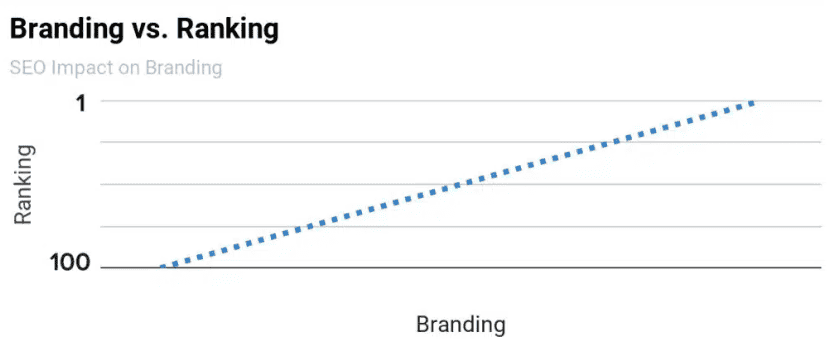
SEO and brand reach go hand in hand. Due to its high viability and ranking potential, SEO is one of the best ways to grow brand awareness for your SaaS startup.
2. Search Ads
Search ad campaigns are paid advertising appearing on your target audience’s search results. These clickable ads are displayed above and below organic search engine results.
For example, a search for “sales automation tool” returns this text ad of a SaaS automation software on top of Google’s SERP:

Cost
Search ads are billed on a pay-per-click basis. The cost-per-click (CPC) can be between $2 and $4. The industry average CPC is around $2.69; for technology brands, this number is around $2.09.
Traffic source
Search ads are paid ads that supplement organic search traffic. They are a great marketing technique for topping off your SEO.
Intent
Search ads are a form of pull advertising and appear to only those running intent-based searches.
Control
Compared to SEO, Search ads offer more control over ad placement, as you can specify the exact placement where your ads must be displayed.
Targeting
Search engines like Google follow demographic and search-term or keyword-based targeting. For example, potential customers of a specific age group, gender, and location.
Conversion rate
The average conversion rate for Google search ads is around 4.4%. Proper ad optimization can improve this benchmark.
Time for results
Search ads show immediate results compared to SEO. For example, Google ads can take 2 to 3 weeks to show meaningful results. Some brands have also reported results within 1-2 business days.
Sustainability
Search ads are paid advertising and, therefore, can cease to exist within 24 hours or be paused on payment cessation.
Measurement
Evaluate search ad performance by monitoring the three main metrics: the number of clicks received, the number of impressions, and the click-through rate (CTR).
Content type
Popular search ad content formats include dynamic search ads with varying ad copy (headlines, CTA, etc.) and landing ads that take users to specific web pages.
Example of a landing page search ad:

Reach
Search ads are custom campaigns that can be targeted to reach the right people based on their search queries. For example, reaching users running high-intent, location-based searches.
User trust
Confusing and misleading ads can hurt your brand reputation. However, displaying hyper-relevant ads to people actively searching for related solutions can improve user trust and conversion.
Engagement
Search ad engagement is measured by the click-through rate (CTR). Keyword targeting, relevant ad copy, testing, and more can improve your CTR and overall campaign performance.
Technical expertise
PPC advertising requires sufficient knowledge of the various ad platforms and methods to test ads, understand target audiences and their search intent, and optimize ad performance.
Compliance
Brands running Search ads must adhere to the specific ad platform policies to avoid the risk of account suspensions.
Updates
Search ad updates must be carried out regularly by monitoring campaign performance, especially to make the most out of your ad budgets.
For example, you can monitor the audience demographics, and if one group is more likely to convert than the other, you can place bids to target this demographic.
Branding
A study of 61 search ad experiments identified an 80% lift in top-of-mind brand awareness, even if the user did not click on the ad.

3. Display Ads
Display ads or display advertising helps you visually showcase your brand or products on several online platforms or websites.
It pushes users to take specific actions, such as signing up for a trial, subscribing to a newsletter, or purchasing.
These ads are highly scalable and let you get creative by combining several visual elements, such as texts, images, or videos, into a single ad.
A display ad by a cybersecurity firm on the Forbes website:

Cost
Display ads can be budget-friendly. They have a lower cost per impression. The average cost per thousand impressions (CPM) is around $3.12.
Traffic source
Display ads are paid ads shown on specific external websites or social media pages. It helps attract niche audiences based on browsing behavior, what they like, etc.
Intent
Display ads are push advertising, where the goal is to “push” your products or services to people who aren’t necessarily looking for that solution.
Control
Display ads offer high control over ad placement. You can specify the exact placement where your ads must be displayed, be it on a website or a webpage.
Targeting
Display ads are shown based on interest-based and demographic targeting, i.e., the focus is on user interests, topics, and specific demographic audience segments.
Conversion rate
Display ads have a moderate conversion rate compared to search ads. For instance, Google Display Ads have an average conversion rate of 0.57%. This lower rate is because display ads target audiences who are not actively searching for your message.
Time for results
You can start seeing results within a few days of running display ads, typically within a week. Ad impressions can grow as your targeting improves with time.
Sustainability
Display ads are paid advertising and, therefore, can cease to exist or are paused on payment cessation.
Measurement
Tracking metrics like ad impressions, CTR, and viewability helps optimize your future display ad campaigns.
Content type
Popular search ad content formats include banner, interactive, video, and static ads.
Example of an interactive banner ad with clickable elements:

Reach
You can reach a broader audience across multiple websites by specifying target demographics and behaviors.
User trust
User trust is relatively low with display ads as they can be intrusive and shown to users not actively searching for your message or solution.
Engagement
Display ad engagement can vary and be lower than that of search ads since performance is counted based on ad impressions, which does not guarantee active user engagement.
Technical expertise
Requires sufficient knowledge of the various ad platforms, display ad types, and optimization techniques.
Compliance
Brands running display ads must adhere to the specific policies of the ad platform to avoid the risk of permanent account suspensions.
Updates
Display ads must be continuously optimized to achieve the best ROI. For example, you may notice that a particular ad gets a lot of clicks but no conversions, indicating an issue with the ad copy.
Branding
Display advertising puts your brand in front of a wider group of audiences via strategic ad placement on websites that align with your niche.
4. Email marketing
Email marketing is a budget-friendly yet effective lead generation channel for B2B SaaS startups. It involves audience segmentation based on their demographics, interests, and online behaviors and sending them hyper-personalized emails.
Emails have multiple functions, from nurturing leads to retaining customers and driving conversions, while you have complete ownership over the content and timings.

Cost
Email marketing can be low-cost while yielding a stellar ROI. Email ROI for software and technology is $40 for every dollar spent.
Traffic source
Email marketing campaigns are sent directly to subscribers, who decide whether to engage with your content by visiting your website or landing page.
Intent
Emails are categorized under push marketing. These brand-initiated emails aim to “push” your products, services, or offers to your email subscribers.
Control
Despite using an email automation tool, you have complete control over the email content, timing, and recipient list.
Targeting
Targeted emails see higher engagement and open rates—almost 26% higher. Segment your email list based on location, demographics, behavior, and customer journeys. This approach ensures your personalized message resonates more deeply with each segment.
Grammarly’s email targets its non-premium users with this promotional email:

Conversion rate
Although email conversion rates can vary between industries, emails let you witness some of the highest conversion rates compared to most marketing channels. That’s considering you’re sending personalized emails to targeted email lists.
Time for results
You can see immediate results or wait months for them. The timeline for results depends on various factors, such as message quality, how well you segment your list and frequency.
For example, you may see immediate engagement by sending a high frequency of targeted emails.
Sustainability
Emails help SaaS startups maintain sustainable growth in terms of ROI, considering you consistently improve your email lists.
Measurement
Email marketing performance can be visualized by tracking open rates, response rates, CTR, and conversion rates.
Content type
Emails can be divided into regular emails like welcome, new offers, follow-ups, and other promotional emails, as well as newsletters sent periodically to a group of subscribers.
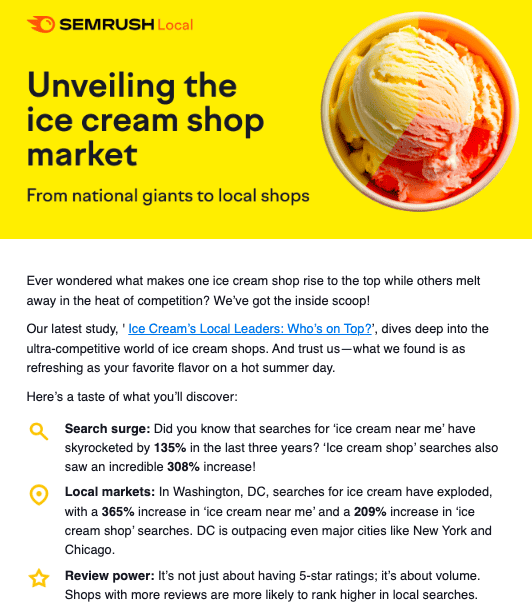
Semrush, a marketing automation SaaS, sends a weekly insightful newsletter to its subscribers:
Reach
Your targeted emails essentially reach a group of email subscribers, such as users who signed up for the free trial, subscribed to your email list, or previously engaged with your services.
User trust
Emails often maintain a high user trust as subscribers are willing to receive updates from your brand. That’s considering you continuously maintain your email list health and messaging.
Engagement
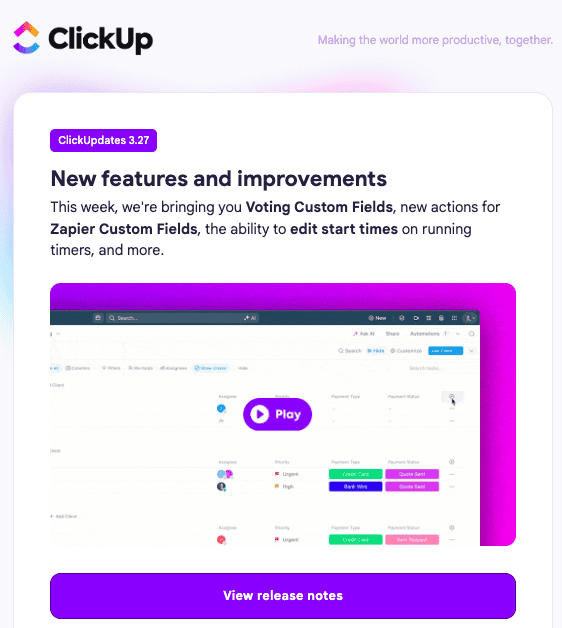
As a direct communication channel, email marketing offers a better platform for brands to experiment with interactive elements to boost user engagement. These elements can include product-specific widgets, GIFs, hover effects, product previews, and so on.
ClickUp, a project management SaaS, uses embedded videos in its emails to announce the launch of new product features:
Technical expertise
You could be dealing with email automation and tracking tools, which require some technical expertise and familiarity.
Compliance
You must comply with email laws and regulations to avoid getting tagged with a bad sender reputation or hefty fines. The US, for example, has a CAN-SPAM act that states several email laws the sender must comply with and meet the required conditions.
Updates
Healthy email lists result in better ROIs. So, it’s best to review your lists and keep it current. Do this by unsubscribing recipients who have not engaged with your emails over the last 90 days, running re-engagement campaigns, and re-segmenting subscribers.
Branding
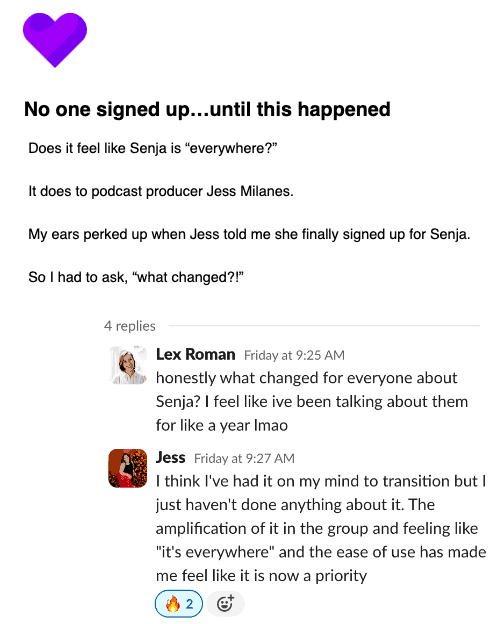
Unlike paid ads, where brand awareness campaigns don’t guarantee audience reach, email content, on the other hand, can be easily modeled to highlight how your products solve the target audience’s challenges, thus creating more brand awareness and identity.
Senja, a testimonial collection platform, raises brand awareness well by subtly placing the product’s benefits in its email content:
Wrapping up
With SaaS becoming a commodity, the best time is now to upgrade your marketing tactics and stay ahead of the curve.
Marketing trends may come and go, but these specific SaaS marketing strategies promote sustainable business growth while allowing you to build lasting customer relationships.
Seek help from the SaaS marketing experts at Contensify to scale your GTM strategy.
Reach out to us today for a consultation!