If you’ve spent any time in marketing conversations this year, you’ve probably heard a lot of new (and not-so-new) acronyms being thrown around:
AI SEO.
AEO.
LLM SEO.
GEO.
Semantic SEO.
Entity SEO.
And somewhere in between, you’re still expected to “just do SEO”.
Most B2B SaaS teams are reacting exactly how you’d expect: running from pillar to post, trying to cover everything, afraid of missing out on the next algorithm shift, platform update, or AI breakthrough.
But here’s the truth most people won’t say out loud:
These aren’t competing disciplines.
They’re different tactics serving the same core goal.
Search optimization.
Search today no longer lives in just Google’s 10 blue links. It lives across:
- AI answers
- Knowledge panels
- Forums
- Product-led pages
- App stores
- Voice interfaces
- And generative search experiences
In this post, we just want to first break down the different search optimization tactics B2B SaaS companies need to account for, what each one actually means, what it involves, and why it matters – without the jargon overload.
But in the upcoming articles, we will be deep-diving into each tactic and sharing our processes with you.
Different SEO tactics that you get you noticed on the search engines
SEO is no longer about finalising a bunch of keywords and writing blogs on the subject. Your search strategy needs to run deep and cover:
1. AI-Driven SEO
What it is
AI-driven SEO focuses on optimizing content and sites for AI-influenced ranking systems – where machine learning models evaluate relevance, helpfulness, depth, and context rather than just keywords.
This includes how Google interprets content using AI systems and how AI assists in content discovery and ranking.
What it entails
- Creating content that answers real user intent, not just keywords
- Structuring content clearly (headings, summaries, logical flow)
- Reducing fluff and increasing informational density
- Using AI responsibly for research, outlining, and optimization – not mass generation
- Optimizing for engagement signals (time on page, satisfaction)
Why B2B SaaS companies should focus on it
- SaaS buying journeys are complex and research-heavy
- AI systems favor depth, clarity, and usefulness
- Thin or generic SaaS content is increasingly filtered out
- AI-driven SEO rewards expertise, not shortcuts
2. AEO (Answer Engine Optimization)
What it is
AEO focuses on optimizing content so it can be directly used as an answer by search engines, AI assistants, and voice interfaces.
Think featured snippets, “People Also Ask,” and AI-generated answers.
What it entails
- Writing direct, concise answers to specific questions
- Structuring content with clear Q&A sections
- Using schema where relevant (FAQ, HowTo)
- Anticipating follow-up questions users may ask
- Creating authoritative, unambiguous explanations
Why B2B SaaS companies should focus on it
- Buyers ask very specific questions during evaluation
- AEO increases visibility without requiring clicks
- Being cited as an answer builds brand trust early
- AI tools increasingly rely on answer-ready content
3. LLM SEO
What it is
LLM SEO focuses on optimizing content so large language models (like ChatGPT, Gemini, Claude) can understand, reference, and recommend your brand accurately.
This is not about “ranking” in a traditional sense – it’s about being learned from.
What it entails
- Clear explanations of what your product does and who it’s for
- Strong entity associations (brand, category, use case)
- Consistent messaging across the web
- Publishing original insights and first-hand experience
- Avoiding vague or buzzword-heavy descriptions
Why B2B SaaS companies should focus on it
- Buyers are using AI tools for vendor research
- LLMs influence perception before a demo is booked
- Misunderstood brands don’t get recommended
- LLM visibility compounds over time, not instantly
4. GEO (Generative Engine Optimization)
What it is
GEO is about optimizing content to appear in AI-generated search experiences, such as Google AI Overviews and generative result panels. It overlaps with SEO and AEO but focuses on how content is synthesized, not just indexed.

What it entails
- Creating comprehensive, multi-angle content
- Covering topics holistically instead of isolated keywords
- Providing contextual explanations, not just definitions
- Using examples, comparisons, and scenarios
- Updating content regularly to stay current
Why B2B SaaS companies should focus on it
- Generative search reduces traditional click-through
- Being part of the generated answer is the new visibility
- GEO favors brands that explain, not promote
- Early movers will dominate AI citations long-term
5. Content SEO
What it is
Content SEO is the foundation: creating content that ranks by aligning search intent, relevance, and authority.
This includes blogs, guides, landing pages, case studies, and resources.
What it entails
- Intent-first keyword research
- TOFU, MOFU, and BOFU content mapping
- Internal linking and topic clustering
- Updating and consolidating existing content
- Writing for humans first, search engines second
Why B2B SaaS companies should focus on it
- Content educates buyers long before sales conversations
- It supports every other search tactic
- SaaS content compounds in value over time
- Strong content reduces dependency on paid channels
6. Technical SEO
What it is
Technical SEO ensures your website can be crawled, indexed, and understood efficiently by search engines and AI systems.
It’s not glamorous; but it’s critical.
What it entails
- Site speed and Core Web Vitals
- Crawlability and index control
- Clean URL structures and canonicalization
- Schema implementation
- Managing JavaScript-heavy SaaS sites
Why B2B SaaS companies should focus on it
- SaaS sites are often complex and dynamic
- Technical issues silently block growth
- AI systems rely on clean structure
- Strong technical SEO protects long-term scalability
7. Programmatic SEO
What it is
Programmatic SEO uses templates + structured data to scale hundreds or thousands of pages targeting long-tail searches.
Common in SaaS for integrations, comparisons, and use cases.
What it entails
- Identifying scalable keyword patterns
- Designing SEO-friendly page templates
- Ensuring content uniqueness and usefulness
- Managing internal linking at scale
- Avoiding thin or duplicate pages
Why B2B SaaS companies should focus on it
- Captures high-intent long-tail demand
- Works exceptionally well for product-led SaaS
- Scales faster than manual content
- Complements core content strategy
8. Entity SEO
What it is
Entity SEO focuses on helping search engines and AI understand who you are, what you do, and how you relate to other entities.
This goes beyond keywords into brand identity.
What it entails
- Consistent brand and product descriptions
- Clear category positioning
- Structured data and schema
- Presence across authoritative sites
- Strong “about” and product pages
Why B2B SaaS companies should focus on it
- Entity understanding fuels AI answers
- Reduces misclassification of your product
- Strengthens brand authority signals
- Essential for competitive categories
9. Semantic SEO
What it is
Semantic SEO focuses on meaning and context, not just exact keywords. It ensures your content covers related concepts, subtopics, and intent variations.
Here’s an example of how this works:

What it entails
- Topic modeling instead of keyword stuffing
- Covering related questions and concepts
- Natural language optimization
- Content clustering
- Avoiding overly narrow pages
Why B2B SaaS companies should focus on it
- Buyers search in varied ways
- AI systems interpret meaning, not strings
- Semantic depth improves rankings stability
- Reduces dependency on single keywords
10. Search Experience Optimization (SXO)
What it is
SXO bridges SEO and UX, optimizing not just for traffic, but for what happens after the click.
What it entails
- Clear content hierarchy
- Strong CTAs aligned with intent
- Readability and scannability
- Page layouts that support decision-making
- Reducing friction across the journey
Why B2B SaaS companies should focus on it
- Traffic without conversion is wasted
- UX impacts engagement and rankings
- Buyers expect clarity, not clutter
- SXO directly influences pipeline impact
11. App Store SEO (ASO)
What it is
ASO focuses on optimizing SaaS apps listed on platforms like Google Play, Apple App Store, Chrome Web Store, or SaaS marketplaces.
What it entails
- Optimizing titles and descriptions
- Keyword research within app ecosystems
- Visual optimization (screenshots, videos)
- Reviews and ratings strategy
- Consistent updates
Why B2B SaaS companies should focus on it
- App stores are search engines
- Marketplace visibility drives adoption
- Reviews influence trust and conversion
- Often overlooked, yet high-intent
12. Voice Search SEO
What it is
Voice search SEO optimizes content for spoken, conversational queries used via assistants and AI interfaces.
What it entails
- Natural language phrasing
- Question-based content
- Concise answers
- Local and contextual optimization
- Clear intent matching
Why B2B SaaS companies should focus on it
- Voice queries are growing via AI assistants
- Many voice answers pull from AEO-ready content
- Supports accessibility and usability
- Future-proofs content for emerging interfaces
13. Product-Led SEO
What it is
Product-led SEO uses your product, features, and integrations as the primary drivers of organic search traffic. Instead of relying only on blog content, your product experience itself becomes searchable, discoverable, and valuable from search.
This works especially well for B2B SaaS companies with modular features, integrations, templates, or workflows.
What it entails
- Creating SEO-optimized feature pages
- Building integration pages (e.g. “Product + Tool” use cases)
- Developing use-case and workflow pages tied to product capabilities
- Structuring in-product content so it’s indexable
- Using programmatic approaches where applicable without sacrificing quality
Why it matters for B2B SaaS companies
- Captures high-intent, solution-aware buyers
- Shortens the path from search to product value
- Scales naturally as the product grows
- Aligns SEO directly with revenue and adoption
14. Demand Capture SEO (Comparisons & Alternatives)
What it is
Demand capture SEO focuses on ranking for evaluation-stage searches where buyers are actively comparing solutions or looking for alternatives. These searches usually indicate strong purchase intent.
What it entails
- Creating “X vs Y” comparison pages
- Publishing “Best alternatives to X” content
- Optimizing pricing, feature, and use-case comparisons
- Writing honest, experience-backed evaluations
- Structuring content to answer decision-stage questions clearly
Why it matters for B2B SaaS companies
- These pages convert better than informational content
- Buyers trust transparent comparisons
- Helps influence decisions late in the funnel
- Captures demand competitors are already generating
15. Brand SERP & Reputation SEO
What it is
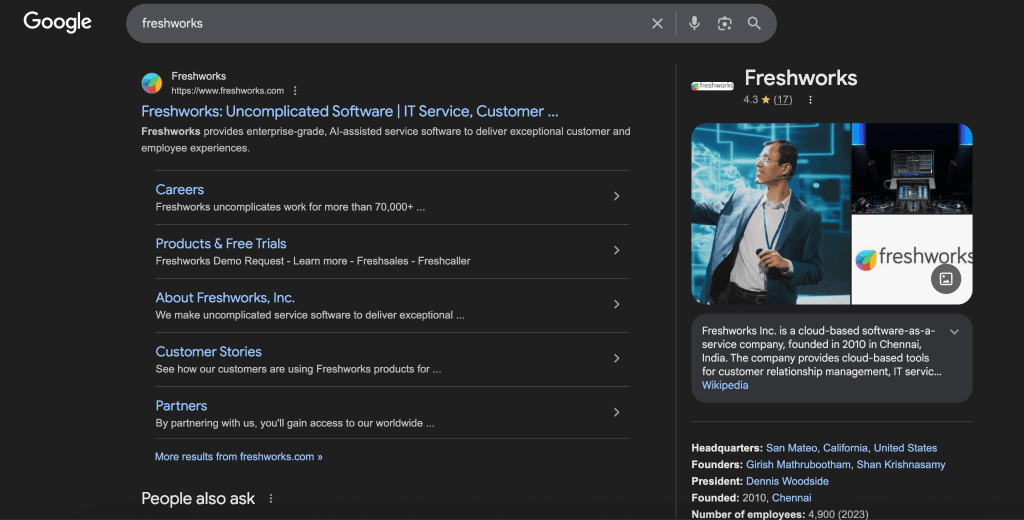
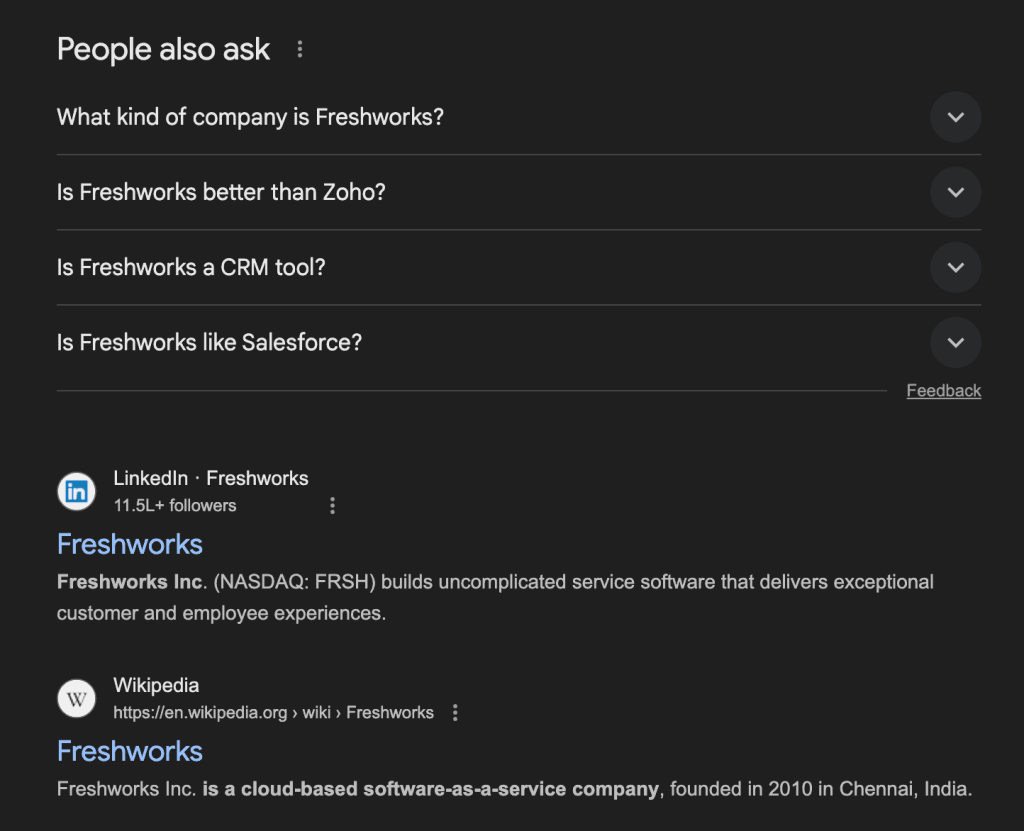
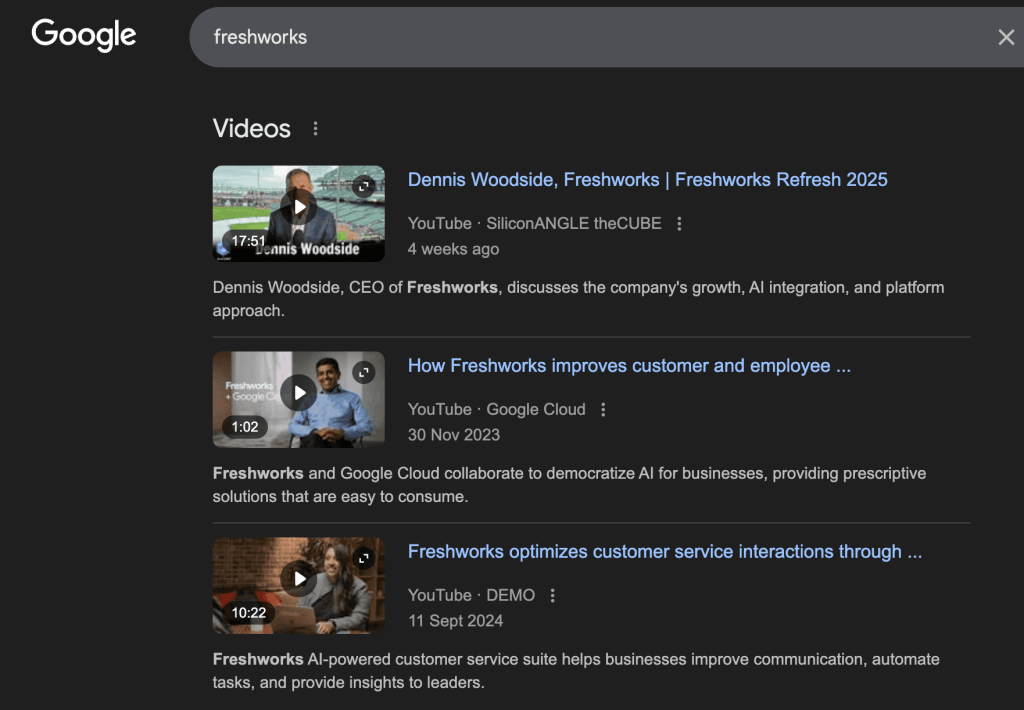
Brand SERP SEO focuses on controlling and optimising what appears when someone searches your brand name. This includes organic results, AI summaries, reviews, and third-party mentions.
Here’s an example from that of Freshworks:
What it entails
- Ensuring owned pages dominate branded searches
- Publishing clear positioning and “about” content
- Optimizing FAQs and brand-related queries
- Encouraging and managing reviews and mentions
- Maintaining message consistency across platforms
Why it matters for B2B SaaS companies
- Brand searches spike during buying cycles
- SERP perception directly impacts trust
- AI tools rely heavily on branded content for summaries
- Poor brand SERPs can quietly kill conversions
16. Community SEO (Beyond Reddit & Quora)
What it is
Community SEO expands search visibility into community-driven platforms where B2B buyers actively discuss tools, workflows, and problems. This includes forums, Slack groups, GitHub discussions, and niche communities.
What it entails
- Identifying relevant communities where buyers gather
- Contributing genuinely useful answers and insights
- Creating content that reflects real community questions
- Monitoring discussions for recurring pain points
- Turning community insights into searchable content
Why it matters for B2B SaaS companies
- Community conversations influence buying decisions
- Many community pages rank directly in search
- AI systems ingest public community data
- Builds trust that traditional SEO can’t replicate
Also read: Using Reddit and Quora for B2B SEO
17. International & Multilingual SEO
What it is
International SEO focuses on optimizing your site for multiple regions, languages, and search behaviors, ensuring the right content appears for the right audience.
What it entails
- Structuring country- and language-specific pages
- Implementing hreflang correctly
- Localising content beyond simple translation
- Managing international keyword differences
- Preventing regional cannibalisation
Why it matters for B2B SaaS companies
- SaaS companies often sell globally early
- Poor international SEO leads to confusion and ranking issues
- AI systems need clear geographic signals
- Enables scalable growth across markets
18. Search Demand Creation
What it is
Search demand creation focuses on influencing what people search for in the first place rather than only responding to existing demand. It sits at the intersection of content, brand, and distribution.
What it entails
- Founder-led and thought leadership content
- Consistent narrative-building across channels
- Educating the market on new problems or frameworks
- Creating repeatable messaging that sticks
- Using distribution to amplify awareness
Why it matters for B2B SaaS companies
- Search volume is not static
- Strong brands create their own demand
- Demand creation accelerates organic growth
- Makes all other SEO tactics more effective
Conclusion
The mistake most B2B SaaS companies make isn’t ignoring these tactics.
It’s treating them as isolated initiatives.
Search optimization today is a system, not a checklist.
At Contensify, we don’t growth-hack individual tactics or chase every new acronym.
We tie all of these layers together – content, SEO, AI visibility, distribution, and experience, so your growth compounds sustainably over time.
If you’re serious about building long-term search authority – not just short-term spikes, this is the approach that actually works.