
The reins of content creation remain the same, but AI has made the process faster, and, in some ways, harder.
As content becomes easier to produce, it has become harder to stand out. Feeds are crowded, formats look identical, and much of what’s published sounds like it’s coming from the same voice.
This is where founder-led thought leadership content makes a real difference. Instead of adding to the noise, it brings a distinct point of view that’s grounded in lived experience, strong opinions, and hard-won insights.
In this blog, we’ll explore how founders can show up with clarity and conviction so content stops being just another marketing asset and starts building trust, demand, and lasting authority.
What Is Founder-Led Thought Leadership Content?
Founder-led thought leadership centers on a founder’s lived experience and point of view, using it to bring clarity to the market, challenge assumptions, and help buyers think more deliberately about their choices.
Founder-Led vs Brand-Led Content
Brand-led content speaks for the company; founder-led content speaks from within it. Most brand content is designed to be safe, consistent, and broadly appealing, which often results in neutral language and predictable messaging. Founder content, on the other hand, allows for sharper opinions, clearer stances, and context that brand messaging usually avoids.
Think of it this way, brand-led content explains what a product does, founder-led content explains why it exists, how decisions were made, and what the founder believes about the problem space.
Why Buyers Trust People More Than Logos
B2B buyers don’t just evaluate products, they evaluate the people behind them. Logos don’t carry experiences, opinions, or accountability; people do. When founders share their POVs openly, buyers get a clearer sense of how the company operates, what it prioritizes, and if their values align.
Founder-led content reduces perceived risk. Seeing a founder consistently explain decisions, admit trade-offs, or challenge industry norms signals confidence and competence. Over time, that familiarity builds trust in a way polished brand messaging rarely can.
When Founder Content Works Best (and When It Doesn’t)
Founder-led content works best when the founder has real proximity to customers, the market, or the product, and is willing to share informed opinions, not recycled advice. It’s especially effective in early to mid-stage B2B SaaS, crowded categories, or emerging markets where clarity and credibility matter more than scale.
Also, it doesn’t work when founders treat it as another distribution channel for marketing messages or delegate their voice entirely. Content that sounds scripted, overly promotional, or disconnected from real experience quickly loses impact.
Why Founder-Led Content Works So Well in B2B SaaS
Here’s how founder-led content naturally aligns with how B2B SaaS buyers think and make decisions:
Long Buying Cycles Need Familiarity
B2B SaaS purchases are long, considered journeys, not impulse decisions, requiring multiple content touchpoints before buyers engage with sales. Nearly half of B2B buyers consume three to five pieces of content before reaching out. Founder-led content builds early familiarity, helping buyers trust a person, not just a logo, long before they enter the funnel.
Trust, Credibility & Perceived Expertise
Trust drives B2B buying, and research shows that decision-makers are more receptive to companies that consistently produce high-quality thought leadership. Founder-led content builds this trust by shaping how deeply buyers research and evaluate a company. When founders share real insights from lived experience, perceived expertise turns into credibility long before a sales conversation begins.
Founder Visibility as a Competitive Advantage
When product specs blur across SaaS categories, the person behind the product becomes a key differentiator. Founder visibility humanizes the brand and signals confidence in the vision, giving buyers a reason to trust one vendor over another. When prospects encounter a founder’s insights early, on platforms like LinkedIn, they’re more likely to see the solution as strategic rather than transactional.
Thought Leadership vs Personal Branding (The Difference Matters)
Here’s how founder-led content and personal branding serve different purposes:
What Thought Leadership Actually Means
Thought leadership isn’t about visibility, it’s about perspective. At its core, it’s the ability to clearly articulate how a market is evolving, where conventional thinking falls short, and what buyers should pay attention to next. The value lies in helping others make better decisions, not in sharing opinions in isolation.
For founders, real thought leadership is rooted in proximity to the problem, customer conversations, product trade-offs, failed experiments, and hard-earned lessons.
At Contensify, Vanhishikha uses LinkedIn to break down real SaaS growth problems, positioning gaps, demand capture vs. creation, and content’s role in the pipeline, to show how strategy drives revenue impact. This consistently reinforces Contensify’s positioning as a growth partner, not just a content agency.
The Problem with “Build in Public” Advice
“Build in public” advice often encourages founders to share everything, metrics, milestones, and struggles, without considering if it’s actually useful to the buyer. Yes, transparency can be powerful, but unfiltered updates rarely build authority. Over time, they tend to attract peers and creators rather than customers.
This kind of content becomes inward-facing. It documents the journey instead of guiding the market, which means authority isn’t built, even as the audience grows, and buyers still lack clarity on why your product or point of view matters.
How to Avoid Becoming a Content Influencer Instead of a Founder
The simplest way to avoid this trap is to anchor content to buyer problems, not personal milestones. If it doesn’t help the audience think more clearly about a decision they’re making, it’s personal branding, not thought leadership.
Founder-led content works best when the founder acts as a guide, not the hero. By keeping the focus on the market, customer, and insight, content builds authority without drifting into influencer territory.
Types of Founder-Led Content That Perform Best
Here’s what separates high-impact founder-led content from everything else:
1. POV & Opinion-Driven Content
Opinion-led content works because it takes a clear stance in a sea of neutrality. When founders explain what they believe, and why, they give buyers a framework to evaluate problems and solutions.
For example, Jason Lemkin challenges the “SaaS is dead” narrative by explaining how legacy SaaS models are aging, but B2B software demand continues to grow, giving founders and buyers a clearer lens to evaluate where real growth opportunities still exist.

2. Lessons from Building the Company
Content drawn from real execution resonates because it’s earned, not theoretical. The focus should be on transferable insight, not the company’s timeline.
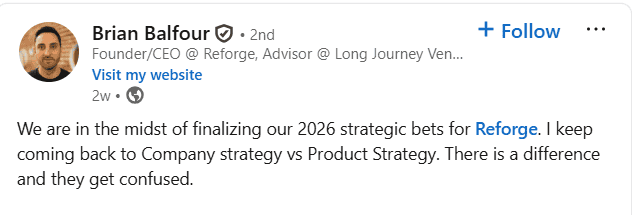
For example, Brian Balfour lays out how company‑level strategy differs from product strategy and why aligning the two is critical for future bets and growth.
3, Market Narratives & Contrarian Takes
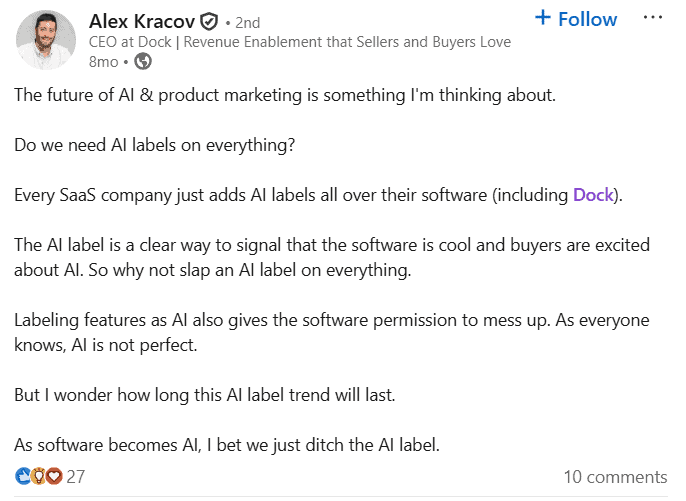
Strong founder-led content reframes how a market thinks by challenging default assumptions or popular trends. This positions founders as category thinkers. For example, Alex Kracov questions the need for “AI” labels on SaaS products, noting they may fade as AI becomes a standard expectation rather than a standout feature.
4. Behind-the-Scenes & Decision-Making Stories
Behind-the-scenes content works best when it shows how decisions are made, not just what happened. Buyers want insight into priorities, trade-offs, and judgment.
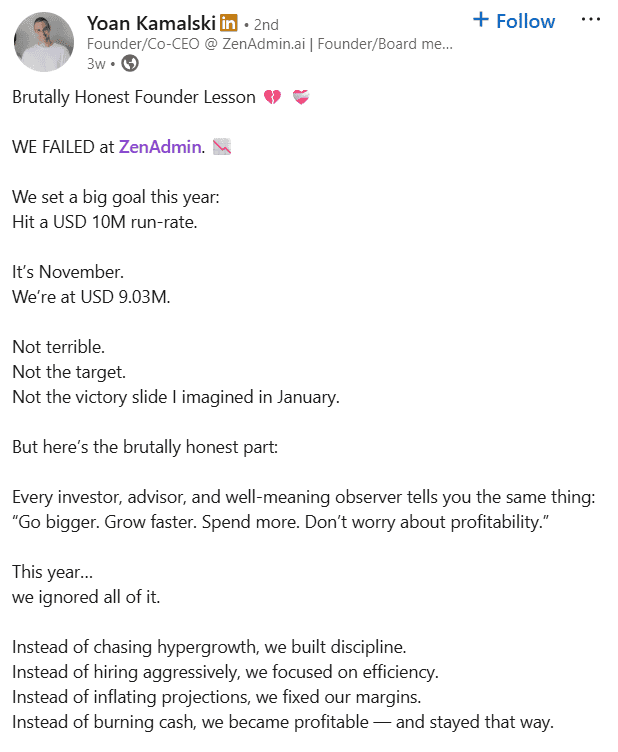
For example, Yoan Kamalski shared why ZenAdmin prioritized disciplined, sustainable growth over chasing a $10 M run-rate, signaling maturity, focus, and long-term leadership.
Platforms That Work Best for Founder-Led Thought Leadership
Here’s where founder-led thought leadership works best, and why platform choice matters:
LinkedIn for B2B SaaS Founders
LinkedIn is the most effective channel for founder-led thought leadership in B2B SaaS because it blends professional identity with industry conversation. Buyers follow founders to understand how they think, not just what they sell, making opinion-led and trend-focused posts especially effective.
For example, a founder explaining why they stopped gating content, and its impact on the pipeline can spark meaningful engagement and build familiarity well before a sales conversation begins.
Blogs, Newsletters & Long-Form Content
Long-form content lets founders go deeper than social posts. Blogs and newsletters are ideal for explaining nuanced ideas, sharing frameworks, and articulating a point of view that needs context. This is where founders can slow the conversation and shape how buyers think about a category or problem.
For instance, a quarterly founder newsletter unpacking customer trends, what’s changing, what’s not, and what’s overhyped, creates a durable asset buyers revisit during evaluation.
Podcasts, Events & Repurposed Content
Podcasts and events work well because they show founders thinking out loud and sharing perspectives more naturally. These formats humanize founders and surface insights that rarely appear in written content, creating high-trust moments with engaged audiences.
Like, a founder discussing a shift in buyer behavior on a podcast can be repurposed into LinkedIn posts, short clips, and a blog, extending the life of one insight across multiple formats.
How Founder-Led Content Supports SEO & Distribution
Here’s how founder-led content goes beyond authority to quietly strengthen SEO, discoverability, and distribution across channels:
Brand Searches & Demand Creation
Founder-led thought leadership increases branded search by building familiarity before buyers are ready to convert. When prospects repeatedly see a founder’s ideas across channels, they’re more likely to search the founder or company name instead of generic keywords.
For example, a founder consistently writing about RevOps challenges may later trigger branded searches like “{Founder Name} RevOps” or “{Company} RevOps platform”, which are clear signals of demand creation, not just demand capture.
Content That Gets Quoted, Shared & Referenced
Content with a clear point of view is more likely to be quoted, shared, or referenced. Founder-led content works especially well because it’s opinionated, attributable, and rooted in real experience, not some generic SEO content.
For instance, a founder publishing a contrarian take on freemium in enterprise SaaS may get cited in newsletters, podcasts, or industry roundups, earning organic backlinks without deliberate link-building.
Founder Content as an AI Citation Signal
As AI-driven search relies more on credible sources, founder-led content becomes a strong authority signal. Content tied to identifiable experts with consistent viewpoints is more likely to be surfaced or referenced in AI-generated responses.
For example, a founder publishing clear explainers on a niche topic may see their insights paraphrased or cited by AI tools, extending reach beyond traditional search.
Building a Sustainable Founder-Led Content Strategy
Here’s a step-by-step approach to how founders can build a sustainable content system without burning out or losing authenticity:
Finding Your Founder Narrative
A founder narrative isn’t a personal story, it’s the lens through which the founder understands the market, the problem their product exists to solve, and the audience it’s built for. It’s shaped by the customers they serve, the patterns and mistakes they’ve seen across those users, and the beliefs they’ve formed while building and positioning the product.
Content Cadence Without Burnout
Consistency matters more than frequency, which means founders should commit to a cadence they can realistically maintain, weekly, biweekly, or even monthly. The simplest approach is to tie content creation to existing workflows, customer calls, internal reviews, or weekly leadership meetings, and capture insights as they surface.
Delegating Without Losing Voice
Founders don’t need to write everything themselves, but they do need to own the thinking. Delegation works best when founders provide raw input via voice notes, outlines, rough thoughts, and let a content team shape it into publishable assets without changing the substance.
Founder-Led vs Ghostwritten Content
Ghostwritten content works when founders own the thinking, even if they don’t write every word. The key is using writers as translators of real insight, not inventors of ideas. When founders review, refine, and stand behind the message, the content stays credible, consistent, and unmistakably theirs.
Common Mistakes in Founder-Led Thought Leadership
Here’s where founder-led thought leadership often goes wrong and how it quietly weakens trust:
Being Promotional Too Early
One of the fastest ways to lose credibility is turning founder content into product marketing too early. Buyers want insight, not a pitch, and premature promotion signals self-interest over expertise. Thought leadership earns attention first, then influence, promotion only works once trust is established.
Chasing Virality Over Relevance
Chasing likes or trends often dilutes the message. While viral content may increase reach, it rarely builds authority if it lacks relevance to real buyer problems. In B2B, impact comes from resonance, not reach, and a smaller, engaged audience that trusts your thinking matters far more than a large, disengaged one.
Inconsistency & Overthinking
Posting sporadically or over-polishing content weakens impact. Inconsistency breaks familiarity, overthinking slows momentum, and dulls authenticity. Trust is built through steady exposure, not perfection, and founder-led content works best when it’s consistent, clear, and grounded in real experience.
Real Examples of Founder-Led Thought Leadership in B2B
Here’s how real B2B SaaS founders turned their personal voice into authority and trust:
SaaS Founders Who Built Authority Through Content
Dharmesh Shah of HubSpot consistently shares insights about startups, marketing, and scaling, building a reputation as both a thought leader and an accessible founder.
Similarly, Des Traynor of Intercom uses product-led storytelling and opinion pieces to influence the industry while staying closely tied to his company’s mission.
These founders didn’t just share product updates, they became trusted guides in their categories.
What They Did Differently
What sets these founders apart is the intentionality behind their content. They combine clear POVs with real-world lessons, share both successes and failures, and engage consistently with their audience. They don’t chase trends, they focus on relevance, authenticity, and insight, encouraging dialogue rather than just pushing a message.
Patterns You Can Apply (Even as a Small Team)
Focus on consistent storytelling around founder experiences, industry perspectives, and clear opinions. Repurpose the same insight across formats like posts, newsletters, or podcasts to extend reach without overextending. Keep the content grounded in lived experience if you want to build authority, trust, and move from mere awareness to real influence.
How Contensify Helps Founders Build Thought Leadership That Converts
Contensify helps founders turn their voice into influence through clear positioning, consistent content, and distribution that supports real business outcomes.
Positioning & Narrative Development
We work with founders to define a clear point of view by translating market beliefs, customer insights, and product experience into a strong, consistent founder narrative. This process identifies core beliefs, recurring customer challenges, and converts real founder experience into a repeatable content framework that works across every piece they publish.
Content Formats & Distribution Strategy
Contensify helps founders pick the right mix of formats, posts, blogs, newsletters, podcasts, and ensures each piece reaches the audience where they engage most. We design a distribution plan that amplifies visibility, maintains your authentic voice, and keeps your content cadence manageable.
Turning Founder Content into Pipeline
Contensify ensures founder-led content drives real results. We connect insights to lead generation, nurture campaigns, and engagement metrics so your thought leadership actively fuels pipeline growth and business impact.
Conclusion
Founder-led content isn’t about chasing attention, it’s about earning trust over time.
Consistency matters far more than virality, and by showing up regularly with insight and authenticity, founders can build authority, influence demand, and create an impact that’s difficult to forget.
Think it’s time to show up for your company? Reach out to us and convert your voice into tangible business results.
FAQs
Does founder-led content actually drive revenue in B2B SaaS?
Yes. Though it’s not a direct sales tool, founder content builds trust, credibility, and influence, often contributing to assisted conversions and accelerating long B2B buying cycles.
How much time should founders spend creating content?
Founders should focus on a sustainable cadence that balances authenticity with bandwidth. Even a few well-crafted posts per month can have a significant impact when consistent.
Can founder-led content be ghostwritten without losing authenticity?
Yes. With a clear founder narrative and close collaboration, ghostwritten content can capture the founder’s voice while maintaining credibility and personal perspective.