If you’re running a SaaS company, you’re probably used to speed. New features get shipped in days, campaigns launch in weeks, and results are expected yesterday. But content marketing doesn’t work that way; it takes its own course.
Which brings us to the question every SaaS team eventually asks, “How long does it actually take for content marketing to work?”
The short answer is longer than most teams hope. The longer answer is that it depends on your strategy, the consistency of your efforts, and whether your content speaks directly to what your buyers are searching for and need.
Content marketing is not an overnight success channel. There are no instant spikes or guaranteed “three-month wins.” But with the right approach, you can start seeing early signals of traction faster than you might think, and real, compounding results over time.
Why SaaS Leaders Ask This Question
It is not surprising that SaaS leaders want a clear answer on when content marketing will start paying off. The urgency usually comes from three directions.
- Paid Channels Set the Benchmark: Google Ads and LinkedIn Ads provide instant visibility. You can launch a campaign today and see impressions, clicks, or signups tomorrow. Against that backdrop, content feels slow because it requires time to rank, circulate, and build authority.
- Investor and Leadership Pressure: Growth targets often come with short reporting cycles. Boards and executives want evidence that marketing spend is driving the pipeline right now. This urgency makes it challenging to defend channels that mature gradually, even when they have substantial long-term ROI.
- Long Sales Cycles in SaaS: Even when content generates the right traffic and leads, conversions rarely happen quickly. B2B SaaS deals typically involve multiple decision-makers, product evaluations, and budget approvals. That means content may be working in the background while results only show months later.
Together, these factors explain why leaders ask the timing question so often and why the answer is rarely straightforward.
General Timeline of Content Marketing Results
Content marketing delivers results gradually, with each stage showing clearer signals of traction and impact. Here is a typical timeline for B2B SaaS companies:
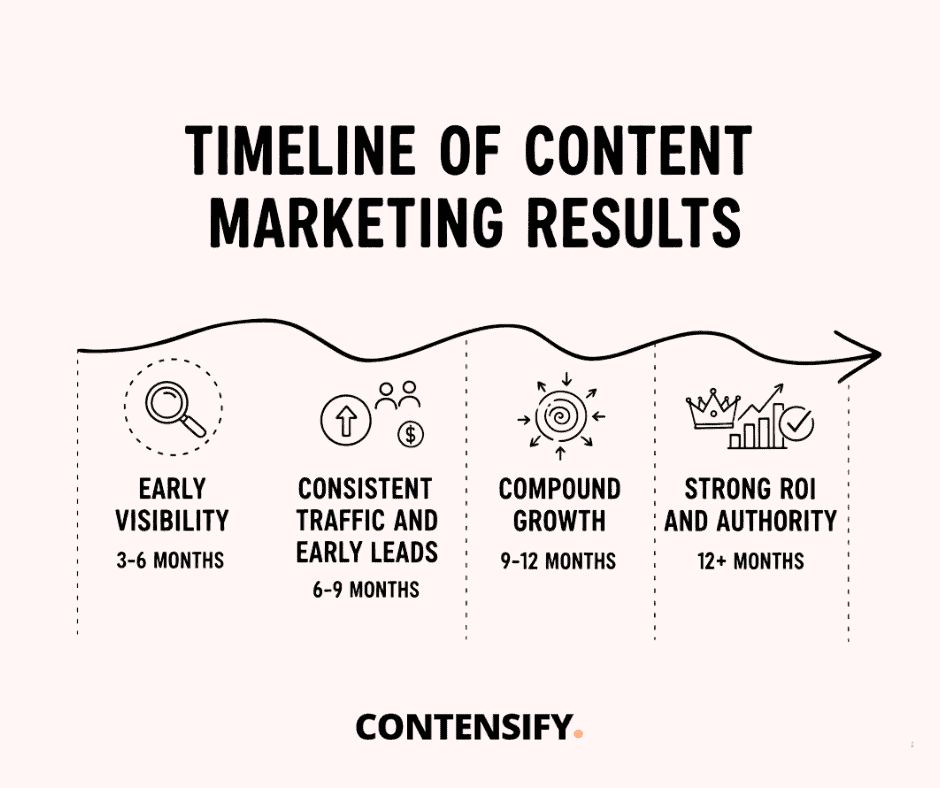
Early Visibility: 3-6 Months
Impressions begin to show up, a few keywords start ranking, and search engines take notice. It is the period where patience and consistency matter most.
Consistent Traffic and Early Leads: 6-9 Months
Posts start ranking more reliably, organic traffic grows steadily, and the first qualified leads can often be tied back to content.
Compound Growth: 9-12 Months
Multiple articles rank, traffic rises month over month, and content begins making a measurable contribution to the pipeline.
Strong ROI and Authority: 12+ Months
Content matures into a dependable growth channel. Inbound leads scale, ROI becomes visible, and brand authority is firmly established.
Each stage builds on the last. The timeline is not fixed for every company, but the progression from visibility to authority is what separates short-term activity from long-term impact.
Factors That Impact Timeline of Content Marketing Results
Here are some factors that determine how quickly content marketing delivers results:
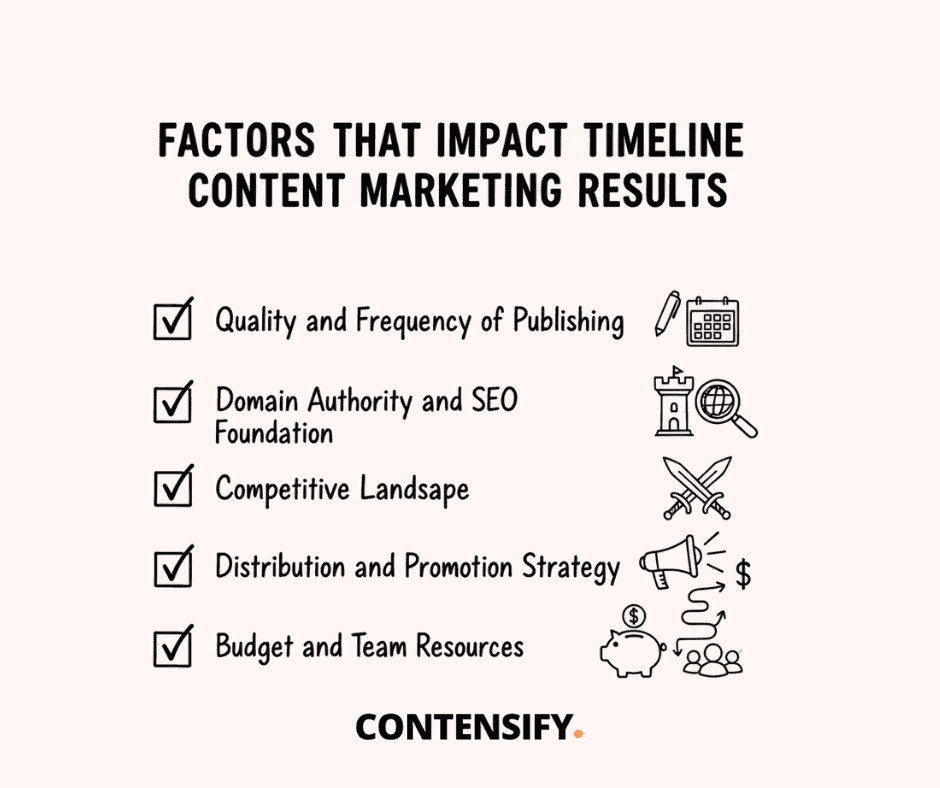
1. Quality and Frequency of Publishing
Consistently producing well-researched, detailed content helps search engines recognize your site as credible and gives readers a reason to return. In contrast, publishing irregularly or relying on surface-level articles makes it harder to build momentum.
2. Domain Authority and SEO Foundation
Websites with a solid backlink profile, clean technical SEO, and some level of authority typically see results earlier. New domains or sites with weak foundations often need more time before content begins ranking competitively.
3. Competitive Landscape
The level of competition in your SaaS niche directly affects the timeline. Highly competitive categories, where many companies already target the same high-intent keywords, require more effort to break through. In less saturated spaces, results can appear sooner with fewer resources.
4. Distribution and Promotion Strategy
Content that is actively distributed, whether through SEO optimization, social media, email, or paid campaigns, gains visibility more quickly. Relying only on organic discovery slows things down, even if the content itself is strong.
5. Sales Cycle Length
In B2B SaaS, buying decisions often involve multiple stakeholders and longer evaluation periods. This means that even when content generates the right traffic, it may take weeks or months before those visitors turn into leads or customers.
6. Budget and Team Resources
Companies with more resources can publish at higher volumes, invest in promotion, and accelerate learning. Smaller teams or limited budgets can still succeed, but the process generally takes longer.
SaaS-Specific Considerations
Content marketing in SaaS comes with challenges that differ from those in other industries. These considerations shape how you plan and measure results:
- Educating Across Complex Buyer Journeys: SaaS decisions involve multiple stakeholders, each with different needs. Content must address problems, solutions, and objections at every stage of the journey.
- Need for Multiple Content Formats: Blogs alone rarely cover the full spectrum of buyer questions. Prospects also look for case studies to validate results, webinars to explore use cases in depth, and product-focused content to understand how the solution actually works.
- Alignment with ICP and Positioning: Content should speak directly to your ideal customer profile. Without clear alignment, it may attract traffic but fail to generate qualified leads.
How to Accelerate Content Marketing Results
Here’s how you can accelerate your content marketing results:
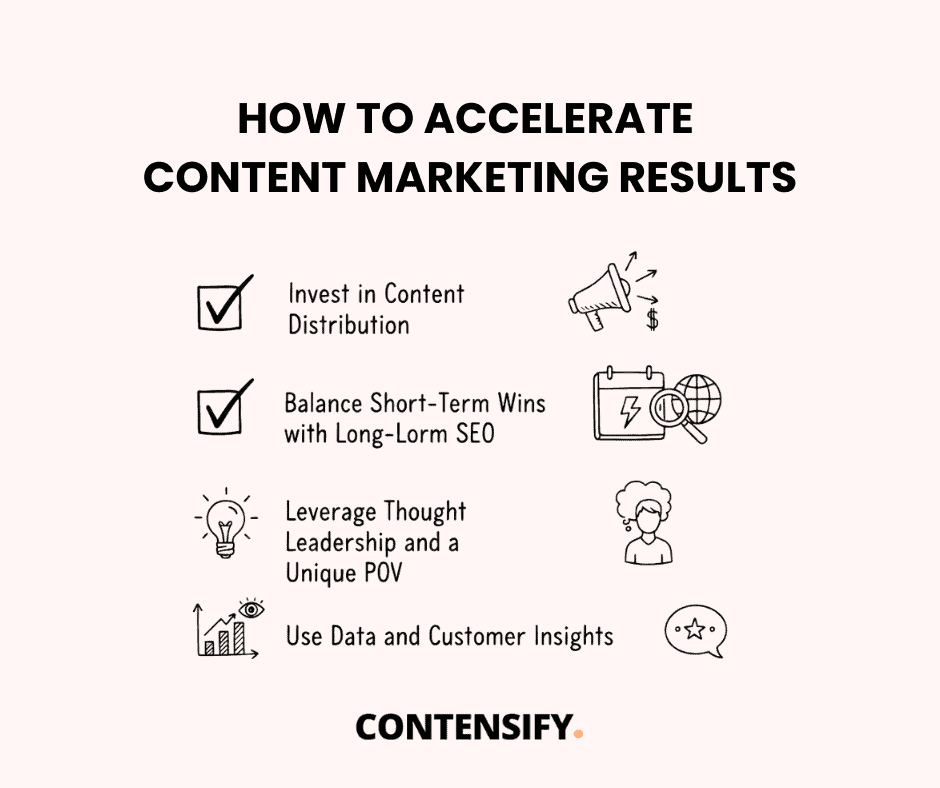
1. Invest in Content Distribution
Publishing is only half the job. With a growing share of high-intent traffic shifting toward LLMs like ChatGPT, relying solely on organic search is no longer enough.
Distributing content through social channels, email campaigns, and syndication ensures that your best-performing assets actually reach the right audience. Strategic placement across trusted channels also signals that your content is authoritative, helping amplify reach and reinforce credibility.
2. Balance Short-Term Wins with Long-Term SEO
Targeting low-hanging keywords and launching gated assets can deliver early traction. Pair this with a structured long-term SEO program focused on high-intent queries, internal linking strategies, and authority-building content clusters. The combination delivers both immediate visibility and compounding organic growth.
3. Leverage Thought Leadership and a Unique POV
Standard “how-to” articles are easy to replicate and rarely differentiate a SaaS brand. Early traction comes faster when founders and subject-matter experts share original insights on platforms like LinkedIn, podcasts, or guest features.
Publishing founder-led content, expert analysis, and contrarian viewpoints not only builds credibility with buyers but also creates topical authority signals that search engines reward in rankings.
4. Use Data and Customer Insights
SaaS companies can use proprietary product usage metrics, customer feedback, and industry research to create assets that are both unique and credible. This not only improves relevance for target buyers but also strengthens E-E-A-T signals, which directly influence search visibility and conversion rates.
Measuring Success Along the Way
Here’s how you can measure the success of your content marketing:
- Early KPIs: In the first few months, focus on leading indicators such as impressions, initial keyword rankings, and on-page engagement (time on page, scroll depth, bounce rate). These show whether your content is being indexed and resonating with readers.
- Mid-Stage KPIs: As content starts ranking more consistently, track traffic growth, lead quality, and demo requests. This stage indicates that your content is moving beyond visibility and beginning to influence the pipeline.
- Long-Term KPIs: Over time, measure sales-qualified leads (SQLs), contribution to pipeline, and customer acquisition cost (CAC) relative to other channels. These metrics confirm whether content is operating as a sustainable growth driver.
Content Marketing vs. Paid Ads: Timeline Comparison
Here’s a quick comparison between content marketing and paid ads:
- Paid Ads: Channels like Google Ads and LinkedIn Ads deliver immediate visibility. Campaigns can start producing impressions, clicks, and conversions within days. However, results stop the moment the budget is paused, making it a short-term lever.
- Content Marketing: Content takes longer to show results, but once traction builds, it compounds. Published articles continue to generate traffic, leads, and pipeline contribution without ongoing spend. Over time, this creates a lower CAC compared to paid campaigns.
Timeline Comparison
| Timeline | Paid Ads | Content Marketing |
| 0–1 Month | Immediate impressions, clicks, and leads as soon as campaigns launch. | Initial setup and publishing, little to no traffic yet. |
| 3–6 Months | Still driving results if the budget continues. Costs remain linear. | Early visibility: impressions, first rankings, and engagement. |
| 6–12 Months | Dependent on ongoing spend, results vanish if the budget is paused. | Consistent traffic growth, early leads, and pipeline contribution. |
| 12+ Months | No compounding effect; spend = results. | Strong ROI, established authority, inbound leads scaling steadily. |
Case Study: From Early Traction to Pipeline Contribution
We worked with a B2B SaaS company that needed a predictable inbound engine. Instead of relying on ads, the strategy combined product-led content with strong distribution and founder-driven thought leadership.
Actions Taken
- Published 8–10 product-led blogs per month targeting solution-aware and competitor keywords.
- Created two ebooks in the first quarter to capture leads through gated content.
- Distributed assets on Quora, Medium, and Reddit, generating an additional 15–20% referral traffic.
- Launched a founder-led LinkedIn program, with 3–4 weekly posts and active engagement through comments and direct interactions
Results Over Time
- Month 4: 35% increase in organic impressions and steady keyword rankings for mid-intent terms.
- Month 6: 120+ demo requests directly tied to blog CTAs and gated content.
- Month 9: Pipeline contribution from inbound leads reached 30% of total opportunities, with consistent traffic from both SEO and distributed channels.
- Month 12: Content-driven leads showed a 22% lower CAC compared to paid campaigns, while LinkedIn became the second-largest referral source for high-quality leads.
By aligning content formats with distribution and using the founder’s presence on LinkedIn, the company built a pipeline that grew steadily and sustained itself beyond the first year.
Conclusion
Content marketing takes time, but the results compound. Most SaaS companies see meaningful ROI in 6–9 months, with stronger growth beyond the first year.
The real challenge is execution. Without a clear strategy, consistent publishing, and strong distribution, timelines stretch longer than they should.
At Contensify, we bring over a decade of experience helping SaaS companies turn content into a reliable growth channel. From product-led SEO to founder-led thought leadership, we know how to move faster and avoid common pitfalls.