
These days, every business knows the value of content. That’s why they are publishing content more than ever, whether through AI tools, in-house teams, or freelancers.
But most of that content never performs. It doesn’t get clicks, and even if it does, it rarely converts into leads. In fact, 96.55% of pages on the web get no traffic from Google at all.
AI has only intensified this problem. Content is being created faster, but without the right approach, websites are being ignored by search engines, and in some cases penalised for thin or unoriginal material.
One of the biggest mistakes businesses make is treating SEO content as keyword stuffing, or assuming that dropping a quick AI prompt is enough. That approach simply does not work.
In this blog, we’ll break down how you can create content for your business that ranks, attracts clicks, and most importantly, brings in leads.
Step-by-step guide on how to write SEO content
We have been writing and ranking content for over a decade. What follows is not theory. These are the exact steps we use to help our clients create SEO content that generates clicks, leads, and revenue. If you want to do the same for your business, here’s how:
Step 1: Topic and Keyword Selection
Every successful piece of SEO content starts here. If your topic or keyword choice is off, the rest of the effort will struggle to perform. After years of doing this, we’ve found that businesses fail at this stage for two reasons: either they chase keywords that are too broad and competitive, or they choose topics that have no real business value.
Here’s how to do it the right way:
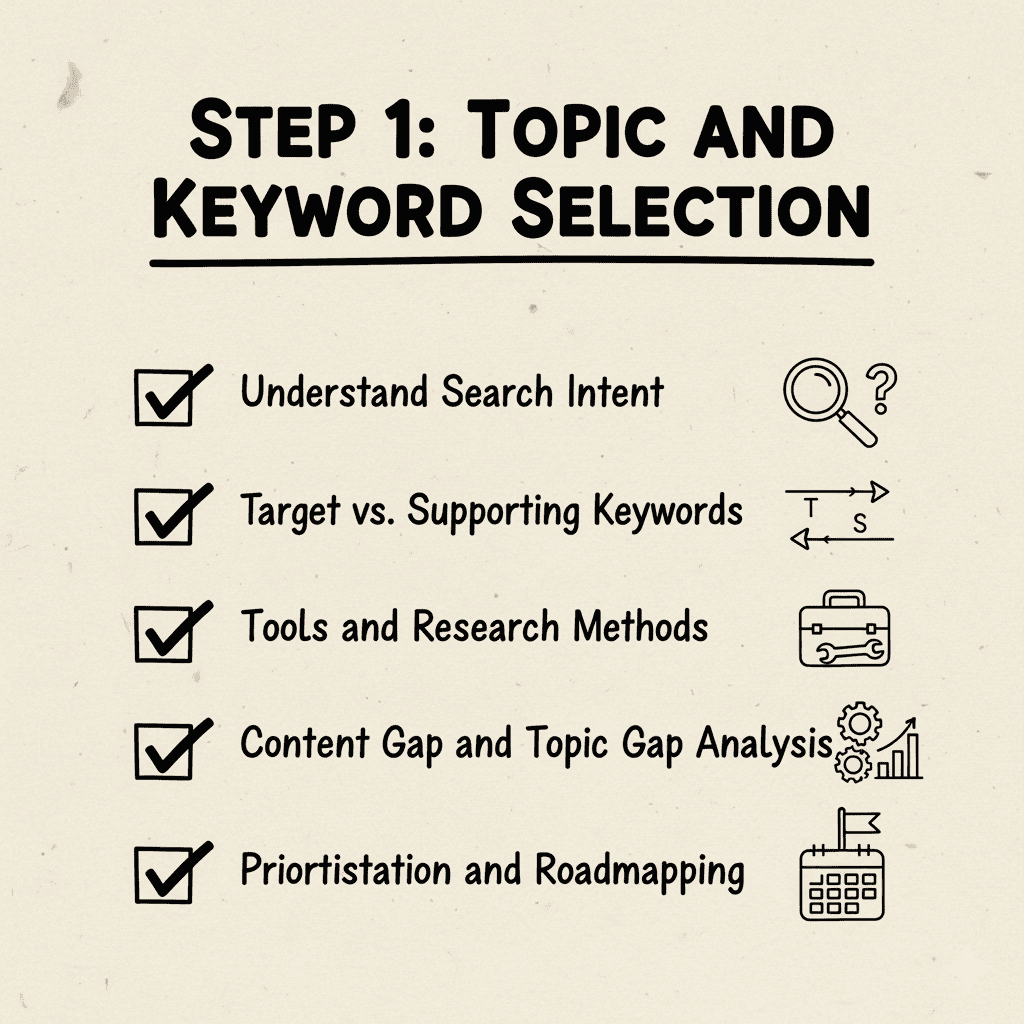
1.1 Understand Search Intent
Ranking for a keyword is meaningless if your content does not match what the user is actually looking for. Google has gotten very good at interpreting intent, and your content must align with it.
- Informational intent: The user is asking a question or learning about a topic. Example: “How does accounts payable automation work?”
- Transactional intent: The user is evaluating or ready to buy. Example: “best AP automation software pricing.”
- Navigational intent: The user is looking for a specific brand or tool. Example: “QuickBooks AP automation.”
Before creating content, decide which intent you are targeting. Trying to force a transactional keyword into an informational blog post is why so much content fails.
1.2 Target vs. Supporting Keywords
Every page should have one primary keyword. Around that, you build a cluster of supporting or semantic keywords that reinforce the topic. This helps Google understand depth and relevance, and it prevents your content from feeling repetitive.
For instance, if your primary keyword is “SEO content writing,” your supporting cluster might include terms like “on-page SEO,” “keyword optimisation,” and “content that ranks on Google.”
We treat supporting keywords as building blocks that guide subheadings, FAQs, and examples within the article.
1.3 Tools and Research Methods
We never rely on a single tool. Here’s how we layer research:
- Keyword tools like Ahrefs or SEMrush give you search volume, keyword difficulty, and competitor data.
- Google itself is one of the best research tools. “People Also Ask,” auto-suggest, and related searches reveal what users are really looking for.
- Competitor analysis shows which keywords are driving traffic to sites in your industry.
- Community research (Reddit, Quora, Slack groups, LinkedIn posts) gives you raw, unfiltered insights into the questions your target audience is actually asking.
This mix ensures you don’t just target obvious keywords, but you also target real user queries and searches.
1.4 Content Gap and Topic Gap Analysis
Look at what others are ranking for and identify the blind spots. Are there questions they’ve ignored? Topics they’ve covered shallowly? SERP feature analysis can also reveal gaps.
For example, if the top results include “People Also Ask” snippets, and none of your competitors are answering those questions in detail, that’s an immediate opportunity.
We regularly build content strategies by mapping gaps like this. It’s one of the fastest ways to create content that stands out without reinventing the wheel.
1.5 Prioritisation and Roadmapping
Not every keyword should be written today. We prioritise based on three filters:
- Traffic potential: Will enough people actually search for it?
- Business relevance: Will these readers ever buy from you?
- Difficulty: Can you realistically rank against the competition right now?
From there, we map keywords to the funnel:
- Top of Funnel: Awareness content like “What is accounts payable automation?”
- Middle of Funnel: Comparison content like “Top 5 AP automation tools.”
- Bottom of Funnel: Transactional content like “Best AP automation software pricing.”
This approach ensures you’re not just ranking for vanity terms, but building a library of content that actually drives business outcomes.
Step 2: Content Structure and Outline
Once you have the right topic and keywords, the next step is building a structure that makes your content clear, engaging, and easy to rank.

2.1 Intent-Driven Outline
Your outline should always match search intent. The rule we follow is answer first, support later. Start by addressing the core question or problem quickly, then expand into deeper explanations, examples, and supporting details. This way, readers (and Google) find value right away without wading through fluff.
2.2 Headings and Subheadings Strategy
Headings are not just for formatting. They guide both the reader and the search engine.
- Use H2s and H3s to break content into clear, scannable sections.
- Naturally, include primary and supporting keywords in some of them.
- Think of subheadings as mini-promises; each one should answer a specific part of the search query.
2.3 Introduction and Lead Section
The introduction sets the tone. If you lose readers here, they will never scroll further. Open by addressing the main question, challenge, or pain point head-on. Make it clear that the article will give them the solution they came for.
2.4 Flow and Logic
A good outline follows a natural progression. You can structure it in several ways, depending on the topic:
Here are three simple ways to structure the flow:
- Simple to Complex: Start with a beginner-friendly explanation, then move into advanced details.
- Broad to Narrow: Begin with the big picture, then zoom in on specifics.
- Question to Solution: Introduce the problem your audience faces, then explain how to fix it.
When the flow is logical, readers stay longer, understand better, and are more likely to take the next step with your business.
2.5 Snippet and Featured Snippet Optimisation (new)
If you want visibility, you need to write with snippets in mind. Featured snippets, “People Also Ask,” and other SERP features drive a huge share of clicks. To optimise:
- Include short definition or summary blocks in key sections.
- Use lists, tables, or bullet points where relevant.
- Keep answers concise; 40 to 60 words is often the sweet spot for snippet grabs.
2.6 Visual and Media Placement (new)
Instead of long blocks of text, use diagrams, screenshots, charts, or infographics to simplify complex ideas. Place them right where the explanation appears so they add context, and use images or tables to break up large sections for easier reading. This not only improves readability but also makes your content more authoritative and memorable.
Step 3: Writing the Draft
With your outline ready, the next step is to turn it into a draft that is both reader-friendly and search-optimized. The goal is simple: make it easy to read, valuable to consume, and structured in a way that search engines can understand.
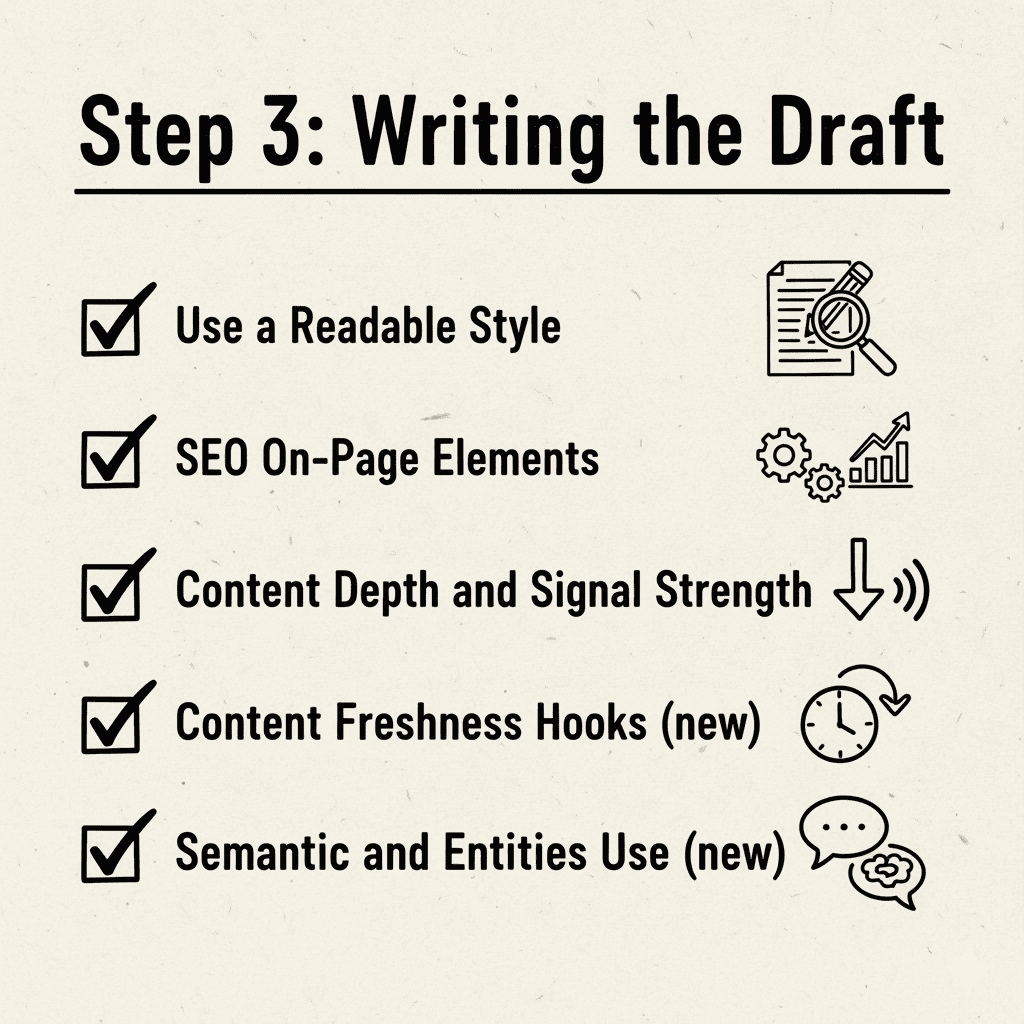
3.1 Use a Readable Style
Write in short paragraphs, use simple language, and keep your voice active. Break up heavy sections with bullets, numbered lists, or callouts so readers can scan quickly. If your content feels easy to digest, people will stay longer and engage more.
3.2 SEO On-Page Elements
Your draft may read well, but on-page SEO ensures it gets discovered.
- Add the primary keyword to your title tag.
- Write a meta description that is persuasive and includes the keyword.
- Keep your URL slug short and clean.
- Structure content with H1, H2, and H3 tags, using keywords naturally.
- Add internal links to related articles or pillar content, and external links to authoritative sources.
- Optimise images with alt text so they appear in image search and improve accessibility.
3.3 Content Depth and Signal Strength
Google rewards content that demonstrates authority and depth. Use examples, statistics, and case studies. Add unique insights or original research if possible. Quotes and expert viewpoints also send stronger signals of credibility.
3.4 Content Freshness Hooks (new)
Search engines favour up-to-date information. Keep your content fresh by adding hooks like “Updated for 2025” in the title or introduction. Include recent data points, new trends, or change logs. Freshness not only improves rankings but also builds reader trust.
3.5 Semantic and Entities Use (new)
Google uses semantic signals to understand topics. That means including related terms, synonyms, and named entities that give context. For advanced optimisation, add schema markup or structured data to help search engines categorise your content more accurately.
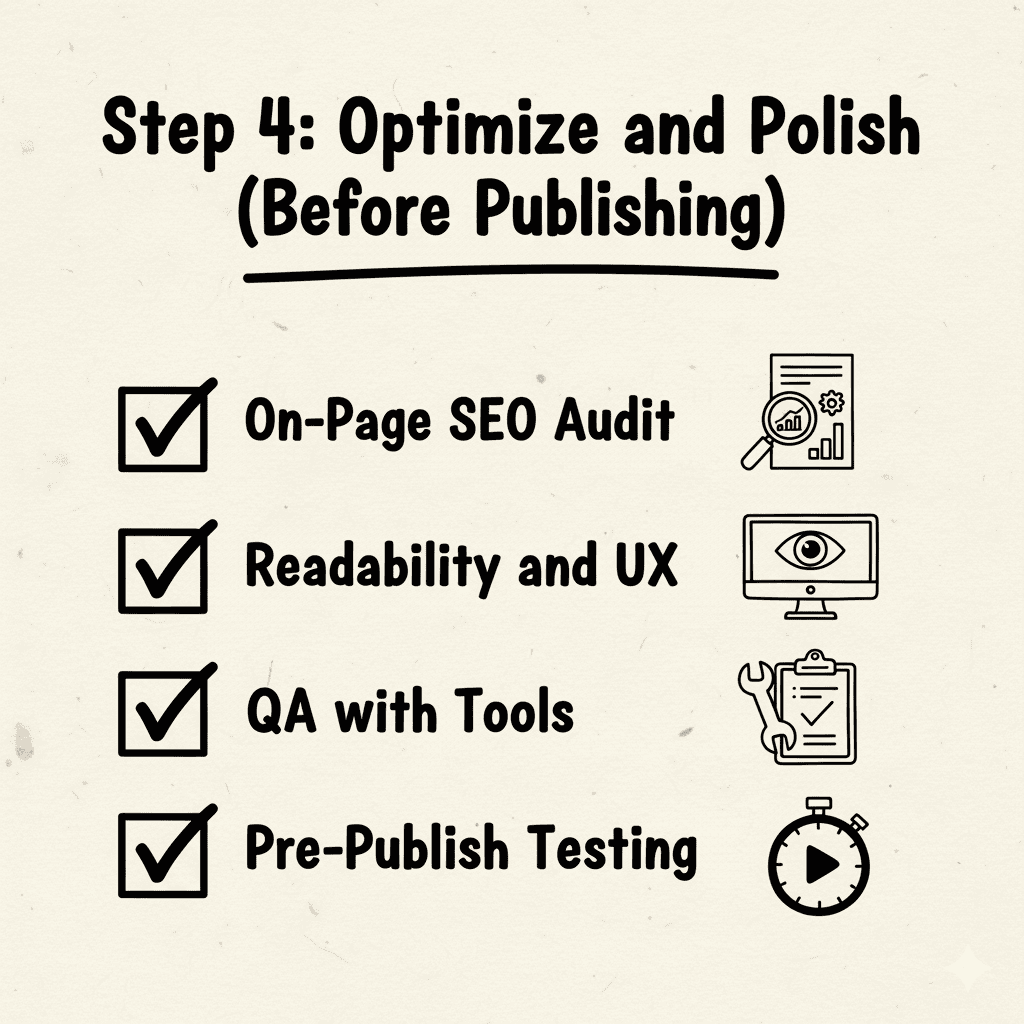
Step 4: Optimize and Polish (Before Publishing)
Before we publish for clients, we run the draft through a polish phase that’s as important as the writing itself. Here’s how you can optimise for SEO:
4.1 On-Page SEO Audit
Do not think of this as “checking boxes.” Think of it as removing roadblocks that stop your content from ranking.
- Keywords should feel invisible, and if the reader notices them, you’ve overdone it.
- Headings must follow a clean hierarchy (H1 → H2 → H3). If Google struggles to read your outline, it won’t trust your page.
- Meta title and description aren’t afterthoughts. We treat them like ad copy. They need to rank and get the click.
- Images should be compressed without killing quality. An uncompressed image can ruin page speed and cost you rankings.
- Always validate canonical tags and URLs. Duplicate signals confuse Google more than bad writing does.
4.2 Readability and UX
Most readers are on mobile, so content must be easy to scan. Keep lines under 70 characters and paragraphs within three to four lines. Use clear, consistent fonts with enough whitespace for comfort. Place images or visuals next to the text they explain, not at the bottom.
4.3 QA with Tools
Once structure and readability are in place, run quality assurance. Tools like Yoast, Clearscope, or SurferSEO can help validate topical depth, but treat them as guides, not rules. Use Grammarly to catch errors and Hemingway to test readability, aiming for a grade level between 7 and 9. Always review manually to maintain tone and flow.
4.4 Pre-Publish Testing
The last step is pre-publish testing. Run a broken link check, preview meta tags with a tool like SERPsim, and measure speed and Core Web Vitals with Google PageSpeed Insights. Validate any schema markup using Google’s Rich Results Test and confirm that all media files load quickly.
Step 5: Promotion, Link Building, and Post-Publish Growth
Here’s what you need to do once you click that “Publish Now” button:

5.1 Cross-Promotion
Promote your content across all owned channels immediately. Share it through email newsletters, adapt it into short posts for LinkedIn and Twitter, and distribute it inside relevant industry communities. Early traffic and engagement send strong signals to search engines that your content is worth ranking.
5.2 Outreach and Link Acquisition
Actively build authority by securing backlinks. Use broken link outreach to replace dead resources with your content, contribute guest posts on industry-relevant sites, and syndicate to trusted platforms. If you’ve included expert quotes in your content, notify them, as many will share and link back, amplifying reach.
5.3 Internal Link Strategy
Support your new content with links from high-traffic or pillar pages already on your site. Use a pillar-cluster structure so your articles interlink logically. This improves crawlability, strengthens topical relevance, and helps spread link equity across your site.
5.4 Content Refresh and Optimisation
Add new statistics, refresh examples, expand thin sections, and adjust based on performance data like rankings, CTR, and bounce rates. Updated content signals freshness to Google and keeps readers engaged.
5.5 Repurposing into Other Formats
Convert articles into LinkedIn carousels, videos, or podcasts. Break sections into micro-snippets for Reddit, Quora, or Twitter. Repurposing maximises reach and puts your expertise on platforms where your audience is most active.
Step 6: Measuring Success and Iteration
To make SEO content a real growth engine, you need to measure how it performs, learn from the data, and refine over time. Here’s how to track what matters and keep improving.
6.1 Key Metrics to Track
Start by focusing on the right indicators:
- Organic traffic growth and keyword rankings show visibility.
- CTR and dwell time reveal if your titles attract clicks and if people stay engaged.
- Conversions, leads, and engagement measure actual business impact.
- Backlinks and referring domains highlight authority growth.
6.2 Attribution and Funnels
Map each piece of content to a funnel stage and track assisted conversions in Google Analytics or similar tools. This shows how content influences the buyer journey, not just the last click.
6.3 A/B Testing and Experiments
Test different titles and meta descriptions to improve CTR. Experiment with CTA placement to increase leads. Rearrange section order or formatting to see what improves dwell time and engagement. Treat content like a product you can iterate on, not a static page.
6.4 Learning and Feedback Loop
Use analytics and heatmaps to identify where readers drop off or stop scrolling. Survey your audience or collect on-page feedback to understand what worked and what didn’t. Feed these insights back into your content strategy so every new piece performs better than the last.
Common Mistakes and Pitfalls to Avoid
Even with the right strategy in mind, many businesses fall into traps that hold their content back. Here are the most common ones to watch for:
- Over-optimizing or keyword stuffing – Cramming keywords into every sentence doesn’t help rankings anymore; instead, it hurts readability and can trigger penalties. Keywords should guide the content, not overwhelm it.
- Creating generic or shallow content – Content that simply rehashes what’s already out there won’t rank or convert. Google rewards depth, originality, and value. Always add unique insights, examples, or data to stand out.
- Ignoring content gaps and competitor analysis – If you don’t know what your competitors are ranking for, you’re writing blind. Content gap analysis helps you identify missed opportunities and outperform existing results.
- Publishing and forgetting – Content is not a one-time asset. Without regular updates, even well-performing pages lose relevance. Refresh your content with new data and insights to maintain rankings.
- Neglecting user experience – Slow load times, poor mobile readability, and clunky design drive visitors away before they read a single word. UX is as important as keywords for SEO success.
Bonus / Advanced Sections (Optional Enhancements)
For businesses that already have the basics in place, these advanced strategies can give your content an extra edge in search and usability.
1. AI-Assisted Writing: When and How to Use It Safely
AI can speed up research, ideation, and drafting, but it should never replace human judgment. Use AI for outlines, brainstorming, or first drafts, then fact-check, refine, and humanize before publishing.
2. Voice Search and Conversational SEO
With the rise of smart assistants, many searches are phrased as questions. Optimize by including conversational phrases, FAQs, and natural language queries. Short, direct answers (40–60 words) often perform well for voice search.
3. Multilingual and Multi-Region Content SEO
If you operate across markets, optimise content for multiple languages and regions. Implement hreflang tags correctly, adapt examples to local culture, and avoid direct translations that lose nuance.
4. Content and SEO Governance
Create internal guidelines and style sheets for voice, formatting, and keyword use. Build a QA process and version control system so every piece of content meets standards before publishing.
5. Schema, Rich Snippets, and FAQ Markups
Schema markup helps search engines understand your content and often improves visibility in SERPs. Implement FAQ schema for Q&A content, use article or product schema for relevant pages, and test everything with Google’s Rich Results tool.
Conclusion
SEO content that works isn’t about publishing more; it’s about publishing smarter.
From choosing the right topics to structuring, optimising, promoting, and refining, every step matters if you want your content to rank, attract clicks, and drive leads.
At Contensify, we’ve spent over a decade helping SaaS brands build content that delivers measurable results. If you’re ready to turn your content into a growth engine, let’s talk!