
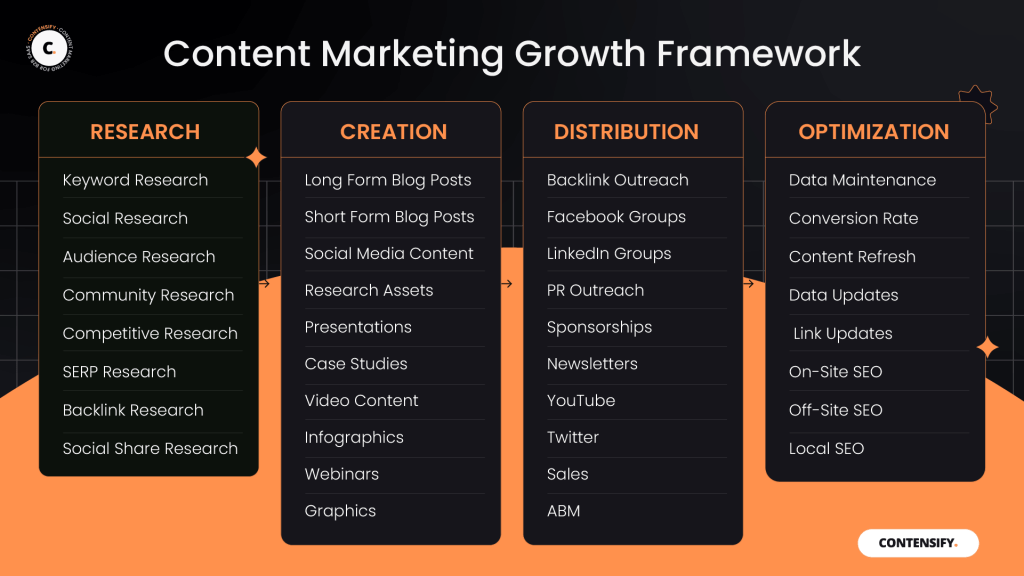
Content marketing is a powerful engine for business growth, but it requires a structured approach to unlock its full potential.
The “Content Marketing Growth Framework” infographic from Contensify breaks down the process into four essential pillars: Research, Creation, Distribution, and Optimization. Each pillar contains actionable steps and strategies that, when executed systematically, drive measurable results.
Understanding the Content Marketing Growth Framework
Let’s explore each stage in depth:
1. Research: Laying the Foundation
The first and arguably most crucial stage in content marketing is Research. This phase is about gathering insights that inform every subsequent decision. Without thorough research, content efforts risk missing the mark with your intended audience.
1. Keyword Research
This involves identifying the terms and phrases your audience uses when searching for information related to your products or services. Effective keyword research uncovers opportunities for organic traffic and helps shape your content calendar.
2. Social Research
Monitoring social media trends, hashtags, and conversations provides a pulse on what your audience cares about right now. This can inspire timely, relevant content.
3. Audience Research
Understanding your audience’s demographics, preferences, pain points, and behaviors ensures your content resonates and delivers value.
4. Community Research
Engaging with online communities (forums, groups, comment sections) reveals common questions and discussions, offering inspiration for content that addresses real needs.
5. Competitive Research
Analyzing competitors’ content strategies helps you identify gaps, opportunities, and best practices to differentiate your brand.
6. SERP Research
Studying Search Engine Results Pages (SERPs) for your target keywords reveals what content currently ranks, what formats perform best, and how to structure your own content for success.
7. Backlink Research
Identifying authoritative sites that link to your competitors can inform your own outreach and link-building strategies.
8. Social Share Research
Understanding which content gets shared most on social platforms can guide your content topics and formats.
2. Creation: Producing Valuable Content
Once research is complete, the next step is Creation – the process of turning insights into high-quality, engaging content assets.
1. Long Form Blog Posts
In-depth articles that provide comprehensive coverage of a topic, often performing well in search and establishing authority.
2. Short Form Blog Posts
Concise, focused articles that address specific questions or updates.
3. Social Media Content
Bite-sized, shareable content tailored for platforms like LinkedIn, Twitter, Facebook, and Instagram.
4. Research Assets
Original data, surveys, or reports that position your brand as a thought leader.
5. Presentations
Slide decks for webinars, conferences, or internal training.
6. Case Studies
Real-world examples of how your product or service solves problems, building trust and credibility
7. Video Content
Engaging videos for education, storytelling, or product demos.
8. Infographics
Visual representations of data or processes, making complex information easy to digest and share.
9. Webinars
Live or recorded sessions that educate and engage your audience.
10. Graphics
Custom visuals that enhance blog posts, social media, and other content formats.
3. Distribution: Amplifying Your Message
Great content is only effective if it reaches the right audience. The Distribution stage focuses on promoting your content across multiple channels to maximize visibility and engagement.
1. Backlink Outreach
Reaching out to relevant websites to secure backlinks, which improve SEO and drive referral traffic.
2. Facebook Groups & LinkedIn Groups
Sharing content in niche communities to spark discussions and attract targeted traffic.
3. PR Outreach
Engaging with journalists and media outlets to earn coverage and expand your reach.
4. Sponsorships
Partnering with influencers or organizations to promote your content to new audiences.
5. Newsletters
Leveraging email lists to keep your audience informed and engaged with your latest content.
6. YouTube & Twitter
Publishing and promoting video and short-form content to tap into large, active user bases.
7. Sales & ABM (Account-Based Marketing)
Equipping sales teams with content and targeting key accounts with personalized campaigns.
4. Optimization: Driving Continuous Improvement
The final pillar, Optimization, ensures that your content marketing efforts evolve and improve over time. This is where you analyze performance, refine strategies, and maximize ROI.
1. Data Maintenance
Regularly updating and cleaning your data to ensure accuracy.
2. Conversion Rate
Monitoring and improving how well your content turns visitors into leads or customers.
3. Content Refresh
Updating older content to keep it relevant and high-performing.
4. Data & Link Updates
Ensuring statistics, facts, and external links remain current and credible.
5. On-Site SEO
Optimizing content structure, metadata, and internal linking for better search visibility.
6. Off-Site SEO
Building authority through backlinks and mentions on other reputable sites.
7. Local SEO
Targeting location-specific keywords and directories to attract local customers.