
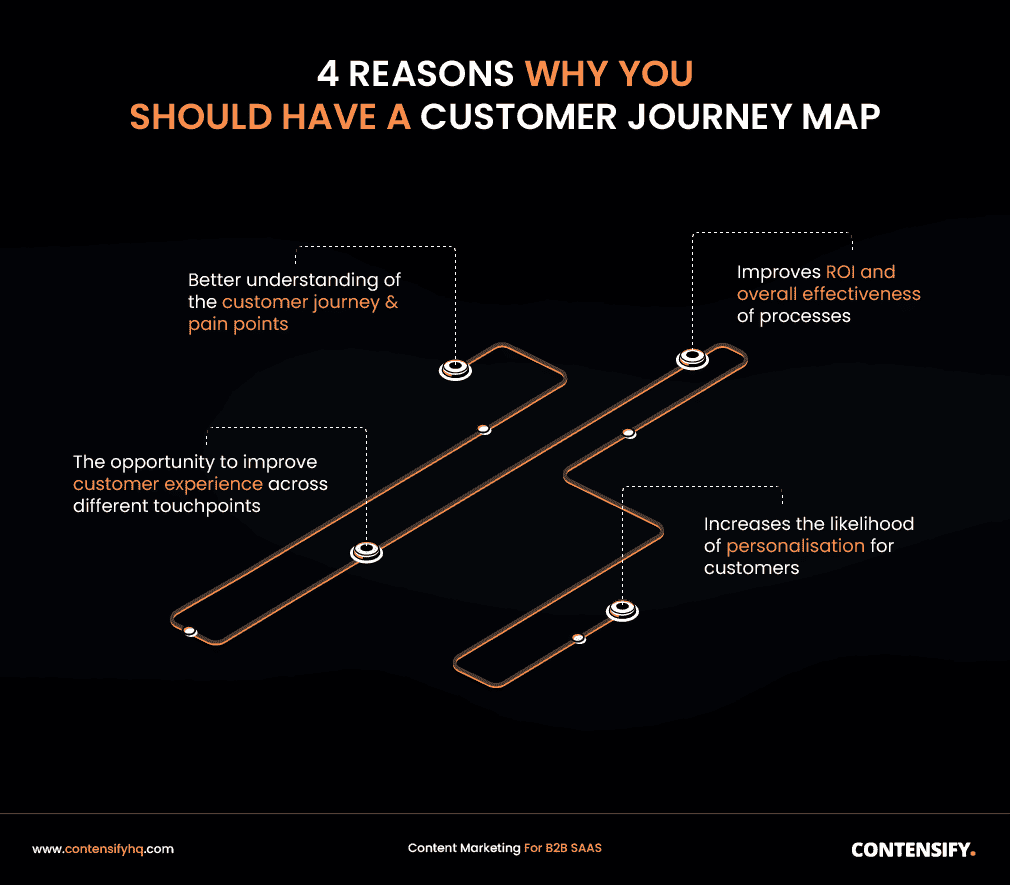
A customer journey map is a powerful tool for any content marketing and SEO strategy, especially in the B2B SaaS space. The infographic highlights four key reasons to create a customer journey map, each of which directly impacts how effectively you can plan, execute, and optimize your content for both users and search engines.
Understanding the role of customer journey map
Here’s how it helps build scalable organic marketing strategies:
1. Better understanding of the customer journey & pain points
For content marketing, this is foundational. When you map out the customer journey, you gain clarity on what your audience is searching for at each stage – awareness, consideration, decision, and beyond.
This allows you to create highly targeted content that addresses specific questions, objections, and pain points. For SEO, this means you can align your keyword research and content topics with actual user intent, improving your chances of ranking for valuable queries and driving qualified traffic.
2. The opportunity to improve customer experience across different touchpoints
Content is often the bridge between a brand and its audience at various touchpoints: blog posts, landing pages, help docs, and more. A customer journey map reveals where these touchpoints occur and what information or experience the customer expects at each one.
By optimizing content for these moments, you not only enhance the user experience but also increase the likelihood of engagement, shares, and backlinks – all of which are positive SEO signals.
3. Improves ROI and overall effectiveness of processes
With a clear journey map, your content team can prioritize resources on the most impactful topics and formats, rather than guessing what might work. This focus leads to more efficient content creation, better conversion rates, and ultimately, higher ROI.
From an SEO perspective, it allows you to build a content architecture that supports both user needs and search engine requirements, such as internal linking structures and content clusters that improve crawlability and authority.
4. Increases the likelihood of personalisation for customers
Personalization is a major differentiator in both content marketing and SEO. By understanding the journey, you can tailor content to specific segments, industries, or even individual accounts (in ABM strategies).
Personalized content tends to perform better in search, as it matches user intent more closely, reduces bounce rates, and encourages deeper engagement – all factors that search engines reward.